


In the quiet, humid evenings of Jepara, Indonesia, the air is often filled with the rhythmic cadence of the tadarus (the communal recitation of the Qur’an) echoing from the mosque just fifty meters from my front door. As a Mennonite pastor, I’ve often felt a complex mix of emotions during these moments: a touch of irritation at the volume, perhaps, but more often, a profound sense of “holy envy.” The term, coined by theologian Krister Stendahl, describes the act of admiring the beauty in another’s tradition and allowing it to deepen, not dilute, one’s own. As we enter Lent, a season ripe for spiritual discipline, I find myself looking across the fence at our Catholic, Orthodox and Muslim neighbors. In many Indonesian Mennonite circles, Lent can feel like a quiet footnote. But what if we used this “holy envy” to sharpen our own spiritual tools?
Spiritual discipline isn’t a legalistic burden; it’s the exercise our souls need to stay fit. Here are five practices inspired by holy envy for this Lenten season.
1. Fasting: Beyond the stomach
Fasting is woven into the very fabric of Scripture, from Jesus’ forty days in the wilderness to the early Christians who fasted every Wednesday and Friday (Didache). In my congregation at GITJ (Javanese Mennonite Church) Jepara, we have embraced a forty-day fast or abstinence from certain foods since 2010. This year feels particularly poignant as our Lenten fast coincides with Ramadan. There is a beautiful solidarity in seeing many people practicing self-restraint. The goal isn’t just to be hungry; it’s to train our “desire-muscles.” If we can control what we put in our mouths, we can better control the evil that often comes out of them: our anger, our greed and our misplaced passions.

2. Almsgiving: Love with a price tag
In the second century, the book of Shepherd of Hermas gave a practical instruction: those who fast should live on bread and water, then calculate the money they saved on a full meal and give it to the widow and the orphan. Our Catholic friends in Indonesia have the APP (Aksi Puasa Pembangunan, or Lenten Action for Development), a structured way to turn sacrifice into service. We’ve adapted this in Jepara as “Easter Love Fasting Action.” Families set aside the cost of one meal each day. By Easter, these small sacrifices become a flood of compassion: disaster relief, scholarships and medical aid for those in need. We reduce our portion so that we may share the portion of love.
3. Rhythmic prayer: The breath of the soul
The Catholic Liturgy of the Hours and the Islamic Salat provide a rhythmic structure to the day. For many Protestants, prayer is often spontaneous or “when we feel like it.” But spontaneity can easily turn into neglect.
I’ve met church members with Islamic backgrounds who initially felt a void in Christianity because the rhythmic calls to prayer were gone. Now, I tell my congregation: when you hear the Adhan (Islamic call to prayer) sounding from the mosque loudspeakers, don’t be annoyed. Use it as a prompt. When the neighborhood is called to pray, let it be your signal to pray the Lord’s Prayer. It is like breathing: prayer is the inhale, and action is the exhale. You cannot have one without the other.

4. Scriptural devotion: Reading to completion
During Ramadan, Muslim families in Java strive to read the entire Quran. Hearing children recite the text late into the night often fills me with a sense of shame. We Christians claim to be “People of the Book,” yet how many of us have read our own holy scriptures from cover to cover? We are often so focused on interpreting the Bible or finding life hacks in its verses that we forget the simple, disciplined act of reading it. If we don’t know the story we are part of, how can we hope to live it out?
5. Daily repentance: The journey home
In the Catholic tradition, Lent is a season of metanoia or repentance. But repentance isn’t a one-time event; it’s a daily returning home.
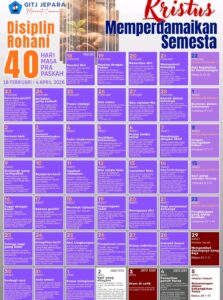
This year, our church theme is “Christ Reconciles the Whole Creation.” We’ve created a Lenten calendar with simple, daily actions. One day, the focus is reconciling with a family member; the next, with a neighbor; and the next, with the environment. Repentance must be concrete. It is the daily practice of turning our faces back toward the Light.
Conclusion: Toward a nurturing spirituality
Holy envy isn’t about becoming “less Mennonite.” It’s about becoming more fully alive in Christ. In theology, we talk about orthodoxy (right belief) and orthopraxis (right action). Now we also need to focus on orthopathi, a right spirituality cultivated through practice. Lent is our training ground. Through these disciplines, we don’t just observe a season; we grow the fruits of love, justice and peace that our world so desperately needs.


Have a comment on this story? Write to the editors. Include your full name, city and state. Selected comments will be edited for publication in print or online.