


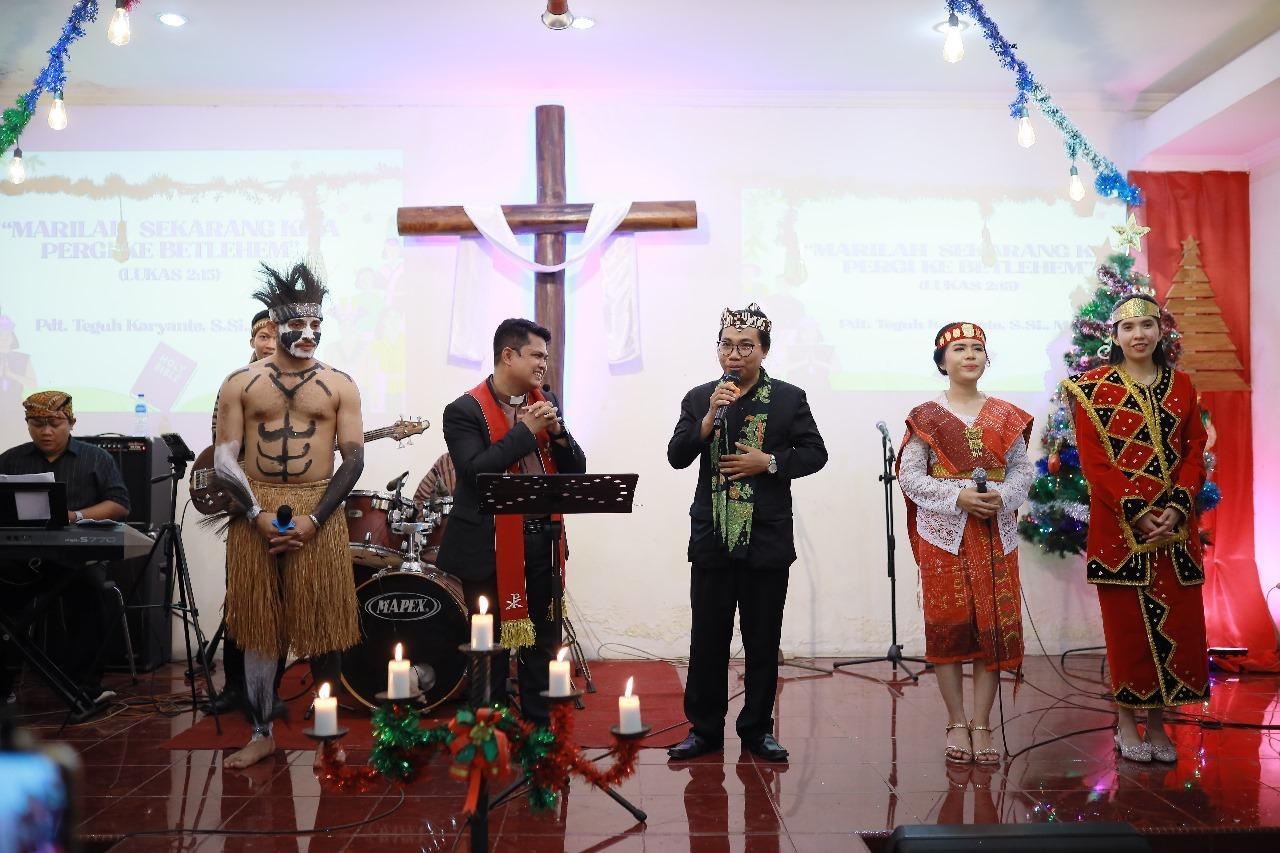
Christmas is a very important moment for Christians to celebrate the birth of Jesus Christ. In the diverse country of Indonesia, Christmas is not only interpreted as a religious celebration, but also as a social moment to strengthen the values of togetherness, humanity and interfaith tolerance. An ustadz (ustadz are Islamic teachers, similar to Christian pastors) shared his refreshing views on Christmas and how to respond to diversity.
Ustadz Sapta Rachmannudin, one of the few ustadz who was willing to attend the Christmas celebration at my church, GITJ Pesantenan Pati, on December 29, 2025. Not only did he attend, but he also delivered a pleasant speech alongside the homily I delivered. Of course, the presence of an ustadz is a form of tolerance.
Here I would like to invite you to explore five things that show what celebrating Christmas with people of different faiths and ethnicities can look like.
1. The existence of tolerance
I am very interested in reading the gospel text from Matthew 5:9, which states, “Blessed are the peacemakers, for they shall be called sons of God,” from Jesus’ Sermon on the Mount. The passage highlights that those who actively foster reconciliation and peace, rather than just keep peace, reflect God’s character and are recognized as his children.
From this passage we learn that one thing to inspire good Christmas celebrations is mutual tolerance. Tolerance is an attitude of mutual respect for differences, such as respecting differences in beliefs. Tolerance is not a choice but a necessity for social life to continue harmoniously and peacefully. This tolerant attitude was reflected by the ustadz, public officials, people with different religions and ethnicities and me, all of whom came to celebrate Christmas together in church. Amidst differences, tolerance becomes a bridge that connects people to one another. With this tolerance we can create a life full of love and peace.
2. Friendships
Friendship is considered an inevitable component to interfaith interactions. Friendships can be formed in emotionally close relationships with mutual support. True friendship is measured by sincerity, willingness to provide small support and sincere advice. Friendships formed across religious differences can be a unifying tool if the interactions are positive. Good friendships teach maturity, tolerance and the meaning of togetherness in life. Interfaith friendships in Christianity are not a form of theological relativism, but rather an expression of faith manifested in mutual respect. The presence of the baby Jesus is a form of God’s solidarity with humanity and his creation.

3. The appeal of the homily
Another aspect of interfaith interaction is the appeal of the Christian homily. From an interfaith perspective, Christian homilies have several aspects that are often considered appealing and even relevant to followers of other religions. These aspects are not related to doctrine but rather to the approach, values and conditions contained in the homily.
As in the Christmas celebration at GITJ Pesantenan Pati, Ustadz Rachmannudin said that the Bible verses delivered by Pastor Teguh Karyanto had positive value for the development of peace on earth. Christian homilies focus on unconditional love, forgiveness and reconciliation. These values are universal and easily understood by followers of other religions because they contain spiritual traditions that value love, compassion and peace. Christian homilies have a narrative style of delivery using parables, stories from the life of Jesus and everyday experiences. Christian homilies are often delivered in a personal tone, as if inviting listeners to reflect on the meaning of life, suffering and hope. It is well known that emulating the actions of Jesus is one of the characteristics of the Mennonite calling.
4. Music
Music is universal in nature, meaning that it can be enjoyed by everyone. Music can also serve a unique role in all religions. For example, in Christianity music can be spiritual songs, in Islam music can be chants of praise and in Hindu and Buddhist traditional mantras are chanted to music. Music plays a role similar to that of hymns, and these spiritual songs often have their own unique appeal. In churches, music functions as a universal language that can evoke emotions, tranquility and a sense of togetherness. For followers of other religions, this music can be enjoyed as an expression of art and spirituality.
This is what makes listeners of spiritual music reflect on life, suffering and hopes for the future. Thus the appeal of Christian music to other religions lies in its artistic power, emotions and universal values. Spiritual music has the potential to become a bridge for dialogue, tolerance and friendship between religious communities. According to Ustadz Rachmannudin, he can enjoy music in church because music is truly a universal language that unites all human beings.
5. Singing and dancing together
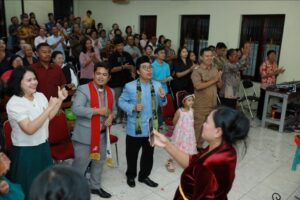
The final point is singing and dancing together. Singing and dancing together is not only a form of entertainment, but it can also be a bridge for peace and tolerance in a pluralistic society. Ustadz Rahmannudin danced and sang along with the congregation during Christmas celebrations. This activity was very warm and humane, where differences in beliefs did not become a barrier to celebrating universal values such as joy, brotherhood and humanity.
The presence of Ustadz Rachmannudin, public officials and people with different ethnicities at the Christmas celebration shows the peaceful and tolerant face of Indonesia. Religion is not a divider but a source of ethics and friendship. This joint Christmas celebration teaches us that celebrating our own faith can go hand in hand with respecting the faith of others.


Have a comment on this story? Write to the editors. Include your full name, city and state. Selected comments will be edited for publication in print or online.