


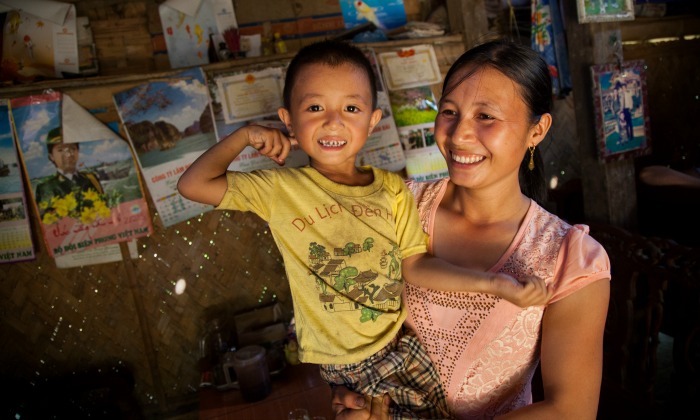
Photo: Hýõng says her son, Xuân Vui, 4, is happier, better behaved and is gaining weight now that he attends all-day preschool with a provided lunch. While he is in school, she can spend more time earning money to support her family. (MCC photo/Matthew Sawatzky)
Everyone loves lunchtime, and the preschoolers in Thang Village in rural Vietnam are no exception.
Meat, tofu or eggs with vegetables each day — the food is more nutritious than what most of the children eat at home.
What the students don’t realize is that lunch isn’t just about having tasty food. It’s about staying healthy and about keeping children in school for the afternoon so they can keep learning. Meanwhile, parents can work longer in the field.
If lunch wasn’t served at school, 4-year-old Xuân Vui might have done what his older brother did when

he was in preschool, said his mother, Tran Thi Hýõng. Vui’s brother would come home at lunchtime, but sometimes skip lunch and then get so busy playing or swimming in the creek that he never made it back up the hill to school.
Now that lunch is served at school, Vui continues to learn his rhymes, practice Vietnamese and work with numbers in the afternoon. Hýõng said her son is happier being in school all day. He behaves better than he used to, and he is gaining more weight than his older brother did at the same age.
Mennonite Central Committee (MCC) has made school lunches possible by building kitchens at three preschools, where teachers prepare the government-subsidized food. In addition, MCC has supported teacher training on nutrition, hygiene and how to monitor a child’s growth to teachers.
Having enough to eat in Thang Village and other villages on the perimeter of Xuan Son Forest National Park is not a simple thing for Muong and Dao people who live there.
They used to rely on natural resources from the park to support their diet and income, until the government restricted use of the forest for its environmental protection. Now families need to rely predominantly on the food they can grow.
The problem with that, according to Výõng Quôc Chiên, a program manager for MCC Vietnam, is that most families don’t have enough fertile farmland to provide food for the year. Also farmers are lacking skills and investment capital to produce a high yield. As a result, people migrate.
For example, 4-year-old Hà Thi Phýõng Thúy’s parents work in Hanoi, the capital of Vietnam city within a four-hour drive of Thang. They stay there for months at a time and send money to Thuy and her grandmother, Ðinh Thi Hanh. She said the family’s rice land, 720 square meters of poor soil, does not provide enough food and income for the family.
To help increase the availability of food, MCC is supporting agriculture work in Thang Village and five other villages in Tan Son District. Training is given on composting, raising chickens and pigs, increasing rice yields and reducing crop pests. Some supplies and animals are provided to help people get started.
Learning how to get better yields in the fields isn’t going to be enough for the future, said Bàn Thi Minh, leader of the Women’s Union in Xoan Village, who is a proponent for MCC’s agricultural, domestic violence and educational training. Children will need a good education to be able to support their families, she said.
At five preschools, MCC is strengthening the education by providing hands-on resources and books for teachers to use to keep children engaged. At least 70 teachers in the area where the schools are located also have learned, through annual MCC-sponsored training, the value of keeping children active, engaged and motivated by encouragement in the classroom and other skills.
“The teacher is the facilitator only and the child is the center of the training,” said teacher Phùng Thi Hà,

who attended training and taught in Thang for one year. “We have learned that in the class, we need to base our instruction on the knowledge of the child and then we develop suitable curriculum for the child to learn best.”
Something must be working because Sa Xuân Truong, 5, wakes up early to ask his mother to bring him to preschool in Thang Village. His mother, Lý Thi Hurong, said that Truong gained eight pounds during the first year that the school started serving lunch. “I like meals in the school because they have meat, and I like candy, too,” Truong said.
The leader of Thang Village, Ðinh Thi Uoc, said the improvements at the preschool have set a good foundation for the children to get more education. “I have a dream for these kids that … they will have jobs as teachers and come back to serve the community.”


Have a comment on this story? Write to the editors. Include your full name, city and state. Selected comments will be edited for publication in print or online.