


Can poetry or other writing really be “Mennonite”? Scholars have debated this question for decades.
What is clear, however, is that writing by Mennonites is diverse. Indeed, the Center for Mennonite Writing’s website tagline is “Mennonite Experience, Many Voices.”
Recent poetry by Mennonite-related authors shows engagement with faith and tradition but also innovation with the visual arts, language and imagery.
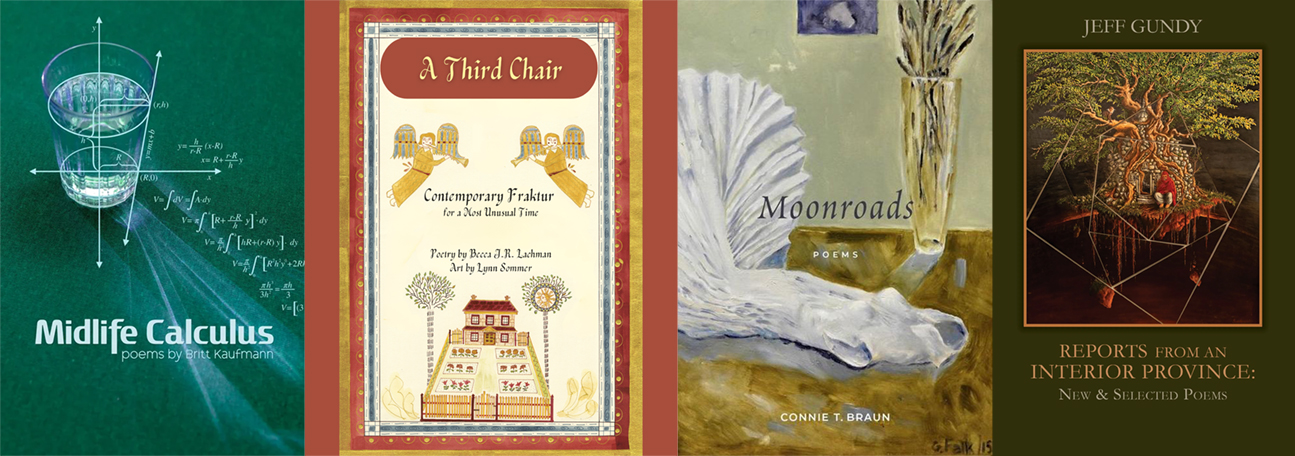
Midlife Calculus
Midlife Calculus (Press 53), the first full-length collection of poetry by Britt Kaufmann, uses the language of calculus and mathematics to bear witness to the challenges of Covid-era teaching, tutoring students in math and the process of aging. “Prime — I am past it,” Kaufmann writes in the poem “Apostrophes.” “Knock that exponent pi-in-the-sky / down a peg — / I am grey at the first roots.” This book describes serious difficulties (unsupportive parents, troubled students, ventilators) but also sees hope: “We create peacewise functions — / , discontinue a slow descent / bend back the long arc toward justice.” This book can be appreciated by math- and language-lovers alike.
A Third Chair: Contemporary Fraktur for a Most Unusual Time
Covid played a direct role in A Third Chair: Contemporary Fraktur for a Most Unusual Time (self-published). A collaboration between poet Becca J.R. Lachman and fraktur artist Lynn Sommer, A Third Chair is born of infertility troubles, Covid isolation and folk art. Lachman’s poems engage fruitfulness and resilience through cooking, flowers, adoption and parenting. Sommer created fraktur to accompany each poem and leaned on traditional imagery such as birds, flowers and angels, but added specific images from Lachman’s poems, such as wooden shoes and eggs. The fraktur are beautifully illuminated in gold and earth tones. Some include music notes and words from hymns.
Moonroads
Connie T. Braun’s Moonroads (CMU Press) may be her first full-length collection of poetry, but it builds on previous short poetry collections and nonfiction works on memory and place. Divided into four sections, Moonroads examines how past and place are carried in our bodies and passed on to descendants. At one point, the poet considers a set of nesting dolls as a metaphor for the body. “The Woman Who Lives at the Summer House” responds to artwork by Victor Wang and describes color and technique. But it is also a meditation on Braun’s Mennonite grandmother in her ancestral Poland and Ukraine: “her hands, / thick from unpaid labour / like my grandmother’s were.” Moonroads holds the body as a site of grief, memory and love.

Reports from an Interior Province: New & Selected Poems
Reports from an Interior Province: New & Selected Poems (Dos Madres) includes poems from Jeff Gundy’s previous eight books of poetry and heads into theological and political territory. An 18-foot python that takes three men to subdue becomes a metaphor for immigration. “Some Naïve Questions” considers, through a series of exam questions, the story of the Israelites escaping the Egyptians through the Red Sea. Reports from an Interior Province is full of restlessness and spiritual wrestling but also humor. “What is it with the geese?” asks the poet. “A wild town meeting?” This collection reveals inward space that often finds inspiration from grounded images.



Have a comment on this story? Write to the editors. Include your full name, city and state. Selected comments will be edited for publication in print or online.