


A fellow Bethel College alum once told me he “would rather have 50 2% solutions than two 50% solutions.” I think there’s wisdom in this idea — wisdom we can apply to economic and racial justice.
None of us participated in enslavement, Jim Crow or the removal of Native people. But there is no doubt that many White Mennonites have benefited — from red-lining (racial discrimination in housing) to advantages in obtaining farmland, houses and bank accounts, to the words and ideals of the Constitution favoring us but not others.
Very few White Mennonites have made reparations for the advantages that came from the evils we so casually forget or ignore. Until we repent and repair, the past will continue to trip us up.
For decades I have listened to sermons about the Jubilee year: After 50 years the land was to revert to the family that first owned it (Leviticus 25:8-38). I have seen very little of that happening. Discussions about dismantling the Doctrine of Discovery are good, but I see a lot more discussion than action.
All through my life I somehow ended up in positions to see, hear and experience the rougher side of our society. Although I don’t remember it, my first contact with people who were disadvantaged was being born on the South Side of Chicago while my father attended seminary. Years later we visited Chicago, and my parents drove through the neighborhood where we had lived. They wouldn’t even let me out of the car to look around.
Five months after I was born, my parents took an assignment at the Hopi Mission School in Kykotsmovi, Ariz., where my father taught for two years. The Hopi reservation is located on Three Mesas in the middle of the Navajo reservation. There are pictures of me on a donkey with my Hopi babysitters. By the time my family left a couple of years later, I was starting to speak Hopi and English.

We moved to Liberal, Kan., in the southwest corner of the state. Liberal is not politically liberal. It got its name because when the wagon trains came through on the way to California, residents gave water to the travelers for free instead of selling it like many other towns did. Travelers said, “That’s mighty liberal of you.” And the name stuck.
As long as I lived there, I ran into people who were very giving. It is amazing what a name and tradition can do. I lived and attended school on the south side of town (the “wrong side of the tracks”), and that’s where my friends were, too.
Liberal had a small Mennonite church. If I was lucky, there would be one other person in my Sunday school class who was in my grade. The town had minimal Mennonite influence. Once I tried to explain pacifism to our Fellowship of Christian Athletes Bible study group. I was playing quarterback, and the next day at practice I couldn’t buy a block to save my neck.
After two years at Bethel, I joined Mennonite Voluntary Service and went to Portland, Ore., as part of Menno Housing, a nonprofit home-repair unit that served people who could not afford to keep up their homes.
I went back to Bethel for premed studies and was accepted to med school. The problem was paying for it. The National Health Service Corp had an Indian Health Service branch, and I signed up to pay back a year of work for every year they paid for med school.
After med school and pediatrics residency on the edge of the poor side of St. Louis, the dilemma was where to go. I had fondness for the Hopi mission site and applied there. I was accepted but told I would have to “put on a uniform” (join the military) as part of the National Health Service Corp, which is a branch of the military.
Indian Health Service has two branches, one civilian and one a subset of the military. They wanted everyone to be in the military side. I wasn’t doing that, so I stayed on the civilian side, but the choices were limited.
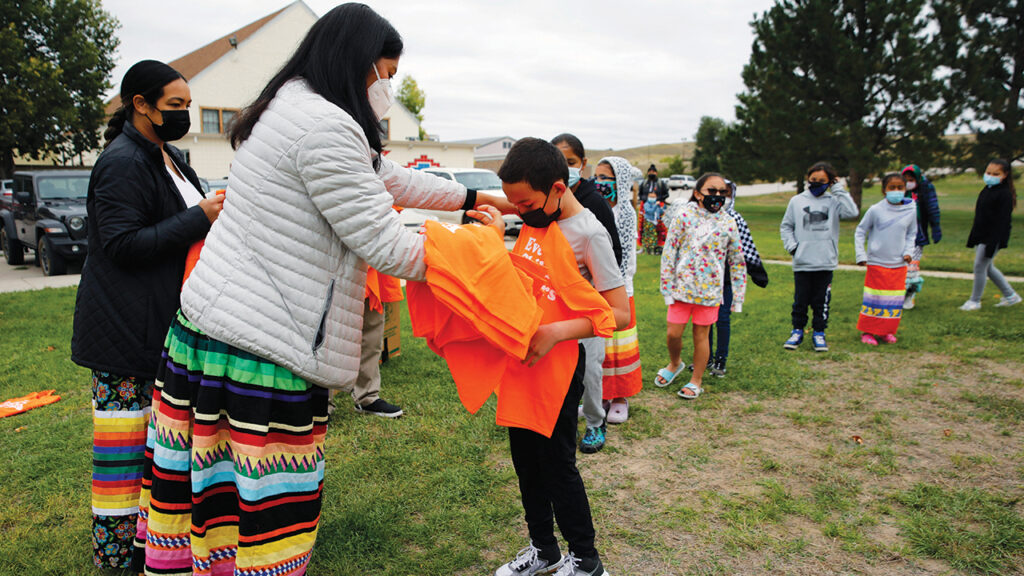
The only place desperate enough to take me was Pine Ridge, S.D., site of the 1890 Wounded Knee massacre where U.S. soldiers killed nearly 300 Lakota people.
Pine Ridge is the poorest reservation in the country. It competes with a county in Mississippi as the U.S. county with the lowest per capita income — not a competition anyone wants to win. Working to provide good medical care to the children and seeing families struggle to give their kids a chance and not be trapped in poverty and alcoholism was difficult and frustrating.
So, how could we repent and repair? Being a math nerd, I’ve thought about how to make this happen today, with fewer people on rural land and more of us with assets like stock portfolios and retirement accounts.
I propose that we who have assets that are “fruit of the poisonous tree” should give 2% per year of our net worth to an Indigenous group, or the descendants of enslaved people or another disadvantaged group, over 50 years. We can start when we begin earning and have assets (like a car). After 50 years, each of us would have provided the equivalent of restoring one household at 100%.
Note that I am not referencing tithing. That is separate from Jubilee. They are not the same thing.
When the U.S. government was negotiating with the Lakota Sioux, it promised to feed, clothe and provide medical care “as long as the sun shines, the grass grows and the river flows.” When I was at Pine Ridge, one of my favorite quotes was from Chief Red Cloud after the Lakota Sioux were surrounded, subdued and moved to the reservation. He said, “Do that for seven generations, and send all our young men to West Point to get an education, and you will not owe us anything more.” (I realize this does not fit with Anabaptist pacifism, but West Point was the best education Red Cloud knew.)
We are now approaching seven generations out, and I have seen that the U.S. government seems to be doing as little as possible to fulfill our commitment and the poverty persists.
Two percent per year equals Jubilee.
Jon Jantz is a pediatrician in Newton, Kan., at Cottonwood Pediatrics, which accepts all insurances, including any child on Medicaid. He serves on the National Committee on Native American Child Health with the American Academy of Pediatrics.

Have a comment on this story? Write to the editors. Include your full name, city and state. Selected comments will be edited for publication in print or online.