


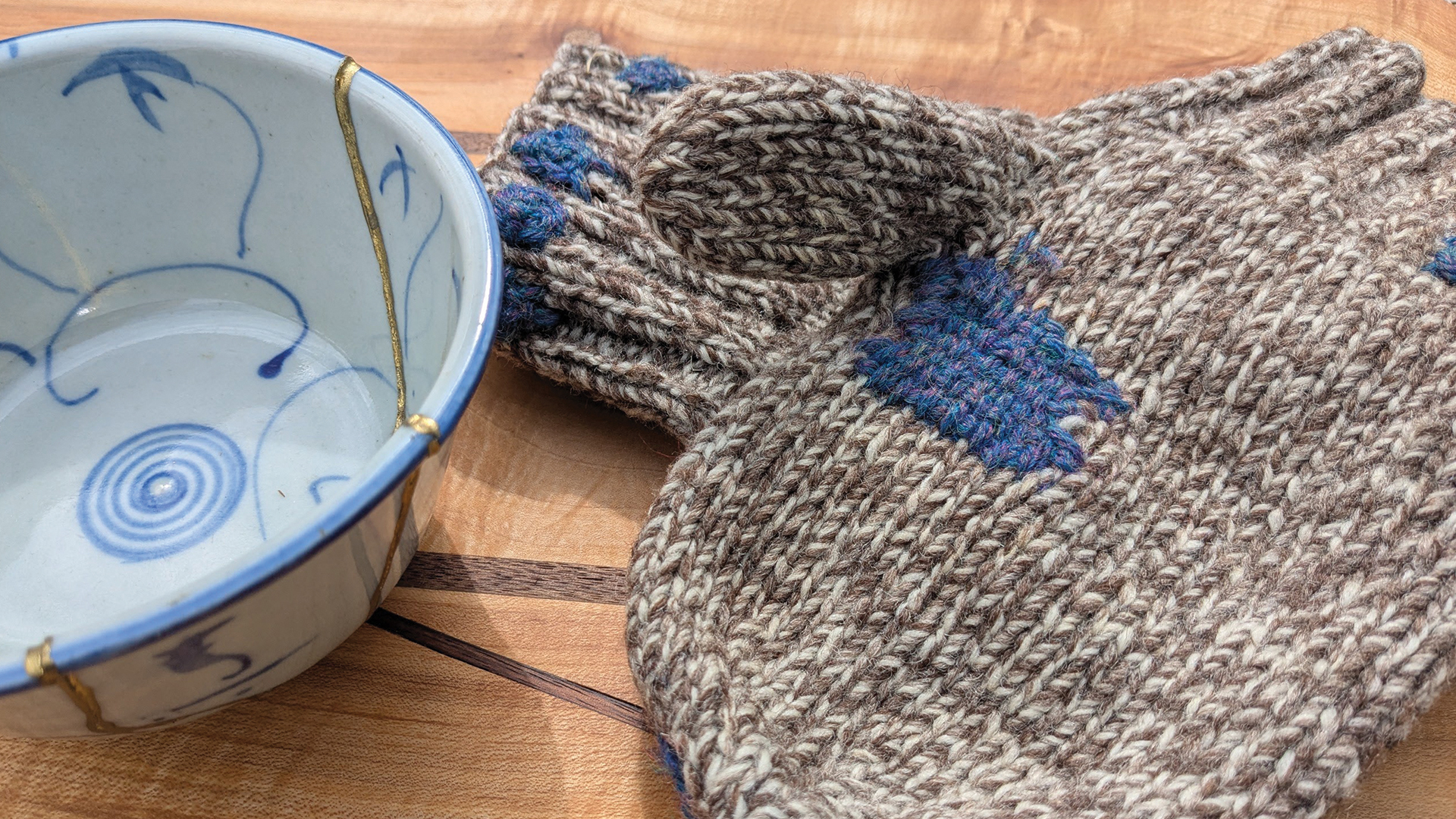
When an old friend died far away, I grieved for words left unsaid, at chances for reconnection not taken. The sorrow was compounded that fall when I brought out my winter wraps and found one of his gifts — a pair of hand-knitted wool mittens, torn and raveling in a dozen places. The moths had ignored everything else in the
bin and chewed up the soft heather-
colored wool.
I couldn’t bring myself to throw away this last reminder of my friend’s warmth and care, so I mended the mittens. I’m no expert in the fiber arts, but I have internet access and a trove of inherited supplies.
I did not have matching wool, and besides, these holes were too big to mend discreetly. I found a skein of variegated indigo another friend had salvaged from a dye lot meant to be thrown away and which I had hoarded for a dozen years. Fibers of teal and purple deepened its color. It didn’t match the mittens well, but it had a similar weight and softness.
I stitched up every hole, using spiderweb rosettes and blanket stitches, cross-stitches and sunbursts and filled in most of one palm with a basket weave.
The mending didn’t cure my grief, but it honored my friend and my regrets. As time passes and the ache of loss is less often in the foreground, wearing these mittens keeps the connection alive. They keep my fingers warm, too.
I have long loved the Japanese tradition of kintsugi, lining the rejoined edges of broken and repaired pottery with gold to highlight the fractures. This honors its history, adding value to the piece. One of my desk treasures is a restored rice bowl with gold detailing added to the seams by a kintsugi artist.

There’s a Japanese iteration of visible mending, too. Sashiko involves replacing or reinforcing torn parts of a garment with additional fabric and stitchwork on top. The idea is to keep something good and to make it better, layering love over the ravages of age.
As a person in her middle years, this makes me hopeful. Let my soul be layers of tear and care, wear and mendings, patch and thread. Let it be stronger, and may there be beauty in the repair.
OUr uneasy relationship with our tattered national history in the United States remains in the news. In January, following the requirements of an executive order for “Restoring Truth and Sanity to the Nation’s History,” national park workers at Philadelphia’s Independence Mall took a crowbar and pried off the plaques that memorialized and interpreted the lives of George Washington’s enslaved workers. They restored the exhibit in late February at a U.S. district judge’s order. Further appeals are in process.
The current administration’s push to eliminate troubling reminders of America’s past in national parks and monuments threatens to remove the truth of the injustices that were part of our country’s founding, built our wealth and underlie systems that persist today. Memorials and storytelling that keep these broken places visible strengthen the fabric of our democracy and keep us honest as we seek to improve the ways we do government and community and to repair lingering inequities.
When we teach the truth to our children and remember these historical failings at our places of national pilgrimage, we bind our history in indigo wool; we etch it in gold.
(But even these metaphors are not innocent — both indigo and gold have their own histories written in blood.)
Last fall, I toured James Madison’s Montpelier with my daughter and some of her classmates. Our guide showed us the imprint of a small finger in a foundation brick near the front entrance of the mansion, left by one of the enslaved children who shaped bricks on the plantation.
We were invited to touch the brick. One by one, each of our sixth-graders bent down and knelt fingertip-to-fingertip with that other child, over 200 years gone but as present as their own fingerprints. For a moment, we fell to our knees beside one of the children whose labor sheltered the man who drafted our Bill of Rights.
I needed to keep the mittens close — and, as a country, we must curate places of truthful memory and pilgrimage. May these tangible reminders of our past keep us wise as we live forward into our future.
I wonder how, as churches, we remember or might remember the broken places in our own histories in ways that make us stronger and wiser. I hope to continue this conversation in my next column.



Have a comment on this story? Write to the editors. Include your full name, city and state. Selected comments will be edited for publication in print or online.