


The Bible contains more than 100 Scriptures emphasizing church unity. So why do those who believe in Jesus tend to struggle with being unified?
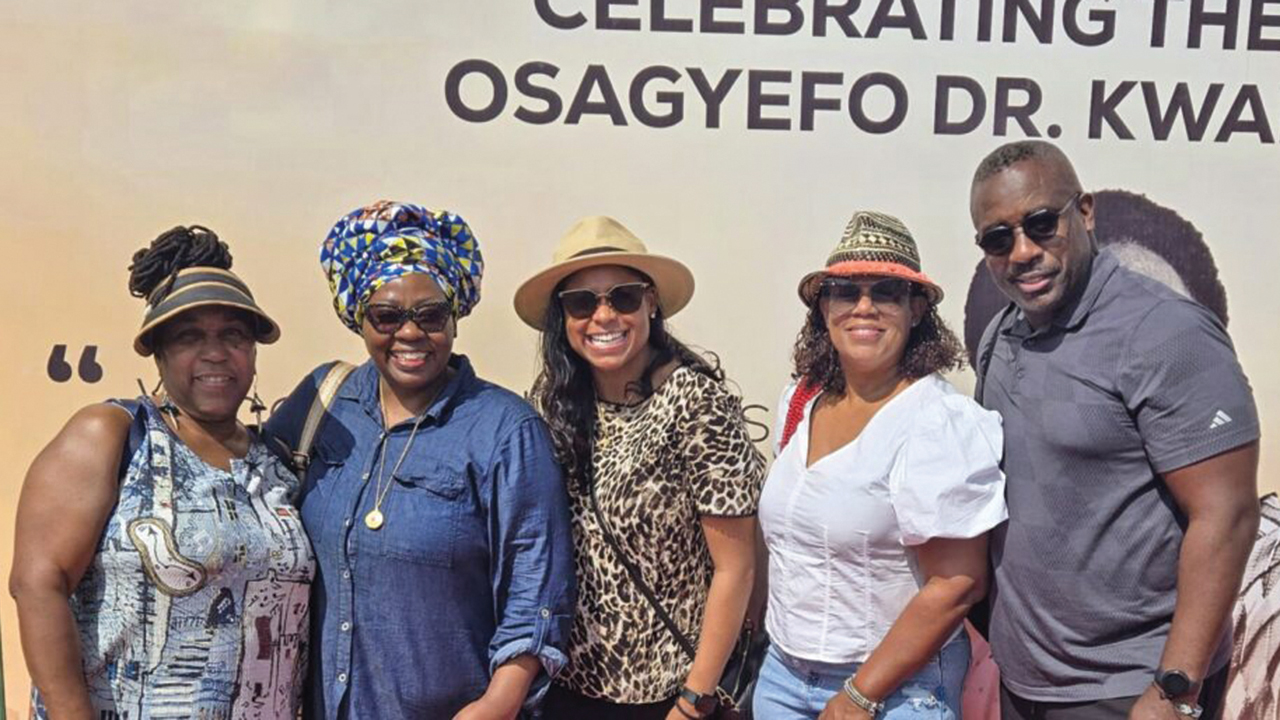
Recently, I was on a learning tour in Accra, Ghana, with a group of African American Mennonite leaders invited to connect and build unity with African church leaders. Our group had representatives from Mennonite Church USA, LMC and Mosaic Mennonite Conference. We were hosted by Thomas Oduru, president of Good News Theological Seminary, a Mennonite Mission Network partner.
I felt right at home worshiping at Trinity Chapel, the Ghana Mennonite Church headquarters. The Rev. Francis Dzivor, moderator of the Ghana Mennonite Church, delivered a powerful message about Jesus’ Last Supper.
Ghana is a majority-Christian country, primarily because of the influence of Western missionaries. Beginning in the 1920s, locally led congregations, including successful African-Initiated Churches, emerged and have continued growing today.
As we drove south from Accra to Cape Coast, we saw churches of different denominations dot the landscape. This was encouraging, but I wondered if nonbelievers would see disunity or different biblical interpretations causing church splits.
But is disunity always negative? The Anabaptist movement resulted from a necessary church split, right?

Our tour took a sobering turn as we visited Cape Coast Castle, a slave post where our African ancestors were stored in a dungeon before being shipped as cargo to the Americas. The tour guide explained that European Christians built the castle’s sanctuary atop the dungeon. These churchgoers worshiped in the sanctuary — their heaven — while African men, women and children agonized below in their hell.
Standing in the dungeon, as my ancestors had, I looked up through an open shaft to see the church’s blue wooden front door. Our enslaved ancestors were forced to stand or lie side by side, shackled. The guide said their flesh, sweat, blood, urine and feces had petrified to form the dark stone floor beneath our feet. The Africans who rebelled and fought for freedom were tortured and killed, their bodies dumped into the sea.
My emotions triggered reflections about what happened to them — us — on the other side of the Atlantic Ocean.

I recalled seeing the British “Slave Bible” on exhibit at the Museum of the Bible in Washington, D.C., a few years ago. White Christians used their tampered version of the Bible to convert enslaved Africans. Scriptures that might inspire rebellion and freedom were omitted.
I thought about the irony of my undergraduate education at Lincoln University of Pennsylvania, the nation’s first degree-granting Black college. The university was founded by abolitionist Presbyterians in 1854 as Ashmun Institute.
Members of the American Colonization Society established this university to train Black men to be missionaries to Africa as part of the “back to Africa” movement. They believed educated free Black people threatened their White social order, and therefore Black people had no safe future in America as equals. These abolitionists set their sights on Christianizing Africa.
Lincoln University was inspired by James Ralton Amos, a free Black man and trustee at the Hosanna Meeting House, an African Union Methodist Protestant Church in the free Black community of Hinsonville, Pa. A man of deep faith, Amos — known by his middle name, Ralston — rejected the notion that Black people were less than human. He knew he was made in the image of God, possessing the intellect for higher education, equal to any man.
Amos applied to Princeton University’s Theological Seminary, where the White southern elite sent their sons. It was a bold statement, a full decade before the start of the American Civil War. Princeton, of course, rejected Amos because he was Black.
This prompted Amos’ mentor, Presbyterian pastor John Miller Dickey, and his wife, Sarah Cresson — a Quaker — to lead Princeton’s “Radical Republicans” to help establish Lincoln University. Amos also raised funds, and the Hinsonville community provided land. Black and White believers unified in doing God’s mission, despite their differences — proof of the good that happens when God’s people unify.
Nonetheless, in 1861, southern Presbyterians split from the denomination over slavery, theology and the Civil War.

Ralston Amos and his brother, Thomas Amos, graduated as part of Lincoln University’s first class, in 1859, and joined the ranks of Black missionaries to Liberia and other African regions. African men came to the U.S. to study. Black missionaries, like the Amos brothers, helped transform the pain of the transatlantic holocaust into promise.
Decades later, a young Christian named Kwame Nkrumah left Ghana to attend Lincoln University, where he bonded and strategized with Black American classmates. After earning a theology degree, Nkrumah returned in 1942 to Ghana, leading it to independence from British colonial rule in 1957. He became the country’s first prime minister (1957–1960) and then its first president (1960–1966).
The unity in our group of American and African Mennonite leaders embodied the Pan-African vision of early Black missionaries like the Amos brothers and leaders like Nkrumah, whose daughter, Samia Yaba Nkrumah, we met on the tour.
From the dark dungeon, our guide led us toward the infamous Door of No Return. Slowly, we walked through it, as our ancestors had. Our teary eyes squinted from the bright sun and blue sky outside. I paused and gazed at the waves of the Atlantic Ocean. The guide, then, led us back through the opposite side of the door, marked Door of Return. “Akwaaba! Welcome home,” he said. Our ancestors had not sacrificed in vain.
So, then, why emphasize church unity? Jesus’ prayer in John 17 offers a powerful answer. Knowing he would soon go to the cross to fulfill his mission, Jesus prayed for his disciples and all future believers.
Jesus prayed that his followers would unite, reflecting the Trinity’s unity, so that nonbelievers would be drawn and convinced to follow Jesus, too.
Perhaps we struggle with church unity because we make it only about us, like looking in a mirror. But the call for unity among believers is more about reflecting Jesus’ love for those who are watching us.
What do they see?
Wil LaVeist is senior executive of advancement for Mennonite Mission Network.


Have a comment on this story? Write to the editors. Include your full name, city and state. Selected comments will be edited for publication in print or online.