


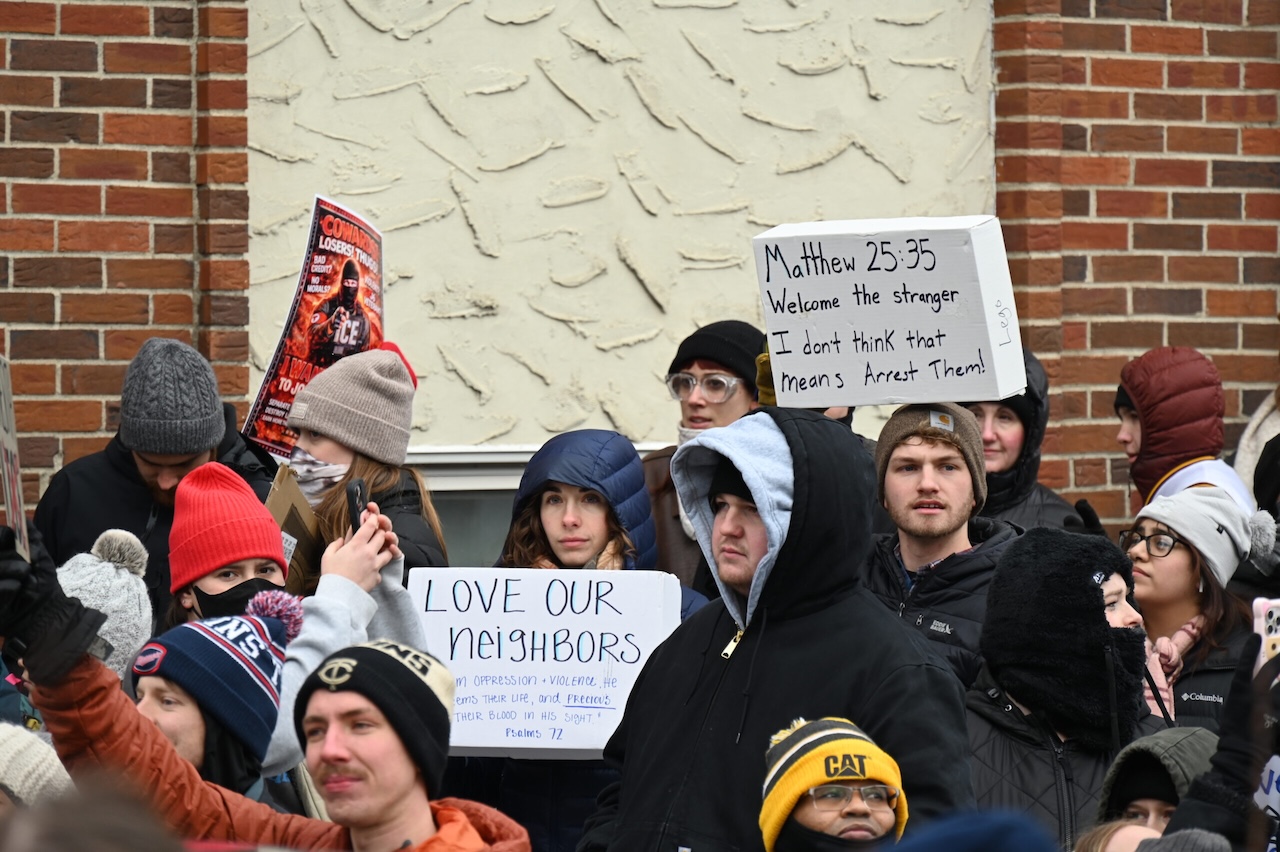
For years, leaders of the Evangelical Immigration Table have summed up the Bible’s view of immigration in three words: Welcome the stranger.
In Bible studies, sermons, videos and other resources, the coalition of denominational and nonprofit leaders has sought to remind churchgoers to see immigrants as their neighbors and people worthy of love and support. They’ve advocated for reforms that ensure America’s borders are secure, keep immigrant families intact and provide a pathway for undocumented immigrants to gain legal status.
Zach Szmara, an Indiana pastor and longtime supporter of EIT, said the Bible, not politics, should shape how evangelicals see the issue of immigration.
“Evangelicals may have room for disagreement, but we have to start with the fact that we are called to love and welcome immigrants, not view immigrants as threats or burdens,” Szmara told RNS in a recent interview at a church conference in Chicago.
When Szmara founded Immigrant Connection, a church-based network of legal clinics that assist immigrants, in 2014, some churches wanted to get involved, others said it was a good idea, and there was little resistance, he said.
Now, he said, critics treat his work as anathema and ask him if he’s lost his faith.
Support for immigration reform has become a flashpoint among evangelicals in recent years. Last fall, the public policy arm of the Southern Baptist Convention, known as the Ethics and Religious Liberty Commission, broke ties with EIT, due in part to pushback in the denomination that the group had become too liberal on immigration.
The break was notable because Richard Land, a legendary SBC figure who led the ERLC for decades, had been one of EIT’s founders and had long promoted immigration reform. That split highlights tensions among evangelicals over immigration that have grown during the Trump era of mass deportations — including in Minneapolis, the current epicenter of immigration enforcement.
Public polling shows that evangelicals, in general, support reforms that would lead to secure borders and provide legal pathways to citizenship. But a 2025 study from Lifeway Research, an evangelical firm, showed evangelicals are deeply divided in how they view immigrants. According to the study, 44% of evangelicals said they see recent immigrants as a drain on the country’s resources, while 43% see those immigrants as a threat to the safety of Americans. Over a third (37%) said Christians have an opportunity to show love to immigrants, while the same percentage said recent immigrants are a threat to law and order. Most (80%) wanted Congress to pass immigration reforms last year.
EIT’s members include prominent organizations like World Relief, an evangelical humanitarian group that resettles refugees, and the National Association of Evangelicals. Meanwhile, critics argue that Christians are called to love immigrants but that call to compassion and love has been misused.
“What we’re learning now is that illegal immigration is not compassionate. In fact, it’s not only bad for Americans, but it’s bad for people who are migrating illegally,” said Willy Rice, a Florida pastor who is running for SBC president, during a recent podcast from the Center for Baptist Leadership, a group that believes the SBC and other evangelical groups have become too liberal.
Carl Nelson, president of Transform Minnesota, an evangelical church network, said he’s seen support for ministry to immigrants and refugees decline in recent years. “I see a moving away from being generally compassionate and favorable towards immigration — immigration that’s done lawfully and orderly, and particularly refugee resettlement — towards much, much more suspicion and resistance,” he said.
Within Transform Minnesota’s network is Arrive Ministries, a Minneapolis-area refugee resettlement agency affiliated with World Relief. Nelson said that to outsiders, the Twin Cities may look chaotic, while inside the cities, people are worried about their neighbors.
“The dissonance between those two viewpoints, I think, has deepened,” he said, adding that he also sees a divide between Christians in rural areas and those in urban areas.
Nelson said he has heard some Christians talk about what’s known as the “sin of empathy,” which views having compassion for others as suspect. That suspicion is meant to put a firewall between compassion and action, he said. As an evangelical, he said he was raised to believe that the role of the church is to be salt and light in the world, a reference to the Sermon on the Mount, a well-known New Testament passage.
Evangelical responses to immigrants and refugees vary even within the same church. For example, while one of the pastors at Cities Church, a St. Paul Southern Baptist congregation targeted by activists, works for Immigration and Customs Enforcement, that church has also been involved in welcoming refugees, Nelson said.
Outside Chicago though, evangelicals have been involved in protesting against ICE, including taking part in efforts to track federal agents’ movements and in protests at an ICE detention center.
The Trump administration’s immigration crackdown has also affected evangelical churches where immigrants make up a large percentage of congregants, including Southern Baptist churches in Minnesota and Wisconsin.
“There are Hispanic churches that are not meeting right now because they are afraid of what’s happening in our part of the world, in part, because of the interaction between the federal government and the state government,” Trey Turner, executive director of the Minnesota-Wisconsin Baptist Convention, told RNS recently.
Some of the current debates about immigration have made evangelicals wary of ministry to immigrants, which Szmara said is unfortunate. “I think we have to remind the church sometimes, when you love an immigrant, regardless of their status, you know you’re not breaking the law,” he said.
Carrie Afanador, a former teacher who lives in Boone, North Carolina, said that in her part of the country, many immigrants work in agriculture and construction, but there’s not much interaction between them and long-time residents. Frustrated that there were few immigration attorneys in Western North Carolina, Afanador started training with a Department of Justice program that allows nonprofits to set up legal clinics to assist immigrants.
“I tried to talk a bunch of people into doing it, and nobody would do it,” she said. “So I got mad, and was like, ‘Fine, I’ll just do it.’”
She eventually joined the staff of Immigrant Connection, Szmara’s church-based effort. Afanador said one of the most important things that evangelical churches can do is to take care of their immigrant neighbors.
“I always ask people, how can you check on immigrants that you already know and make sure they have what they need?” she said.


Have a comment on this story? Write to the editors. Include your full name, city and state. Selected comments will be edited for publication in print or online.