


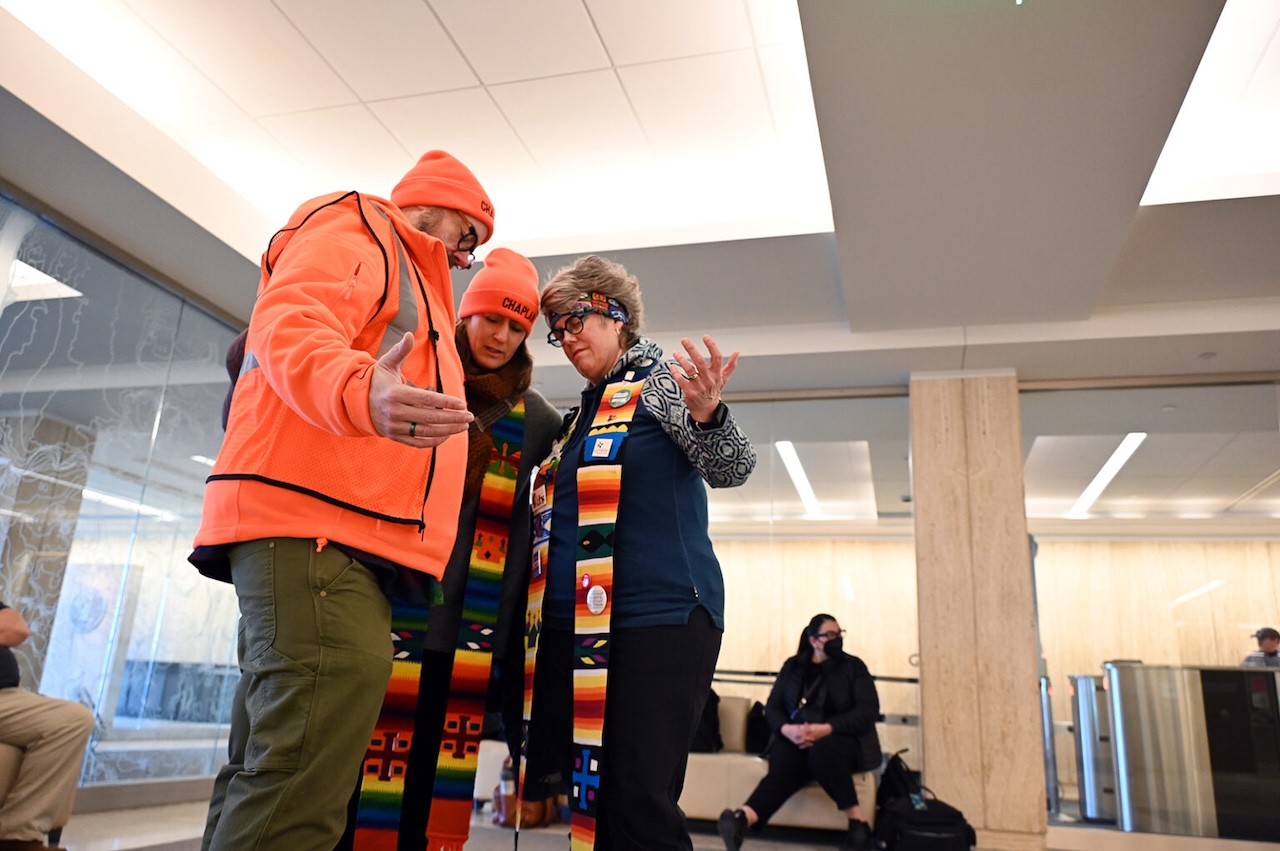
A group of religious organizations and faith leaders in Minnesota has filed a lawsuit against the Department of Homeland Security, alleging the agency is violating their religious freedom by denying them access to immigrant detainees at a local federal building.
The lawsuit was filed Monday, Feb. 23, by the Minneapolis Area Synod of the Evangelical Lutheran Church in America, the Minnesota Conference of the United Church of Christ and Christopher Collins, a Jesuit priest. It alleges the government’s refusal to allow faith leaders access to the Bishop Henry Whipple Federal Building, which houses the local offices of the U.S. Immigration and Customs Enforcement, is a violation of their rights under the First Amendment and the Religious Freedom Restoration Act.
“Pastoral care is the heart and soul of what our Pastors and Deacons are called to provide in their congregations and around the community. We walk together, listening, praying, guiding, and offering the peace and presence of Jesus Christ,” Jen Nagel, a bishop in the ELCA’s Minneapolis Area Synod, said in a statement. “This is particularly important during times of stress, grief, isolation, and transition.”
Clergy have been denied access to Whipple as recently as Monday morning, according to Irina Vaynerman, CEO of Groundwork Legal, one of the law firms representing the plaintiffs along with the firm Saul Ewing.
“Faith leaders and clergy across the state have been attempting to access the Whipple building since the beginning of Operation Metro Surge,” Vaynerman said in an interview, referring to the immigration enforcement campaign that began in Minneapolis in December. Clergy, she added, were even denied access on Ash Wednesday, a Christian holy day.
The lawsuit alleges that preventing clergy from entering the facility to offer pastoral care to migrants infringes on their religious freedom.

“By categorically barring faith leaders from praying with detainees, offering sacraments, or providing spiritual guidance, the government imposes a profound and unjustified burden,” the complaint reads. “The ability to provide pastoral care ensures that even in the most dire legal processes that could result in deportation or prolonged detention, individuals are treated with dignity and humanity, not as mere inventory.”
DHS did not immediately respond to a request for comment on the lawsuit, but the complaint alleges agency officials told Nagel that Whipple is a processing facility, not a detention facility, and that “no one is allowed access to provide pastoral care, purportedly for safety reasons.”
A Religion News Service reporter was present last month when Susie Hayward, a UCC minister, and two other UCC pastors entered the Whipple building and attempted to minister to detainees. While the trio was allowed into the building, they were denied access to the detainees, with the group eventually praying in the building’s foyer before leaving.
The trio was told by an official at the building that they should call a number to arrange a visit to the detainees. But Vaynerman said faith leaders have tried that and hit a brick wall.
“When (clergy) finally were able to reach someone on that number, they were again categorically barred from providing pastoral care,” she said. “Ultimately, upon speaking with someone, they were told, ‘No, you cannot come in.’”
Hayward, who has been active in faith-based pushback to Trump’s mass deportation efforts in Minneapolis, celebrated the new lawsuit.
“Pastoral care is not optional for us,” she said in a statement. “It is a sacred duty. Blocking clergy from ministering to people in detention violates their rights and ours. It reveals the contradiction between the government’s rhetoric and its actions.”
Last week, a federal judge issued an order requiring the federal government to coordinate with the Coalition for Spiritual and Public Leadership — a Chicago-area Catholic advocacy organization and one of the plaintiffs in the case — to allow clergy to access the site on Ash Wednesday. The government ultimately granted two Catholic priests and a nun access to the facility, but for reasons that remain unclear, they initially found the building empty. After an hour wait, a small group of detainees were brought to the facility, where they met with the faith leaders.
In an interview, Leandro Fossá, who was part of the delegation allowed into the facility, described an emotional meeting with the detainees — young men and women “just past their teens.”
“We saw their tears, confusion. For them, their dreams were just about to end, they had to start all over, so you could see the anxiety on their faces — the battle is lost,” he said.
But Fossá, who has long worked in prison ministry, said that as he and others offered the group Communion and rubbed ashes on their foreheads, the value of their ministry was made clear. “Our presence, our words, our journeying with them — it was a moment where they could feel that they are not alone,” he said. “The community is with them. God walks with them.”
Fossá said he and others discussed with officials in the building the possibility of a weekly or even daily delegation at the facility, but a formal agreement has yet to materialize, and the lawsuit is ongoing.
“We have to follow our gospel: ‘I was in prison and you visited me. I was naked and you clothed me,’” he said. “We cannot choose to love someone only when that person has papers. We love — love doesn’t choose.”


Have a comment on this story? Write to the editors. Include your full name, city and state. Selected comments will be edited for publication in print or online.