


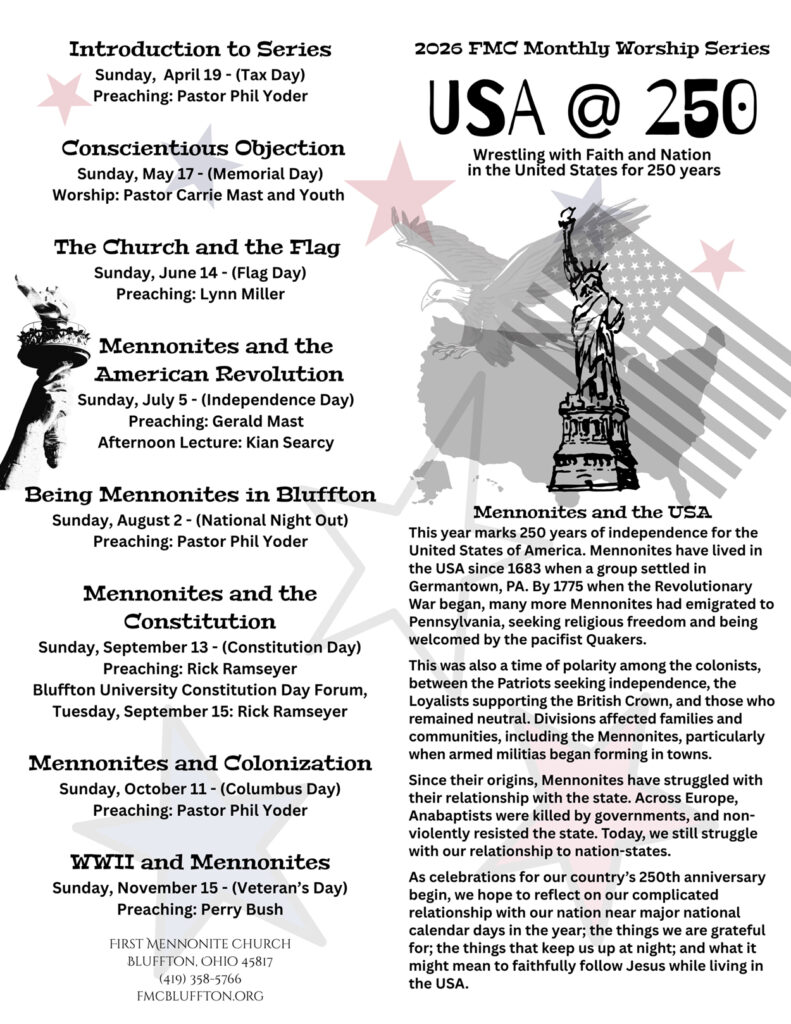
“Why are we doing anything related to the United States’ 250th year of independence?” a member of our church asked after looking at the brochure of our yearlong worship series, “USA at 250.” “Shouldn’t we just ignore it?”
Should we ignore it?
In our small village of Bluffton, Ohio, there are events throughout the year celebrating the 250th anniversary of U.S. independence. Small towns love their patriotic events! From hymn sings to cake-decorating contests to a parade, Bluffton is celebrating proudly.
For many in my congregation, First Mennonite Church of Bluffton, it is an ongoing struggle to figure out how to engage in community events that have patriotic components. This year we were invited to create a float for the America at 250 parade. Some ideas have included building a float that says things like “Pray for Peace, Act for Peace” or “Love God, Love Neighbor.” The easy solution that we normally take is not to participate.
However, the tricky part of a Mennonite peace witness in small-town America is that creating change often happens through building relationships, not through shouting at people or creating a float that is essentially a “forget you” to our community.
My fellow Blufftonites are people I will be working with on other village projects, who will deliver lumber from the hardware store to my house, give my child a sticker at the post office and help stock the town’s food bank. Tact is of the utmost importance.

Is it possible to participate in such events and give witness to the kingdom of God without burning bridges?
Each year, my town’s ministerial association hosts a National Day of Prayer event on our main street. I struggle with how or if I should participate. As a Mennonite pastor, do I withhold participation and strain relationships with fellow congregations, or do I participate in hopes of pointing the village toward Jesus’ kingdom of God and the belovedness of God’s children all over the world?
There are no clear answers. So, instead of ignoring the celebrations, we decided to tarry with these tensions and create a worship series, “USA at 250: Wrestling with Faith and Nation in the United States for 250 Years.”
The series consists of a monthly worship service where we reflect on our faith, history and relationship with the U.S. Each service features stories from people in our congregation and a theme: conscientious objection, the flag, Mennonites and the American revolution, being Mennonite in Bluffton, Mennonites and the Constitution, Mennonites and colonization, and Mennonites and World War II.
The goal is not to criticize our country for seven months but to tell the story of our involvement, name and confess our sins and give thanks for what we are grateful for. Through confession and better understanding of our participation in the U.S., we hope to be better equipped to honestly engage our patriotic town.
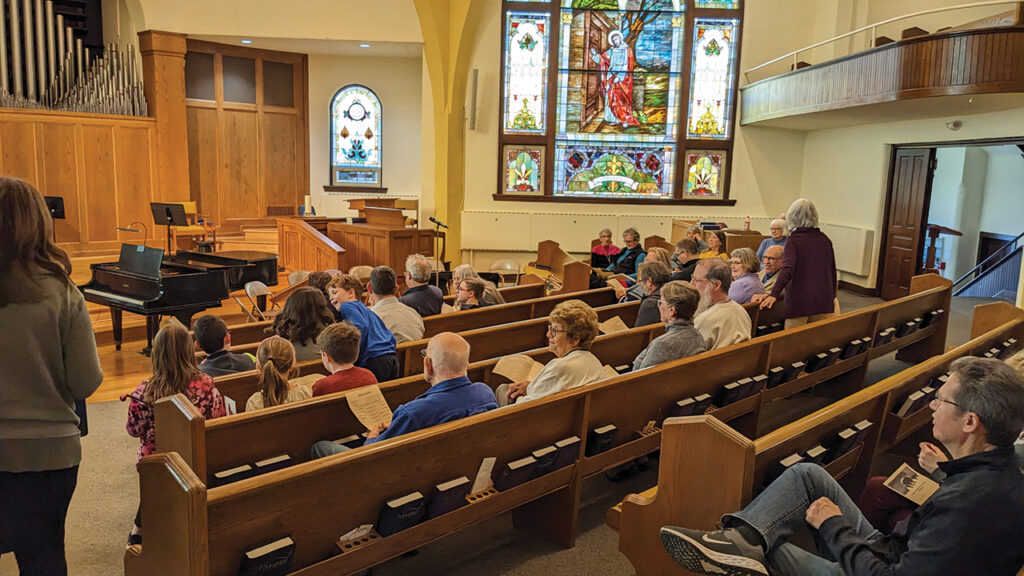
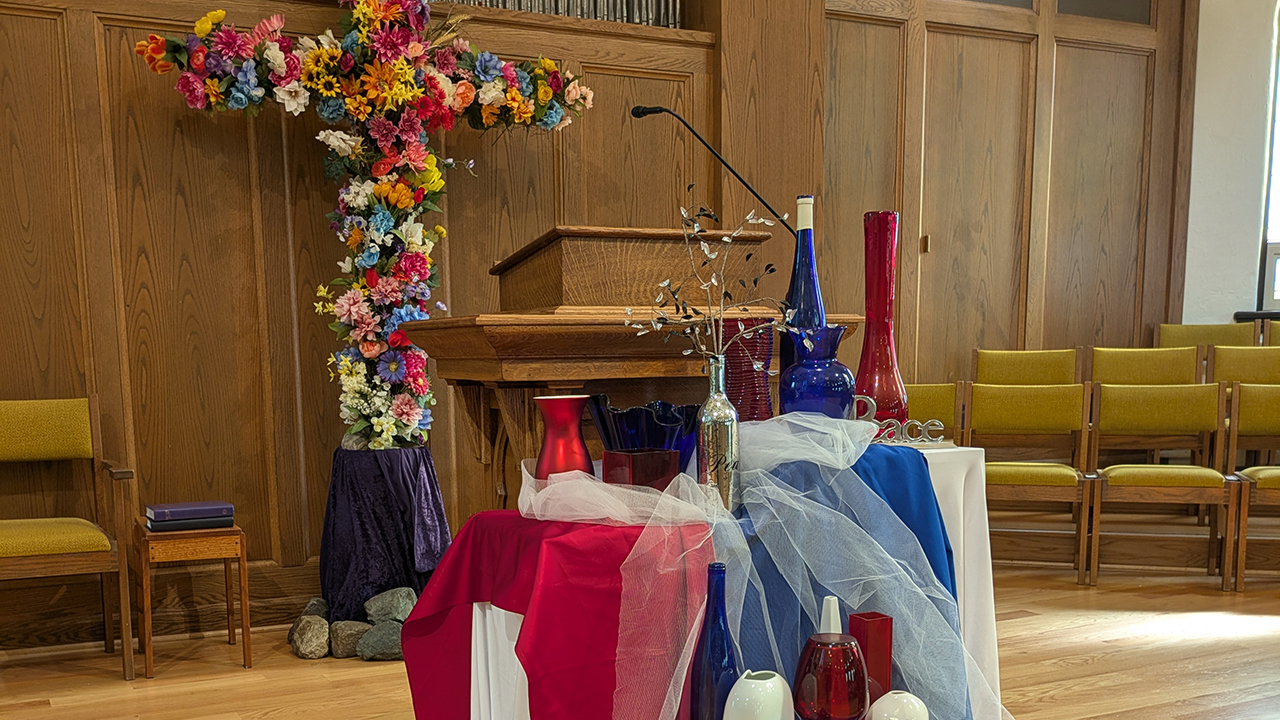
The first Sunday of the series started as a shock to some: Our chancel was covered in red, white and blue. It’s what I requested, but I am still unsure about it. Maybe a controversial chancel display is just what we needed to start a controversial series.
Kian Searcy, a local high school U.S. history teacher and a member in our church, was the worship leader. He opened with these questions:
“What relevance does the story of America hold for us? What place do Mennonites have in it? For starters, I know if we don’t talk about it, others will, and their narratives and their stories and their opinions will be the ones we hear.”
He continued with more questions:
“Which stories in American history are worth telling? What do we mourn, give thanks for and critique about this place we live in? How can we stay true to our faith in this place?”
We continued through the service and sang hymns like “For the Healing of the Nations” and “God of the Fertile Fields.”
Midway through the service, Anne Marie Hardy Spelman provided a children’s time that brought the children and congregation into deeper tensions of being American and Mennonite.
“In some ways, I am truly grateful to be an American,” she said. She went on to name things she was grateful for: a country where kids don’t have to work in factories, a diverse country, the abolition of slavery, the right for women to vote, rights for those with disabilities, the right of LGBTQ+ folks to marry.
She reminded us: “Even as Americans who care about our country, our main loyalty is to God and to the whole world. The most important thing about me isn’t that I’m an American. The most important thing is that I am a child of God, a member of the human race, a member of Planet Earth.”
As she showed the kids the new photo of Earth from the Artemis II mission, Anne Marie reminded us of our identity in Christ and our identity as humans who live on the same planet.
“The big idea for today is that when you care about someone or something, you want to make it better,” she said. “And we get to participate in making our country and the whole world a better place for all people and creation!”
I concluded my introductory sermon with another question: How can our community participate in God’s healing and hope in the world if we are not critically reflecting on our relationship with our country?
After the first Sunday, we were left with more questions than answers.
As I prepare for future Sundays, I find myself asking: If we are critical of others’ patriotism, how shall we participate in the patriotism we want to see? Is there such a thing as patriotism filled with truth-telling, confession, gratitude and the reminder that the reign of God comes not through national power but faith as small as a mustard seed?
As a Mennonite who has kept his distance from all forms of patriotism, this still doesn’t sit well with me and many in my congregation. I hope that means we are wrestling with the right questions.
Phil Yoder is lead pastor of First Mennonite Church of Bluffton, Ohio.


Have a comment on this story? Write to the editors. Include your full name, city and state. Selected comments will be edited for publication in print or online.