


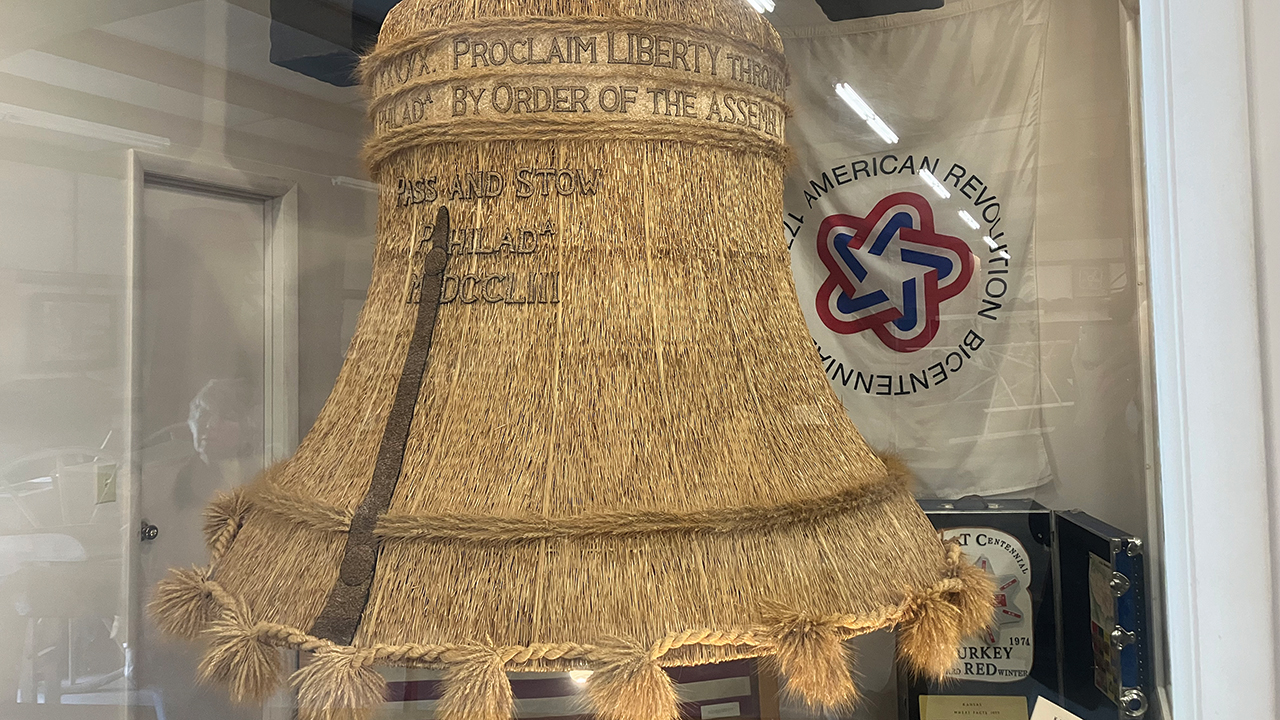
The inscription on the Liberty Bell in Philadelphia commands action: “Proclaim liberty throughout all the land unto all the inhabitants thereof.” The words are God’s, according to Leviticus 25:10. It’s a mandate worthy of any nation’s obedience. It also reflects Americans’ self-image as a people with a divine mission, uniquely blessed.
Anabaptists count ourselves among the segment of U.S. Christians who reject the idolatry of identifying America as a special work of God. We resist applying sacred rhetoric to a secular government. We owe our highest allegiance to the reign of God and our deepest loyalty to the worldwide body of Christ.
And yet, followers of Jesus who have “no lasting city” (Hebrews 13:14) nevertheless “seek the welfare of the city where I have sent you” (Jeremiah 19:7).
The ancestors of many U.S. Anabaptists believed God sent them to claim a land of promise. In the early to mid-1700s, the prospect of liberty to live and worship without fear of persecution drew pacifist Mennonite and Amish immigrants to Quaker-founded, diversity-welcoming Pennsylvania.
In the centuries that followed, preachers and politicians have referred to the United States as a “city on a hill” (Matthew 5:14), an example for the world. But it is Jesus’ followers, not any nation-state, who are the salt of the Earth and the light of the world.
American Mennonites placed their light on a lampstand — quietly at first and later publicly, joining movements for liberation ranging from Civil Rights marches in the 1960s to Mennonite Action vigils for Gaza in the 2020s.
Alongside activist movements, the Anabaptist tradition of strict separation from worldly influences persists in some circles. The separatist impulse was evident 50 years ago when Lancaster Mennonite Conference encouraged its members not to participate in celebrations of the Bicentennial. “Nationalistic celebrations . . . are not consistent with our spiritual heritage,” an LMC document said. “Self-righteous identification of the American way as God’s way distorts our witness to the Kingdom of God.” These statements remain true today.
The biblical command to proclaim liberty underscores the gap between American ideals and realities. Though often associated with the American Revolution, the Liberty Bell did not become a national icon until about 50 years later, when the antislavery movement adopted it as a symbol.
The liberty that the Leviticus verse refers to includes a mandate that in the Jubilee year Israelite bond servants were to be set free. Scripture does not record whether the Israelites ever fulfilled the Jubilee law. Its liberating ideals may have remained unrealized — in the same way that the U.S. declaration of liberty rang hollow for enslaved and Indigenous Americans.
How have Anabaptists helped to extend liberty? In Chosen Land (Basic Books, 2026), Matthew Avery Sutton identifies four streams of U.S. Christianity: conservative, revivalist, liberal and liberationist. “Conservative” most closely fits the Mennonite experience. Conservatives, Sutton says, “tended to be the most isolated. They focused on strengthening their own communities and didn’t often obsess over what other Americans were doing.”
But American Mennonites aren’t so easily pigeonholed. We’ve mingled conservative and liberal streams, often holding stereotypically liberal beliefs (pacifism) for conservative reasons (biblical literalism).
Over the past 60 years, progressive Mennonites have fit the liberationist stream. Liberationists strive “to free people from stifling gender norms, economic inequalities and racism,” Sutton says. While “frequently the smallest and [having] the least power,” this stream’s adherents “aspired to build a truly peaceable kingdom free of racism and discrimination.”
Along with Leviticus 25:10, a list of Americans’ favored Bible verses would include 2 Chronicles 7:14: “If my people who are called by my name humble themselves, pray, seek my face and turn from their wicked ways, then I will hear from heaven and will forgive their sin and heal their land.” Presidents and preachers have invoked this promise for “God-and-country vibes,” says Brian Kaylor, author of The Bible According to Christian Nationalists (Chalice Press, 2025).
Removed from its context — God’s covenant with ancient Israel — the verse has been used to assert that the United States is the new Israel and Americans the new chosen people. The idea is as old as America itself. The current ascendance of Christian nationalism is merely the latest version of efforts to empower a specific version of Christianity with political and cultural dominance.
As with the Leviticus command to proclaim liberty, the call in 2 Chronicles for humility, prayer and repentance is both specific to its time and forever relevant. The promise of healing for collective sin offers hope for the unfinished work of liberation.



Have a comment on this story? Write to the editors. Include your full name, city and state. Selected comments will be edited for publication in print or online.