


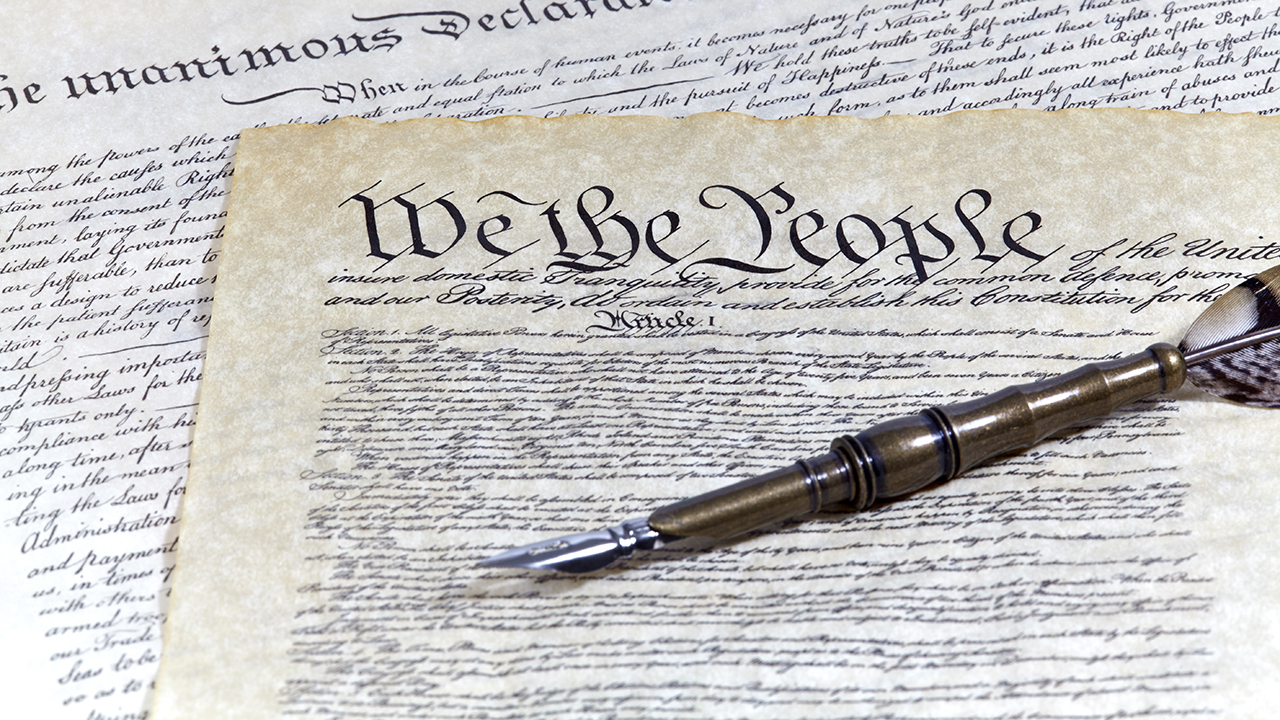
From a distance of 250 years, Anabaptists today might think we have little in common with the U.S. Founders — just as most Mennonites in the American colonies had little to do with the Revolution, typically choosing pacifism over engagement with either the Loyalist or Patriot side.
I’d argue differently: that the best qualities of the colonists who declared independence from England are some of the highest ideals Anabaptists hold today.
We espouse these qualities unevenly and live them imperfectly (as the colonists also did) — too often acting on selfish motives, hampered by bias or bigotry. But when we embrace our better values and act on them, we embody ideals as radical as those the Founders established: equality, respect for conscience and an obligation to act together for the common good.
The Anabaptist movement and the struggle for American independence had a common adversary: the union of church and state. Between 1525 and 1776, the cause of equality had a great foe in the divine right of kings. But long before the American Revolution, the belief that a king ruled as a representative of God on Earth had been knocked quite a blow by England’s 1688 Glorious Revolution. Overthrowing King James II, England embraced a system in which a monarch governed with the consent of Parliament.
About a century later, the American War of Independence ended even that pretense of royalty. Though limited in its execution, the fledgling democracy disproved the idea that political power was the reward of blood or birthright. Power no longer resided in the person of a king or queen. Instead, “all men are created equal,” as the Declaration of Independence states.
In biblical terms, Romans 13:4, quoted by supporters of the monarchy — “[For the ruler is] God’s servant for your good. . . . [T]he authority does not bear the sword in vain! It is the servant of God, to execute wrath on the wrongdoer” — lost to Galatians 3:28: “There is no longer Jew or Greek, there is no longer slave or free, there is no longer male and female; for all of you are one in Christ Jesus.”

Today, though Anabaptists are often too proud of our family trees — as if being able to trace our roots back to 16th-century Switzerland or Holland makes us “Mennonite royalty” — when we are at our best, we embrace equality, seeking to “show no partiality” (Romans 2:11).
Soon after the ratification of the nation’s new Constitution, James Madison saw a flaw in it: It failed to adequately protect individual rights. He began the work of amending it to ensure those rights, including the one the Anabaptist martyrs had died for: religious conscience.
In 16th-century Europe, Anabaptists rejected the state’s claim that citizenship determined faith. More than 250 years later, in 1791, the U.S. Constitution’s Bill of Rights delivered what the Anabaptists had asserted in 1525: freedom of religion.
The First Amendment’s free-exercise clause guarantees we can practice our faith without government interference. Its establishment clause frees us from supporting a government-endorsed religion.
The First Amendment enabled the United States to become a place of both religious diversity and deep devotion. We can live at peace with others because one’s neighbor’s religion “neither picks my pocket nor breaks my leg,” as Thomas Jefferson noted dryly.
The First Amendment is also a theological statement — for, as Jefferson proudly wrote about his efforts to promote religious freedom: “The rights of conscience we never submitted, we could not submit. We are answerable for them to our God.”
The government cannot compel us to believe or disbelieve — to act on our belief or refuse to act — because only God can judge matters of faith.
Or, as Menno Simons suggested in “A Christian and Affectionate Exhortation” to the political leaders of his own day: “Do not interfere with Christ’s jurisdiction and kingdom, for he alone is the ruler of the conscience and beside him there is none other; let him in this matter be your Emperor.”
The American Founders and our Anabaptist principles agree that we owe each other not only freedom of conscience but also care. The Preamble to the Constitution includes, among other reasons for the creation of “a more perfect Union,” the promotion of the “general Welfare” for “ourselves and our posterity.” Individual liberties do not free us from our obligation to ensure that others can themselves live.
The Founders called for us to protect the common good: the things all of us need to live healthy lives. George Washington took the idea so seriously that he mandated smallpox inoculation for his troops, the first mass vaccination effort in the Americas. The Founders, at their best, saw that we were all in this American experiment together and would need to cooperate to ensure its survival.
Mennonite theologian Palmer Becker has said Anabaptists believe community is the center of our lives and reconciliation is the center of our work. We seek to heal the world so that communities can flourish — which is one of the reasons the Founders referred to Americans as “We the People.”
These are lofty ideals, and we, Americans and Anabaptists, more often than not fail to reach them. As much as I wish it were not so, the Founders really did mean “all men are created equal” — and even men was limited to White property owners: a step backward, as colonial women sometimes voted prior to the Revolution.
Anabaptists, too, have often embraced and even promoted the sexist, racist and classist assumptions of a domination system, even though we have the language of liberation in our sacred texts and models of inclusion in our history.
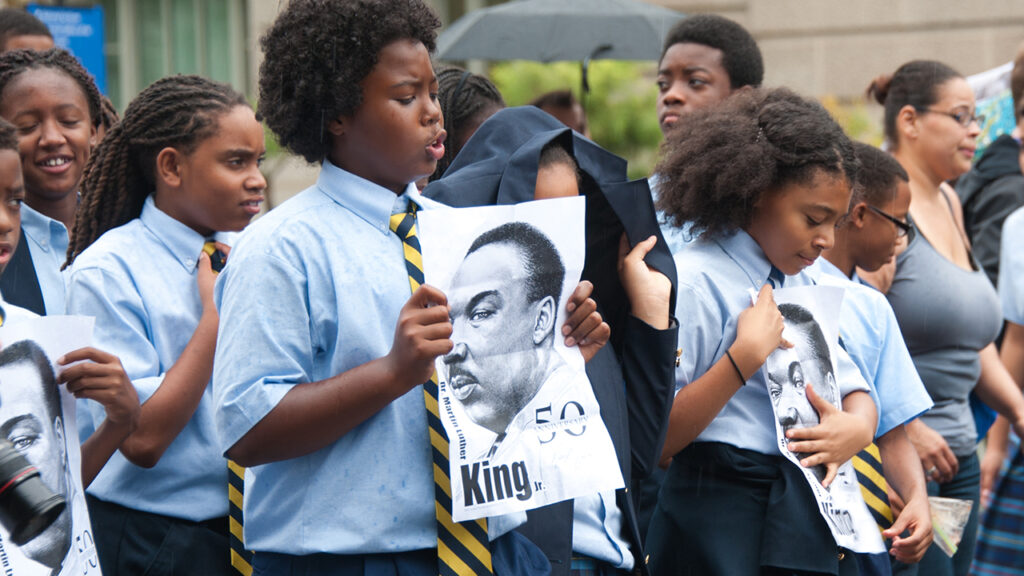
And yet, in knocking down the divine right of kings in favor of equality among even a limited group of men, the Founders set us up for future movements to challenge the limitation of rights. When the distance between divinely ordained kings and common men was closed — when George Washington had the same inalienable rights as King George — then any justification for denying women, people of color and the poor those rights was already failing. Because power was not held in a royal body but in everyday bodies.
The hardest work of justice was done not by the Founders but by those who took their words more seriously than they did. In the 250 years that followed, the Founders’ ideals were tested by movements of people even further from divine kings: the enslaved, women, people of color, LGBTQ+ people, the poor, non-Christians and others whose efforts to advance individual liberty would have dismayed most of the Founders.
The Founders rejected the divine rule of kings, not expecting that doing so would prompt an expanded view of human equality. Anabaptist and American movements for justice and freedom have often been more radical than the reformations and revolutions they emerged from.
Rebecca Barrett-Fox of Salina, Kan., teaches sociology and ethical decision-making to college students. She is the executive editor of Journal of Hate Studies and the author of God Hates: Westboro Baptist Church, American Nationalism and the Religious Right as well as many scholarly articles about religion, politics, hate and violence.


Have a comment on this story? Write to the editors. Include your full name, city and state. Selected comments will be edited for publication in print or online.