



“What can I make with this?”
This question comes from the cunning, the crafty and the desperate. It is a question we come back to over and over again. We have random ingredients and we need dinner; what can I make with this? Seeds and plants didn’t come up how we expected; what can I make with this? Life isn’t going as expected; what can I make with this?
It takes skill to look at things before they are organized and then make something amazing. It takes creativity. Making it work takes determination. Making it turn out right takes practice. Today is Thanksgiving, so this month I’m going to publicly wrestle with gratitude. I’m not sure I’ve ever gotten it quite right, but this year, I’m thinking it’s a skill. And I think it’s the skill of thrift.
Nowadays most of my gardening is for clients who are compromising garden space against landscaping. The garden beds are in tight spaces around homes. I am working with partial shade, strange soil temperatures and irregular watering. Sometimes things don’t come up, or they grow in ways that are unexpected or frustrating. I had a Swiss Chard plant grow sideways for a few inches before it remembered it should grow upward.
During my weekly check-in, I end up asking myself, “What can I make with this?” I have a vision, a plan — and nature has no obligation to comply. When things come in irregularly, I need to diagnose what went wrong. I have to make a plan in order to make something great happen. I use flexibility and creativity. I revise the plan and figure out how to make “what is” into something worth admiring. It is my job to see possibility and make that possibility real.
How can I add a companion plant, add some spinach, add some alyssum? Can I transplant something from where it’s too thick? Can I clone something that’s doing very well? “What can I make with this?” is a question that puts the mind in the position to see everything, even messes, as a resource waiting to become a solution.
For those who are poor, the skill of thrift takes what is and “makes it enough.” There is a skill, an art and a grace required to make ends meet. The thrifty mind can see what can be repurposed, repaired and reduced. The thrifty chef asks where we can change beef for lentils, chicken for lentils or pork for lentils. This is the miracle of a mother making a Christmas tree out of construction paper.
The skill of thrift can find enough, and the skill of thrift can make it happen. Faith and creativity stretch materials in a way that echoes Jesus stretching fish and bread. This manifestation of thrift exists. It is impressive. It is beautiful only in the way that it is inspiring to see someone transform a bad situation into a beautiful moment.
Thrift can be a survival skill, but thrift also exists as a virtue. For those who don’t have to face lack, thrift is not about stretching our means to survive. It is about saying we could make it work with less. It is about knowing when enough is enough and choosing to hold back. The virtue of thrift is about self-limitation.
Bigger. Better. More. It’s a lie is that enough is always out of reach. You can be happy after you have more. You can be happy after you throw a bigger party. It will be enough after something else.
The lie is complicated. It would be nice to be able to invite your loved ones to a meal and not be concerned about fitting them all in your house. It would be nice to buy all the ingredients to that very involved, hip new turkey recipe you’ve seen all over Facebook. Even if we want these things for good reasons, the lie is that what we have isn’t enough. The lie is false because it says that “enough” must show up in a specific way.
The temptation claims that what we want is a big home to fit more people. But that’s not exactly it. Maybe it’s the desire to host all of our friends and family comfortably. That’s almost it. The need at the bottom of it is connection and community. When we focus on that need and allow creativity and flexibility to shape how we meet it, we can see the different paths we can take to make it work. We can see different ways it can be enough. “Enough” isn’t a matter of external markers, but really an internal sense that we are surrounded by solutions.
Building the internal sense of what is enough and resting easy in it is powerful as its own practice of gratitude, but it also enriches other practices. When we find ways to “make it work” and “make it enough” for ourselves, it frees up resources and attention. When we make a practice of doing more with less, we start to realize that less was always enough. I think this is also a key distinction between being cheap or miserly and being thrifty. Thrift is about being prudent with how materials meet needs, and miserliness is about refusing to use materials even when they are needed.
Returning to the question, “What can I make with this?”, I’ve been talking about a skill and framework for making sense of what one can “make with this.” I think we enrich ourselves to reflect on that — and we enrich ourselves to sidestep that question. It’s powerful to see the goodness in the “this” before it gets made into anything. It’s powerful to see the ingredients and be grateful that there are ingredients at all. There is power in knowing that one will have to do work to make something amazing, and to be thankful for the ingredients and thankful for the work.
So this year, my conclusion is that thankfulness is like thrift. It is about cutting through the lies that enough or abundance must look a certain way. It is about creativity and determination and making enough to celebrate in whatever circumstance one finds themselves in. It is about focusing on the center of our needs in a way that frees us to best connect with our family and neighbors. It is about celebrating all things, even the work of making something hard into something new.
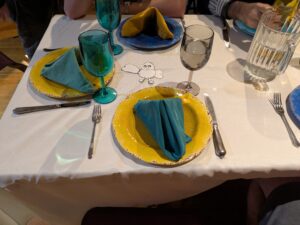
Thanksgiving opening: Gratitude in three parts
Before your Thanksgiving meal, respond to one or each of the prompts:
- What is something you are grateful for, as it is?
- What is something you are grateful to make into something new?
- What is something you are grateful to share with others?



Have a comment on this story? Write to the editors. Include your full name, city and state. Selected comments will be edited for publication in print or online.