


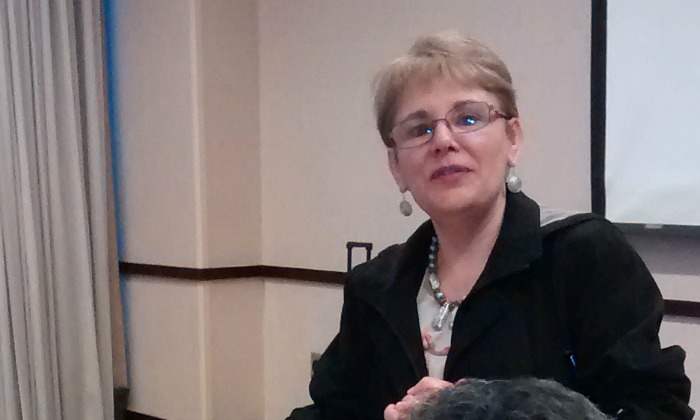
Photo: Moderator Elizabeth Soto Albrecht at the April meeting in Kansas City, Mo.
Mennonite Church USA’s Executive Board (EB) met April 6-8 in Kansas City, Mo., to prepare the agenda for this summer’s delegate assembly.
The EB processed four resolutions affirmed by the Constituency Leaders Council (CLC) members at their March 26–28 meeting in North Newton, Kan. The EB also produced a fifth resolution for the delegates that addresses the LGBT membership issue and church documents.
A significant process for the EB, this resolution will be finalized and released by May 1, said Ervin Stutzman, executive director for Mennonite Church USA, in an interview on April 8.
The first four resolutions affirmed include:
- A Resolution on Forbearance, sponsored by Chicago Community Mennonite Church, North Baltimore (Md.) Mennonite Church and Reba Place Church in Evanston, Ill., observes that there is no consensus within Mennonite Church USA about how LGBTQ persons are included in the life of the church, and states, “We call on all those in Mennonite Church USA to offer grace, love and forbearance toward conferences, congregations and pastors in our body who, in different ways, seek to be faithful to our Lord Jesus Christ on matters related to same-sex covenanted unions.”
- The Faithful Witness Amid Endless War Resolution calls for a recommitment to the way of peace and a rejection of mechanized (drone) warfare technologies.
- A Churchwide Statement on Sexual Abuse mourns the ways in which sexual violence has been present within Mennonite Church USA and offers several concrete commitments and steps to prevent future abuse.
- The Israel-Palestine Resolution offers support for continued Mennonite learning tours to the region as well as a commitment to the ongoing work for “just peace” in the region.
The fifth resolution produced by the EB seeks to clarify the relationship between the Mennonite Church USA Membership Guidelines; the newly released Mennonite polity manual, A Shared Understanding of Church Leadership; and the resolution of forbearance.
The board did not support the resolution unanimously, but passed it with a vote of 12 to two.
“The board’s resolution tries to speak to the board’s understanding of how we would go forward in light of the proposed resolution on forbearance [if it is affirmed by delegates] and the stated policies in our documents,” said Stutzman. “It tries to clarify our next steps and suggest a way to move forward together as a church.”
The resolutions will now go to the EB’s Executive Committee, which will present finalized versions no later than May 1.
Moderator Elizabeth Soto Albrecht praised the four constituent-developed resolutions as a “vitally important part of helping the church to shape its peace witness to the world.”
Soto Albrecht said that board members discussed elements to include in a “pastoral letter” to delegates to encourage them to begin the work of discernment prior to the delegate assembly.
“I want our church to focus on the signs of hope that are all around us,” said Soto Albrecht.
Updating the Purposeful Plan
Each biennium, the EB and staff update the Purposeful Plan to include new goals to help set the strategic direction for Mennonite Church USA for the next two years.
Stutzman presented the EB with a list of new goals for approval, which include planning for a large church planting summit, re-evaluating the scope and form of Mennonite Church USA conventions, and reviewing denomination-wide policies for sexual misconduct, among others.
The EB also counseled staff to include a new overarching priority within the Purposeful Plan that emphasizes a commitment to outreach, evangelism and church revitalization.
We want to focus on strengthening and growing, but also on formation and identity, said Soto Albrecht, in an interview on April 8.
The EB recognized that many congregations across Mennonite Church USA are struggling with their identity and with numbers and that many Mennonites are not comfortable with evangelism. The EB urged staff to give greater time and energy to these initiatives.
Discernment around fraternal relationships
The EB spent time in conversation about possibilities for new types of associations or fraternal relationships within Mennonite Church USA. The board did not specify any groups that would be eligible for such relationships but asked staff members to continue exploring possibilities when approached by area conferences or congregations about this topic.
“There is no specific proposal for what this would look like, but we want to value ongoing relationships over structure,” said Stutzman. “We want all parts of the church to be able to flourish, and we’re open to exploring ways to continue to collaborate, even if the structure of our relationship looks different than it has in the past.”
Other agenda
- Delegate survey: The EB received a preliminary report on the results of the ongoing delegate survey from sociologist Conrad Kanagy of Elizabethtown, Pa. While the report was helpful in their discernment, EB members noted that the survey is still in process. The results of the delegate survey will not be released publicly until after the survey closes on May 7. In the interview, Stutzman said that about half of the delegates are credentialed leaders and would have taken the credential leaders survey in August 2014, so there is some overlap in the results.
- Delegate table group leader training: The EB has hired several process consultants to lead an educational session for table group leaders at KC2015 prior to the first general delegate session. In addition, the board has allotted delegates more meeting time than at past conventions.
The next meeting of the EB will take place on June 30 at the Crowne Plaza Hotel in Kansas City, Mo.


Have a comment on this story? Write to the editors. Include your full name, city and state. Selected comments will be edited for publication in print or online.