


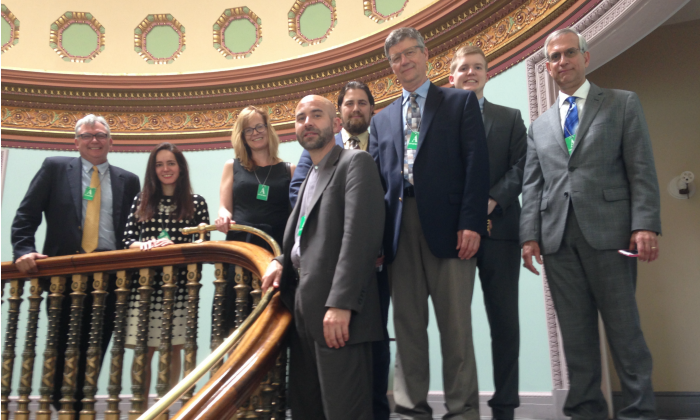
Photo: On July 14 , a delegation of church leaders visited the White House to express concerns about the federal government’s drone program. From left to right: Jay Wittmeyer, Church of the Brethren; Yasmine Taeb, Friends Committee on National Legislation: Catherine Gordon, Presbyterian Church, USA; Rev. Chris Antal, Unitarian Universalist Association; Ervin Stutzman, Mennonite Church USA; Robert McCaw, Council on American-Islamic Relations. Some members of the group did not wish to have their names or organizations published. Photo by Mennonite Central Committee.
On July 14, Ervin Stutzman, executive director of Mennonite Church USA, was among several faith leaders who visited the White House to express concerns over the lethal drones program that the federal government has run for 15 years. The program is thought by many human rights groups to have been responsible for hundreds, if not thousands, of civilian deaths and has shown few signs of abating.
Stutzman and others met with White House officials to question the program, express their dismay at the disregard for life, and ask for limits to be imposed upon it. While not all participants in the meeting were from peace churches, every denomination represented had numerous moral concerns.
Chief among these concerns was the way in which drones proliferate war, which was furthered by the Obama administration’s decision to begin selling armed drones to other countries last year.
During Mennonite Church USA’s 2015 convention in Kansas City, Mo., a resolution entitled “Faithful Witness Amid Endless War” was successfully passed. The resolution called for an end to drone warfare, and noted that “drone warfare is emblematic of our current state.” Due to the lack of oversight in the lethal drones program, “This continuous state of war is the new normal.” The resolution went on to note that “one consequence is that our nation no longer experiences times of national debate related to the morality of its participation in war.”
The White House says the drones program removes threats to U.S. security in the most limited way possible, but the reality is quite different. In addition to the numerous civilian casualties that they cause, lethal drone strikes do not provide an incentive for combatants to end war, but to continue it. These are among the many reasons that people are questioning the lethal drones program, and calling for an end or limit to it.
Concerns such as these rise to the fore in an election year, when voters have the power to decide who will take over one of the deadliest and least-understood programs in the U.S. government. While lethal drones have rarely been discussed during the current election cycle, they remain an important moral concern for Mennonites and others.
Without a demand for accountability from votes, this program is likely to continue to expand. Lethal drone strikes have been carried out extensively in Afghanistan, Pakistan, Somalia and Yemen. Without limits, the list of countries targeted could easily expand in the future.


Have a comment on this story? Write to the editors. Include your full name, city and state. Selected comments will be edited for publication in print or online.