


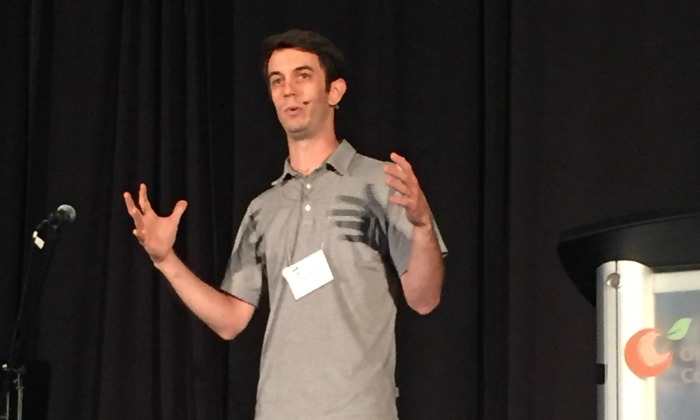
Photo: Nathan Grieser speaks during the Friday MennoTalk session. Photo by Jena O’Brien.
The last of three MennoTalk sessions Friday featured Kathy Neufeld Dunn, Nathan Grieser, David Lapp Jost, Sarah Thompson and Jon Carlson. Each spoke on the topic of global and local peacemaking.
Kathy Neufeld Dunn, associate conference minister for Western District Conference, shared with the audience how there are practical opportunities for peacemaking in everyday life.
Admitting that she had been in some volatile situations and has used her body as a shield between police officers and anarchists, between Israeli police and Palestinian youth and white supremacists, Dunn believes that these situations don’t happen accidentally. As a nonviolent interventionist, she said she tries to stop violence and bring peace into elevated situations wherever she goes.
“I don’t look like the person to run into danger, but that’s the point. We can each do more than we think we can in uncomfortable situations everyday,” she said.
Dunn explained how finding the peace in everyday conflict is not only easy to do, but can be a blessing.
“You can do it, too. Use what you got. Claim the space. Find peace within. Listen and affirm, intervene creatively and confidently. And bring peace into your everyday life,” she said.
Nathan Grieser, director of the Shalom Project based in Lancaster, Pennsylvania, explored the idea of vulnerable peacemaking and how we can use the lessons Jesus taught his disciples today.
“The disciples were sent out with this incredible gift of the good news and the power to heal, but they were also sent out with the reliance in the people that they encountered along the way,” Grieser said. “I believe going with the gift to offer, but also opening ourselves to receiving gifts from others is the way of vulnerable peacemaking.”
Grieser explained how this could be a safeguard against doing violence to others as we seek peace.
“Vulnerable peacemaking invites us to see people in all of their beauty and complexity rather than as projects that need to be fixed. So we offer who we are and we receive from the people who were sent as they are,” Grieser said.
David Lapp Jost, development associate for Mennonite Mission Network, told the story of Sadi Othman and Leymah Gbowee, two people who helped do conflict resolution in civil wars and were greatly influenced by their Mennonite connections.
While these two seamlessly devoted themselves to finding the peace in times where the odds were stacked against them, Lapp Jost admitted it may not be as easy for Americans to do the same.
“We can partner with people who do terrific work and peacebuilding and development and relief,” he said. “And we can learn from them and offer our friendship and encouragement and assistance.”
“It’s easy to be drawn in by our political binary and to choose this faction or this faction, take this side. The hard work is identifying people who are working for good in every context and help empower them and assistant them and befriend them, and that’s the work we’re called to,” he said.
Sarah Thompson, executive director of Christian Peacemaker Teams, explored the idea of “Engaging the Powers,” which comes from Walter Wink’s book of the same name. Thompson explained how the powers in the world are good, but the powers are fallen. The power can be redeemed whenever peace and justice making has occurred, she said.
“Being a peacemaker means getting comfortable engaging the powers, or if not comfortable at least willing to engage,” said Thompson.
Thompson shared with those in attendance a simple stance involving one hand in front of their chest and the other facing palm up. Thompson explained how this stance can be used whenever you see or informed about oppression, in stead of getting depressed about it, it’s a reminder to think about what you want to see be stopped and who do you have to engage to in order to see these changes.
“This stance is strong. It’s ‘this behavior needs to stop, I’m open to you as a human being.”
The stance introduced by Thompson showed options for what to do as a peacemaker and that with practice, we can get better at engaging the powers.
Jon Carlson, lead pastor at Forest Hills Mennonite Church, Leola, Pennsylvania, shared about his church’s experience taking in a refugee family who was joining their community.
“What began as a simple attempt to extend hospitality in Jesus’ name became a politically contentious project, but we persisted,” he said. “In the face of complexity and questions, even hostility, the most important thing we could offer was our steadfast friendship.”
“We are not bringing God to people, we are meeting God in people.”


Have a comment on this story? Write to the editors. Include your full name, city and state. Selected comments will be edited for publication in print or online.