


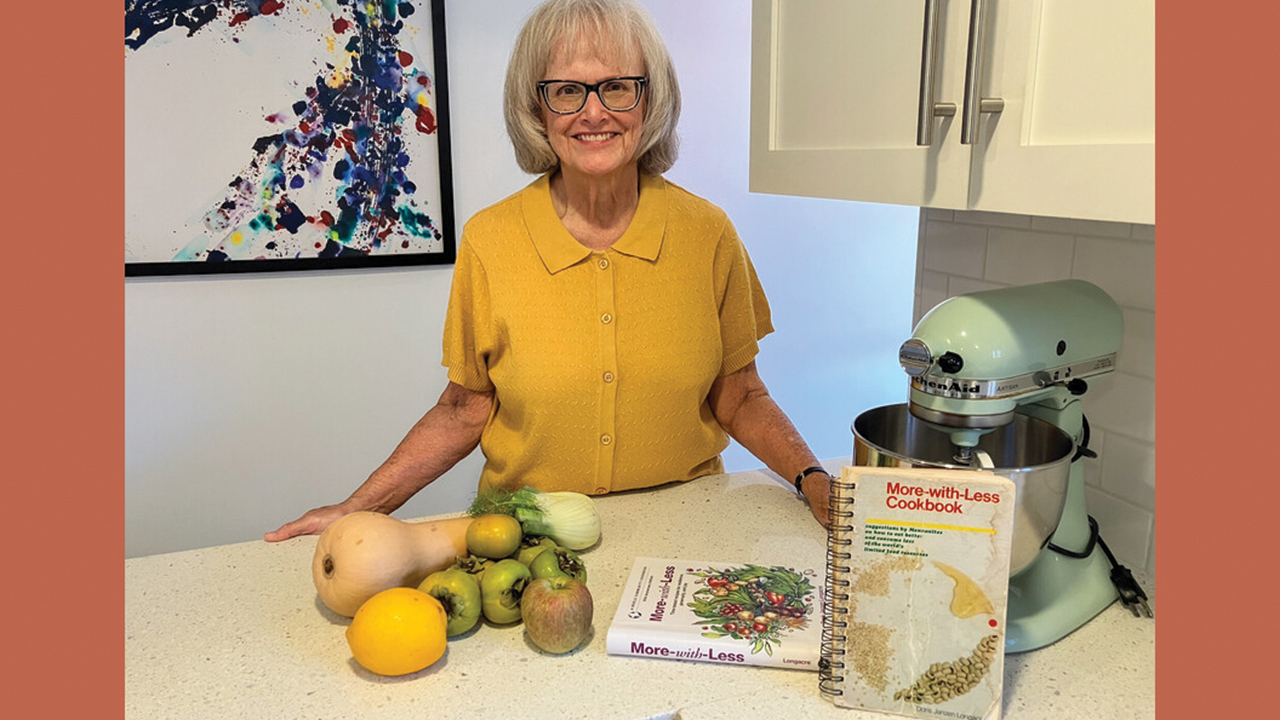
When Jan Harmon first heard about the cookbook that would become the beloved 1976 classic More-with-Less, it was a Sunday morning. The service at her Brethren in Christ church in Upland, Calif., had just ended, and her family was lingering on the patio.
The pastor’s wife rushed over. Mennonite Central Committee was putting together a cookbook, she said, and recipes were due right away. She knew their family liked to cook. Could they help?
That afternoon, Harmon, not long out of college, wrote out a honey-baked chicken recipe she liked. Her sisters and mother copied other recipes. At that evening’s service, they handed over submissions to be mailed to the MCC office in Akron, Pa.
The call for recipes and stories spread across church sanctuaries and fellowship halls, church publications and MCC newsletters.
Then, as author Doris Janzen Longacre wrote in the 1976 edition of More-with-Less: “Within weeks, letters from men and women, from students and grandparents, filled my box. Thousands of recipes arrived from around the world.”
Longacre was building far more than a collection of recipes. It was an invitation to explore not only a way of cooking meals with simple, whole foods and less meat but also what it could look like to live out Christian faith in the choices made daily in kitchens and at dinner tables.

More-with-Less crossed boundaries of denominations, cultures and countries. It became a mainstay in Anabaptist households, voluntary service units and the kitchens of MCC workers around the world.
When Harmon was in an MCC VS unit in Washington, D.C., from 1977 to 1979, cooking duties rotated among residents. The honey-baked chicken recipe — now printed with her name beneath it in More-with-Less — provided a connecting point with her East Coast Mennonite housemates.
Hundreds of miles away, in rural Brookings County, S.D., that honey-baked chicken would find a treasured place on the family table of Miriam Iverson. For her, as for so many others, the book became a connection to international dishes and tastes uncommon in her small rural community and to stewardship that resonated with her faith.
Harmon’s honey-baked chicken recipe became a favorite that the Iversons’ now-grown son Nathan Iverson and his sisters would cook and eat long into adulthood.
Earlier this year, Nathan Iverson, now living in Riverside, Calif., was having a meal at the home of friends from his Brethren in Christ congregation, Crest Community Church, when he spotted their copy of More-with-Less.
“And I said, ‘Oh, I had this cookbook growing up, too,’ ” he remembers.
He told them what a favorite the honey-baked chicken is — and discovered they know Harmon, who lives in Los Angeles. He marvels: The person behind the recipe his family made on a farm 1,200 miles away is close enough to maybe meet one day.
For Harmon, this is just part of the DNA of More-with-Less — a far-reaching spiral of unexpected connections.
Her mother, after a visit to Brethren in Christ mission sites in Zambia, told Harmon, “You can’t believe how many times we were served honey-baked chicken when we’d go into people’s homes.” Each host was surprised to hear that it was her daughter’s recipe.
Harmon has seen the book and its message planting seeds that would grow through the years — from eating patterns rooted in local food and global flavors to hearts open to the breadth of communities across the globe and here at home.
“It just opened up the world in many ways that we hadn’t thought of before,” she said.
Marla Pierson Lester is co-director of communications and marketing for MCC U.S.


Have a comment on this story? Write to the editors. Include your full name, city and state. Selected comments will be edited for publication in print or online.