


Editor’s note: This article has been updated to include lyrics from “My Soul Cries Out” by Rory Cooney. Used with permission.
In times of turmoil, when the weight of suffering and uncertainty feels unbearable, we often find ourselves asking: How can we hold on? How can we remain faithful in the face of overwhelming forces that seem to thrive on division and oppression? I (Josh) don’t believe the answer lies in grand gestures, but in the persistent voices of those who have walked this difficult path before us. These voices remind us, despite appearances, that God is at work in the world.
1. Mary: Hold fast
“From the halls of power to the fortress tower, not a stone will be left on stone. Let the king beware for your justice tears every tyrant from his throne. The hungry poor shall weep no more for the food they can never earn; there are tables spread, every mouth be fed, for the world is about to turn.
“Though the nations rage from age to age, we remember who holds us fast: God’s mercy must deliver us from the conqueror’s crushing grasp. This saving word that our forebears heard is the promise which holds us bound, ‘till the spear and rod can be crushed by God, who is turning the world around.”
— Rory Cooney, “My Soul Cries Out” (adaptation of the Magnificat); music and lyrics copyright 1990 GIA Publications, Inc, Chicago, IL. All rights reserved.
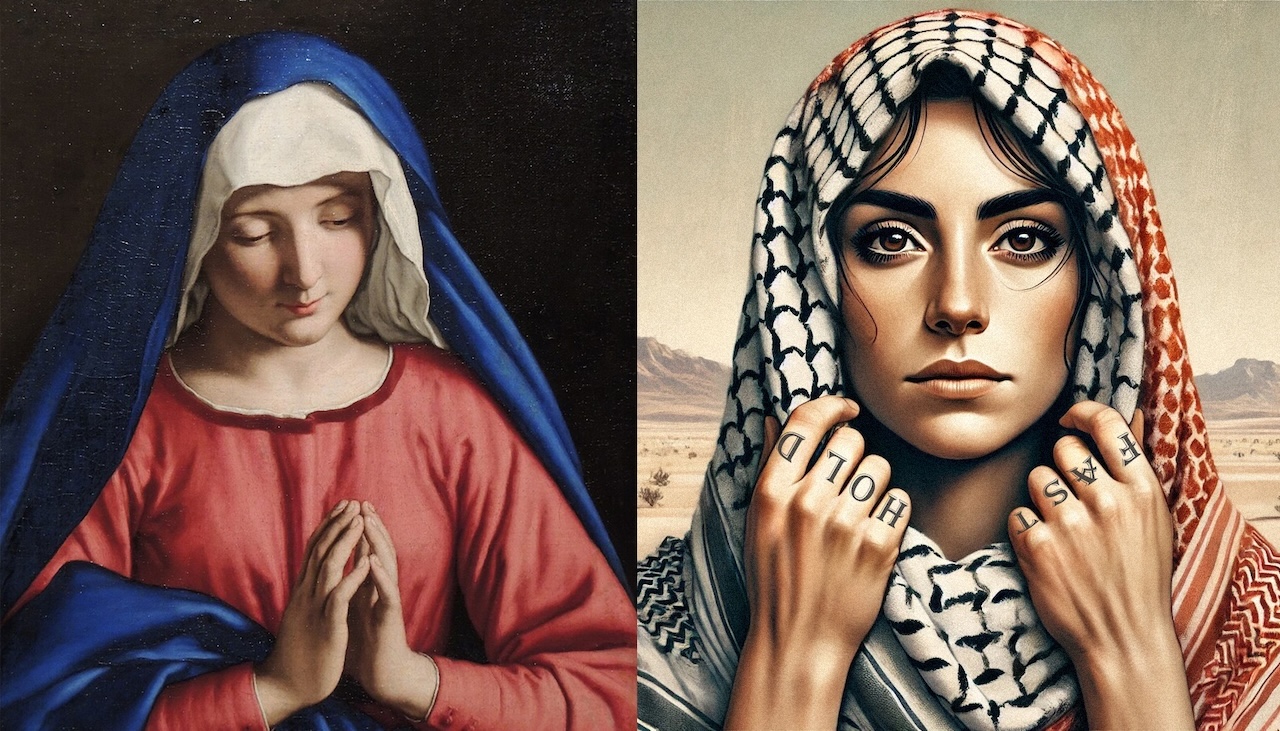
Jesus was to be born into an occupied land under an empire that was ruled by a vindictive and harsh tyrant. His unflinching mother defiantly looks this harsh reality squarely in the eyes and declares a future where God’s goodness overwhelms the evil of empire. Mary’s song of resistance encourages us to hold fast, for the world is about to turn.
2. Julian of Norwich: All shall be well
All shall be well, and all manner of things shall be well.
— Julian of Norwich, Revelations of Divine Love
Julian of Norwich, an English mystic and theologian, lived in a sick world marked by plague, uncertainty and fear. In medieval Europe, the Bubonic Plague (also known as the “Black Death”), killed one in every two or three people — a mortality rate so great that some historians believe it caused the whole of society to devalue human life, with increased violence, warfare, crime and persecution filling the public sphere.
Despite experiencing the deaths of those close to her (and nearly losing her own life), Julian of Norwich received visions that always returned her to God’s love, describing it as “so tender that He may never desert us.”
Julian of Norwich’s groundedness amid distressing times may serve as an encouragement: “[God] said not, ‘thou shalt not be tempested, thou shalt not be travailed, thou shalt not be dis-eased;’ but He said ‘thou shalt not be overcome.’”
3. Dorothee Sölle: Fight the good fight
To be content with the world as it is[,] is to be dead.
— Dorothee Sölle, The Truth Is Concrete
It’s unnerving when the world is fraught with problems, and most of society seems to carry on as though nothing is happening. I sometimes ask myself, “Does everyone else know something I don’t?”
Dorothee Sölle, a German theologian and writer, would say those of us who hear creation groaning and are engaged in the work of liberation and social justice are doing exactly what we’re supposed to. She coined the term Christofascism to describe a distorted form of Christianity that aligns with authoritarian power, suppresses dissent, and uses religious language to justify violence, injustice and the marginalization of others.
Let Sölle’s words encourage you to reject spiritual death and embody the true message of the gospel – one of solidarity, compassion and transformative action.
4. Dorothy Day: Be steadfast
A pebble cast into a pond causes ripples that spread in all directions.
Each one of our thoughts, words, and deeds is like that.
— Dorothy Day
Even small steps taken in love and justice have lasting significance. Dorothy Day, a social activist, journalist and co-founder of the Catholic Worker Movement, was no stranger to the significance of small gains. Her efforts to help foster larger social transformation were characterized by small, consistent acts of service, love, and justice – feeding the hungry, providing shelter for the unhoused, advocating for peace and standing in solidarity with the marginalized.
She didn’t view these as isolated or insignificant tasks. Rather, she believed that each act, no matter how small, was a part of a larger, redemptive process. Be encouraged, knowing that every pebble you cast counts in making a difference, especially when the challenges seem insurmountable.
5. 1 Corinthians 1:26-29: Upside-down kingdom
Consider your own call, brothers and sisters: not many of you were wise by human standards,
not many were powerful, not many were of noble birth. But God chose what is foolish
in the world to shame the wise; God chose what is weak in the world to shame the
strong; God chose what is low and despised in the world, things that are not, to reduce to
nothing things that are, so that no one might boast in the presence of God.
— 1 Corinthians 1:26-29, NRSV (emphasis mine)
Unlike a capitalist, consumer-driven society, God’s kingdom is not built by the strong or influential, and certainly not on the backs of the poor. It is built by those whom society (and presidents) says are losers, who make plowshares from their swords and cultivate the earth so that God’s abundance can be known by all. In all your imperfections, be encouraged that your willingness to love like Jesus makes you exactly whom God is looking for.


Have a comment on this story? Write to the editors. Include your full name, city and state. Selected comments will be edited for publication in print or online.