


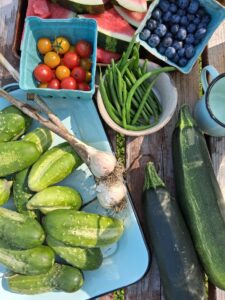
Midsummer harvest has begun. Gathering from gardens filled our ‘give and glean table’ at Wild Church with fresh fruits and veggies. Homegrown grains were also on the table in the form of winter rye berry salad (your recipe for today), eggs (you’ll learn shortly why I’m naming these as a grain) and a loaf of bread was our “talking stick” passed around the circle at sharing time.
Early August marks the halfway point between the summer solstice and autumnal equinox, true midsummer. I learned from seminary classmates this is celebrated as a cross-quarter holiday on the Celtic calendar (Lughnasadh) which corresponds to the Anglo-Saxon Christian harvest festival of Lammas (translating as loaf mass) where the first wheat harvest loaf is baked and blessed.
At our last Wild Church gathering, someone baked and brought my “Bye-Bye Banana bread” recipe published in June using wheat she ground herself. I have a new recipe for you today using grains, a summer salad made from rye berries I grew.
I like to experiment in the garden, and so I left the winter rye cover crop, which I’d planted last season, to mature on the empty rows vacated by the peas, potatoes and garlic. Amber waves of grain have delighted us as the golden heads have plumped to the point of picking.
The August scene of scything our little patch looked antithetical to a Grim Reaper tale. Rather than death, it was full of life and fed my soul. It reminded me of Biblical passages pertaining to hospitality, generosity and justice. Israelites were commanded not to harvest to the edges of their field and to leave fallen grain (or olives or grapes) for the poor and foreigners: When you reap the harvest of your land, moreover, you shall not reap to the very edges of your field nor gather the gleaning of your harvest; you are to leave them for the needy and the stranger. I am the Lord your God (Leviticus 23:22, New American Standard Bible).
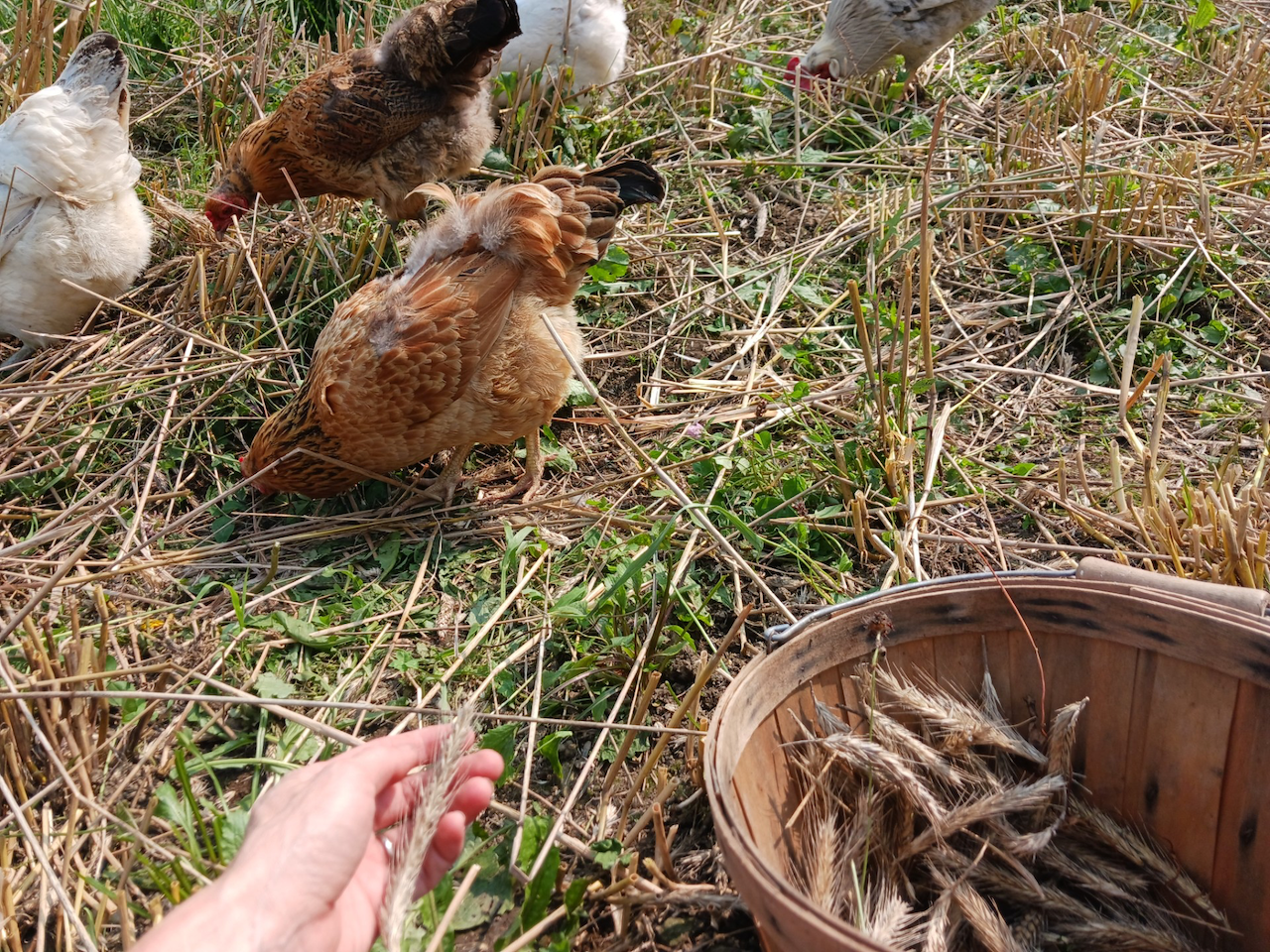
As I reaped, I was given the opportunity to practice faithful living. As I began to gather the cut grain, some of the chickens took advantage of the open garden gate and joined the harvest. I was tempted to pick every fallen stalk and shoo the birds away. Initial feelings of “this is mine” came and eventually gave way to the bigger truth that “this is God’s garden.”

That reality flipped me from being in a position of someone like Boaz to feeling like Ruth, a humble recipient of God’s kindness and provision. Receiving that truth and trusting that there would be enough for everyone is the mindset of abundance alive in God’s kin-dom, rather than the scarcity worldview our society tends to hold. I could also see interconnection that made my initial selfishness feel silly. Sharing my grain harvest with the chickens meant I would need to buy less for them at the feed store.
This also echoes the “Honorable Harvest” shared by Robin Wall Kimmerer, author of Braiding Sweetgrass, a set of unwritten guidelines in the Indigenous community she is a part of that govern ethical harvesting. One of those guiding principles is Take only what you need and leave some for others. Not only does this sound like the Levitical law, but also like Jesus’ teaching us how to pray, “give us this day our daily bread” and God’s strict command to the Israelites (in Exodus) to gather only the manna they needed for a single day. Dependence and trust, rather than greed and hoarding, are the rules of life that will give life to all.
I do not regret the generosity of shared grain harvest. The chickens were happy. That made me happy. I imagine God was happy too. The grain God gave from the garden, which I gathered, and the chickens gleaned, went into gorgeous eggs which were shared at Wild Church, making many others happy.
Blessed are those who find great delight in God’s commands. Praise God!
For more on whole grain benefits and cooking, here are some resources to explore:
https://wholegrainscouncil.org/
https://nutritionsource.hsph.harvard.edu/what-should-you-eat/whole-grains/
RECIPE:
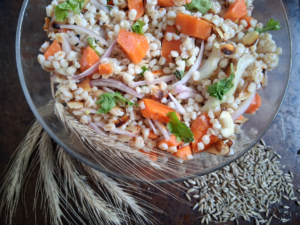
Rye berry salad
Whole grains are great! Nutty flavored and nutritious, whole grains are seeds of grass that are intact, containing three parts: fiber-rich bran, nutrient-dense germ and starchy endosperm.
Ingredients
- 1 cup dried rye berries (or some other whole grain, such as wheat berries, oat groats or hulled barley)
- 2 bay leaves, divided
- 2 cups chopped carrot, about ½-inch size
- ½ cup slivered or sliced almonds
- ¼ cup extra virgin olive oil
- 4 teaspoons lemon juice or wine vinegar
- 1 teaspoon Dijon mustard
- 1 clove garlic
- ½ cup thinly sliced celery
- ½ cup thinly sliced red onion or shallot
- ¼ cup chopped cilantro
- Salt and pepper to taste
Instructions
- Cook the grain. In a medium pot, add grain, 1 bay leaf and ½ teaspoon salt. Add water until the grain is covered by about 2-inches of water over top. Bring to a boil, then reduce to a simmer and cook for about one hour, until tender. Drain and rinse under cool water, and then allow the grain to rest in the strainer to continue to drain while preparing other parts of the recipe. Be sure to remove the bay leaf.
- Cook the vegetables. In a small pot, add remaining bay leaf, carrots, ½ teaspoon salt and cover the carrots with at least 1-inch of water. Bring to a boil, then reduce to a simmer until tender, about 10 minutes. Drain and remove the bay leaf. Set aside.
- Toast the nuts. In a skillet over medium heat, toast the almonds, stirring constantly until they begin to brown.
- Make the dressing. In a large mixing bowl, whisk together olive oil, lemon juice, mustard and garlic.
- Create the salad. Add the cooked grain, carrots, almonds plus raw celery, onion and cilantro to the large dressing bowl. Stir gently until everything is evenly coated. Taste. Season with salt and pepper if desired.
- Enjoy! Store in the refrigerator and eat within five days.



Have a comment on this story? Write to the editors. Include your full name, city and state. Selected comments will be edited for publication in print or online.