


I make very heavy sourdough. It’s a workout for your jaw to chew through it. See, I am impatient in my kneading, and I add too much flour as a quick thickener, rather than waiting for the microbes to get the job done.
Good sourdough takes all the senses – how does it feel to your fingers? Does the starter smell hungry; does the dough smell ready? Does the starter look bubbly and ready for the next step? You can even knock on the loaf to listen to how it has baked. And of course, taste can happen at every step of the process.
And like so much of baking and cooking, sourdough is as much about timing as it is about ingredients. If you make kefir, kombucha, sauerkraut or other ferments, there’s the time of waiting for the microbes to do their thing. That’s time we bakers and cooks get to rest (or clean the kitchen). It’s counter-cultural for those of us who inherited a protestant work ethic to rest, but we might get on board with extra time to clean.
Yet the humility of rest and knowing that someone else is still at work is the heart of sabbath. Which means it’s simply essential to our faith. “Remember the Sabbath day and keep it holy. Six days you shall labor and do all your work. But the seventh day is a Sabbath to the Lord your God; you shall not do any work—you, your son or your daughter, your male or female slave, your livestock, or the alien resident in your towns. For in six days the Lord made heaven and earth, the sea, and all that is in them, but rested the seventh day; therefore the Lord blessed the Sabbath day and consecrated it. (Exodus 20:8-11)
Sabbath might seem like the easiest commandment to keep – who wouldn’t want a rest?! But I believe it’s in the top three of commandments we break in the West. It takes a lot of trust to rest. Trusting God to keep the planet spinning, gravity constant, our hearts beating and lungs moving and kidneys filtering…. Trusting that we are worthy, and that we are beloved whether we’re busy or not. Trusting that our colleagues and loved ones won’t resent us if we take a day off email every week. Trusting that even if they do resent us, we’ll be able to reconcile. Trusting that they might be ready to claim Sabbath sooner or later, too.
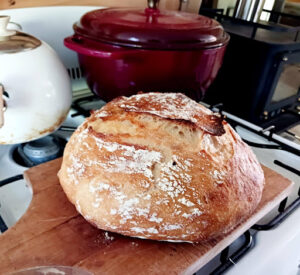
One of the best sourdough bakers I know is Erica. She made the bread pictured here. She gets paid for it and she also gladly gives it away! We got to share our 7 acres with Erica and her family for one blissful year. They lived in a schoolbus and worked in the gardens and petted the cats and lit up our lives. We wish they had built a house here and stayed forever! Instead they moved closer to their parents and built a beautiful little house where Erica still makes sourdough.I would rather Erica’s family just came back. But instead I try to trust that God will open the doors and windows so some other people can find their way here. That God will open our minds and hearts so we can welcome at the right time, in the right ways.

It helps to read this stunning poem-prayer when I need grounding in trust, written by a French Jesuit Catholic priest, scientist, paleontologist, philosopher, mystic, and teacher about 100 years ago:
Patient Trust
by Pierre Teilhard de Chardin, SJ
Above all, trust in the slow work of God.
We are quite naturally impatient in everything
to reach the end without delay.
We should like to skip the intermediate stages.
We are impatient of being on the way to something
unknown, something new.
And yet it is the law of all progress
that it is made by passing through
some stages of instability—
and that it may take a very long time.
And so I think it is with you;
your ideas mature gradually—let them grow,
let them shape themselves, without undue haste.
Don’t try to force them on,
as though you could be today what time
(that is to say, grace and circumstances
acting on your own good will)
will make of you tomorrow.
Only God could say what this new spirit
gradually forming within you will be.
Give Our Lord the benefit of believing
that his hand is leading you,
and accept the anxiety of feeling yourself
in suspense and incomplete.
And when I miss Erica’s family, I can also find communion in warm sourdough with a slather of butter. I have some sensory sensitivities, and sticky dough on my hands can stress me out. So I trust the labor of the stand mixer I inherited from my uncle Andy–I had to let go of the ego of wanting to be all sensual in the kitchen, but now I enjoy making sourdough! How sensuous is that?!
Today I’m only going to explain how to start a sourdough starter. Because sourdough is slow work, let’s not rush it. First we just mix flour and water and wait for the yeasts and bacteria in our own kitchens to move in! I believe God designed this process and possibility!
It might take 7-10 days to be ready to make bread. And if something goes wrong (if it turns orange or stinky), compost your starter and start over!
Flour: It helps to start with rye and/or whole wheat flour (not white, or not only white) because these have more nutrients, which will give the microbes more to eat. After your starter is alive and active, you can make bread with all-purpose or unbleached white, and feed your starter with all-purpose or unbleached white. I suggest keeping at least some whole wheat, spelt and/or rye in the mix for your own nutrition. Also–you can use white flour if you prefer that!
Water: Chlorinated water inhibits the microbial activity. If your water is chlorinated, you can draw a glass of it and leave it out overnight, and at least some chlorine will evaporate. You can also stir the water to get the chlorine out more quickly. But if your water comes with chloramine, it won’t simply evaporate. You can read more about dealing with that online, like a Reddit thread this one. You would probably be able to tell if you’re dealing with either of these by the smell and taste of your water. You can also buy distilled water, or use a reverse-osmosis filter. Or just see what happens with your tap water.
Temperature: If room temperature in your house is under 70 degrees, your starter will activate more slowly. That’s okay! You could also keep it somewhere warm, like on top of your fridge, or inside/atop an oven with a pilot light.
Starting sourdough:
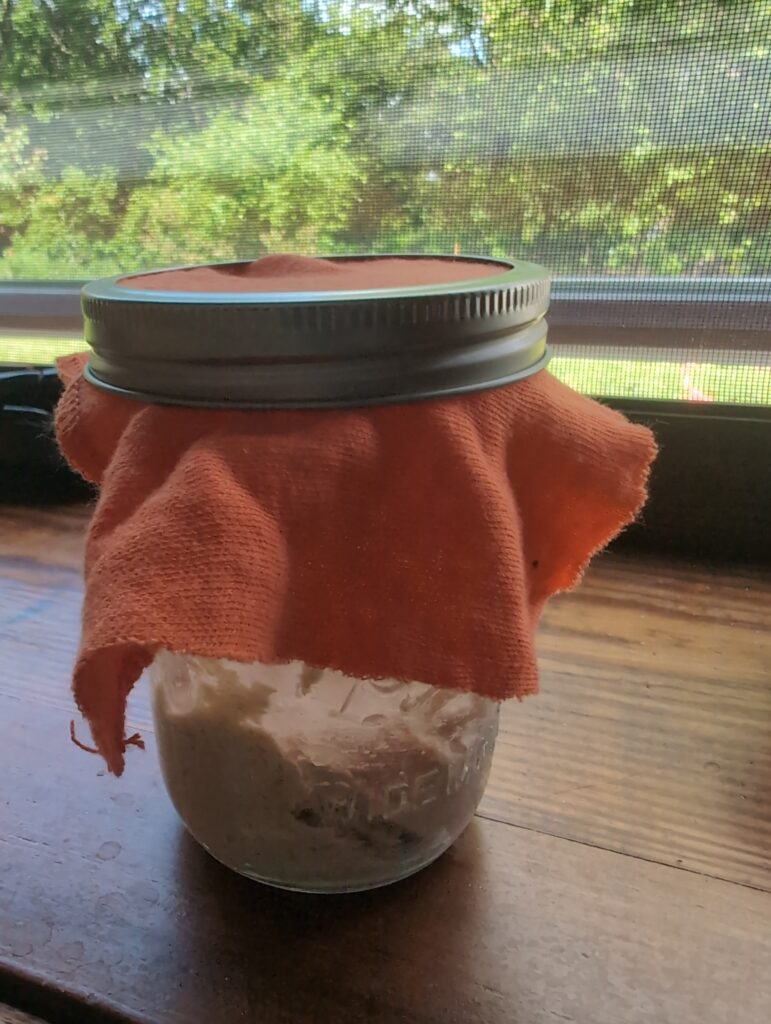
Day 1: Mix 50g* flour (whole wheat/rye) with 50g water in a clean jar. Cover loosely with fabric or paper towel, and leave at room temperature for 24 hours.
Day 2: Discard** most of the mixture, keeping about 25g. Feed with 25g water and 25g flour. Stir well and leave for 24 hours.
Day 3: Repeat Day 2.
Days 4–7: Continue daily discards and feedings using a 1:1:1 ratio*** (e.g., 30g starter, 30g water, 30g flour). If the starter doubles in size, increase feeding frequency to every 12 hours and switch to all-purpose flour. How do you know if it’s doubling in size? You can mark the height immediately after feeding with a rubber band.
Readiness: The starter is ready when it smells pleasantly sour and lively, doubling in size within 4–8 hours of feeding. It will be bubbly, and you can try the float test (a spoonful floats in water because it’s full of the gases of living creatures feasting on it).
On August 6, I’ll post what to do next! Of course there are tons of instructions on sourdough all over the internet and in books. You don’t need to wait on me. But this is a meditation on waiting, so I invite you to slow down!
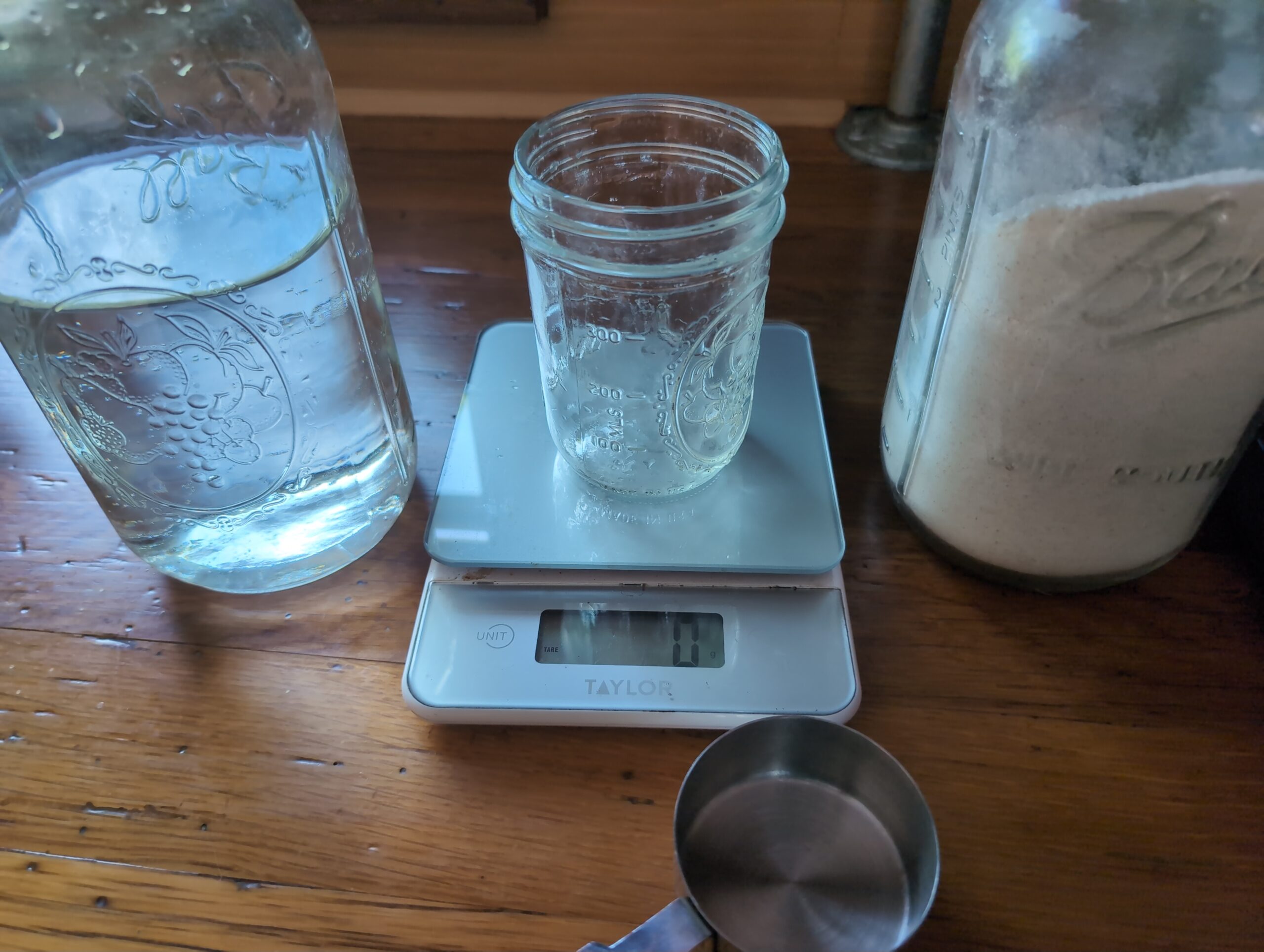
*If you don’t have a kitchen scale, you can keep in mind that you’ll use about twice the volume of flour to water. That’s to say, ½ cup of flour weighs about the same as ¼ cup of water. If you get into making sourdough, you’ll learn the ratios feel and look and may quit measuring altogether.
**It’s excruciating for me to discard good food. There are infinite recipes for using up the discard (aka, unfed starter) but if you try to keep up with this kind of baking you may end up with more carbs and calories than your household really wants. You can also compost it, which feeds soil, worms and bugs!
***This ratio is “100% hydration” and shows up a lot in sourdough baking.


Have a comment on this story? Write to the editors. Include your full name, city and state. Selected comments will be edited for publication in print or online.