


Disagreement is inevitable: you just need two people and time. So the question is not whether you’ll find yourself in a disagreement, but how will you respond.
Our family is preparing to launch into Glasgow, Scotland – a complicated city that’s no stranger to sectarian violence, disequity and religious polarization. It’s a place and culture shaped by disagreement and, if our cross-cultural experiences have taught us anything, it’s that how we hold our differences will determine how well we can live into our roles as Community Catalysts.
We can only imagine what more we’ll learn in the years to come, but in the meantime, here are five guiding ideas we’ve identified when it comes to building bridges and loving people with whom we disagree.
1. Jesus lives in the conflict
When I first heard “Together” by Nathan Grieser (Voices Together, 389), it really struck a chord. These lines were especially resonant: “Difference is a place where God is found. In seeking peace, we’re walking onto holy ground” (excerpt used with permission).
In the Gospels, wherever you find conflict and disagreement, you find Jesus. Or maybe wherever you find Jesus, you find conflict and disagreement. However you choose to look at it, I don’t believe that’s a coincidence. Yes, we are called to be instruments of peace. However, in Luke 12:49-53, Jesus also says that the path he invites us to will inevitably lead to difference and division.
It’s into these difficult spaces that we’re called to be peacebuilders – an act that requires us to humanize the “other” and learning to see them as God sees them. And, as Jesus demonstrates, being willing to sit at the table with all sorts of people is an important first step.
2. It’s about relationships
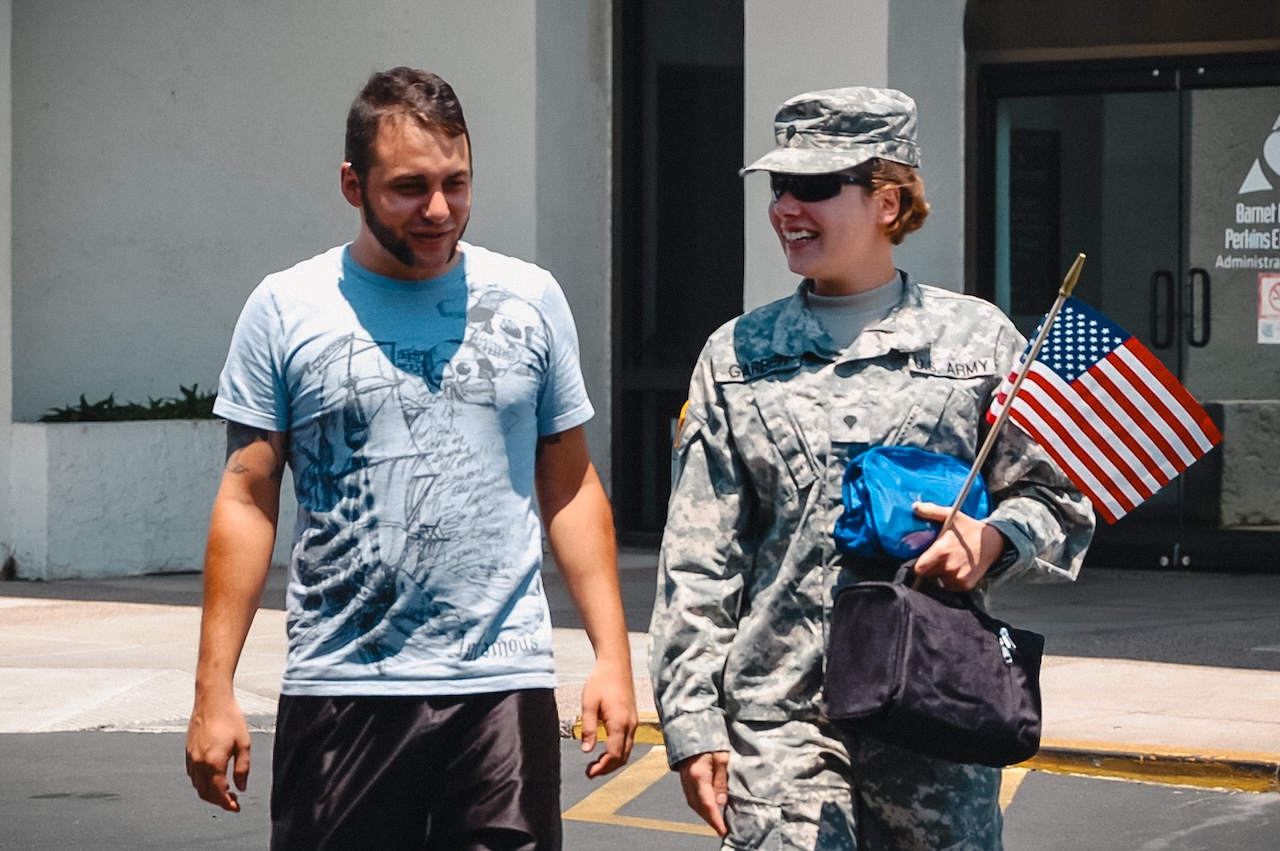
Disagreement might snag you a spouse – or at the very least, open the door to amazing, unexpected relationships. When Alisha and I met, we fell for each other fast and hard. After about three weeks of dating, I asked if she wanted to catch a movie over the weekend. It went like this:
Alisha: “Can’t, I have drill.”
Josh: “Makita or Black & Decker?”
Alisha: “No, I’m in the Army National Guard, and we have training this weekend.”
Josh: “Oh … I’m definitely a pacifist.”
We were already in love, so what to do? We had a choice: resign ourselves as incompatible, or push deeper into our understanding of one another and find our commonalities. We chose the latter and realized that even though we’re very different, we share a lot more.
Focusing first on relationships rather than differences has allowed me to connect with all kinds of folks, from making friends with Alisha’s military colleagues to playing in bands with folks who won’t set foot in a church. As a result, I have a more compassionate, empathetic understanding of such people, and they know a Christian who challenges stereotypes.
3. The power of diversity and inclusion
When we started our cross-cultural ministry at LCC International University (LCC) – a Christian university in Lithuania – in 2012, I quickly recognized that my Anabaptist theology set me apart from a majority of the students, staff and faculty. It was clear that if I were to only work with the people who shared all my values and convictions, then I would find myself alone and ineffective.
At the time, LCC boasted students from 30+ countries from faith backgrounds ranging from Catholic to Protestant to Orthodox (plus several students disinterested in church and a few Muslims). To make that kind of community function, we needed to work together and push through the temptation of tribalism.
The power found in bridge-building, collaboration and inclusion cannot be understated. Examples included watching the community stand up for one another during Russia’s first invasion of Ukraine (Crimea) and helping develop a spiritual culture framed by curiosity rather than conformity.
4. The other person was me
I think back to the person that I was in high school. That guy was pretty great and a good person, and yet now I find myself on the other end in terms of values:
- He was the person who believed God condemns a person based on their sexuality or gender
- He was the person who thought there should be more Bible taught in U.S. public schools
- He was the person who thought being a Christian was only about saving souls
I’m really glad I’m not that person anymore, and I thank God for the journey I’ve been on. It’s been filled with so many people who’ve shown me patience as Jesus molds me, encouraging me to grow often through places of disagreement and difference.
Now, when I sit in a place of conflict, I think about young Josh. I hope I can be the kind of person he needed in his life for someone else.
5. You need to take the first step
Anabaptists in the U.S. carry both a grounded peace theology and a reputation for avoiding interpersonal conflict. We can talk about making peace, but if nobody takes the first step, then little actually happens.
Over the past several months, our life group has been working through Mennonite Central Committee’s Peaceful Practices curriculum, which focuses on how to embody healthy dialogue in our individual, day-to-day interactions. Each lesson is a reminder of how each of us has a voice that can play a role in God’s healing work.
If you’re not sure where to start, consider just listening. The curriculum offers a helpful reminder:
[…] it is important to recognize and remember that listening does not mean agreement. We can actively listen to someone and still respond with our own opinions, understandings and beliefs. Listening does not mean we approve of or agree with what is being said – it does not inherently affirm the positions and opinions of another. The act of listening does, however, speak to our character.
(Peaceful Practices curriculum, page 47, used with permission of MCC.)



Have a comment on this story? Write to the editors. Include your full name, city and state. Selected comments will be edited for publication in print or online.