


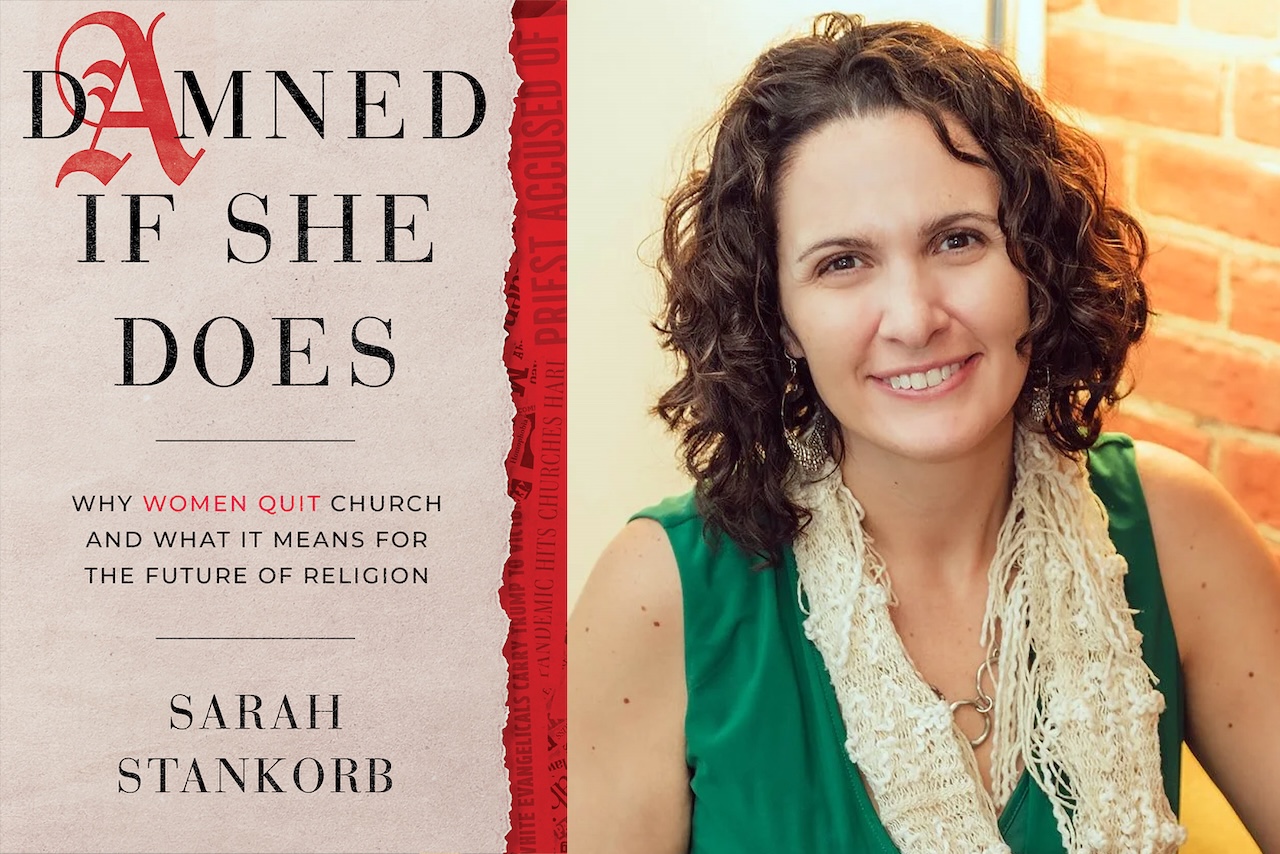
Before she was an agnostic and a religion reporter known for her sharp analysis of abuse in churches, Sarah Stankorb was a faithful United Methodist who believed she was called to Christian ministry.
“My green, leather-bound Bible lived on my nightstand and traveled with me to church each week and to youth group meetings and retreats,” she writes in her latest book, Damned If She Does: Why Women Quit Church and What It Means for the Future of Religion.
In her teens, she was taught a literalist understanding of the Bible in an evangelical Bible study — and in college, when she was exposed to different, non-literal interpretations of the Bible, her faith shattered.
“It hurt as if someone had died,” she writes. “A part of myself surely did.”
Several years later, in 2014, a landmark religious landscape study from Pew Research Center reported that religious disaffiliation was growing among men and women at about the same rate. Stankorb told RNS she knew two things: She wasn’t alone in her departure from religion, and readers needed more context.
“I knew that women are almost always more religious than men,” the Wyoming, Ohio-based author told RNS. “We tend to inherit religion from our mothers, and when women start to leave in numbers similar to men, you’re usually on your way to secularization.”
No one took up her book proposal on the topic in 2014. But 12 years later, Stankorb said now is the perfect time for this book. Damned If She Does, published by Broadleaf Books on Sept. 15, explores why today, women are leaving the church at higher rates than men and where they’ve landed since.
RNS spoke with Stankorb about what’s behind this spiritual shift, what Christian nationalism has to do with it and what women have found outside the church. The interview has been edited for length and clarity.
What does the data tell us about how women’s relationship to religion is shifting in the United States today?
At this point, the gender gap is pretty much gone for millennials, and for Gen Z, it has flipped. So you have more women leaving than men, which is a huge deal. And it’s not just the millennials and the Gen Zers — the rate of leaving has continued to increase, not at the same level, but with boomers and on back. It’s a multigenerational story.
At the conservative organization Turning Point USA’s Women’s Summit in June, speakers repeatedly pointed to feminism as reason for women’s exit from religion. Do you agree?
Some of the old sociological theories argue that as women’s lives start to resemble those of men’s, if their faith community does not resemble that same equality, there’s going to be cognitive dissonance. I don’t know that I’d say feminism is at fault. Personally, I would look at it and say, if women are experiencing more equality in other parts of their lives and the church is not keeping up, I think the blame could go the other way. That distance has not been good for keeping many women engaged and interested in being inside an organizational structure where they may not be given the opportunity to preach or where they may be asked for endless free labor that is not recognized for the value that it is.
In your book, you point to several overlapping reasons why women have left the church. If you had to summarize why women are leaving, what would you say?
That is a hard question because it really is a list. I mean, for some women, it’s homophobia. For some, sexism is to blame. Misogyny is to blame, racism, abuse. Due to the internet and our access to information, when they confront a prejudice or an abuse that’s happening in their church, they no longer have the ability to think it’s just in their church. So many stories of abuse have been well-documented. There’s a pattern here, and it’s systemic.
Also, the version of faith that has so successfully branded itself as American Christianity is very authoritarian. There’s one right way of doing things. When the face of Christianity is aligned with abuse, with Christian nationalism and a thirst for power, then that does become a big problem.
You write that Christian nationalism has injured our collective understanding of truth. Can you say more about how that injury occurred and what the implications are?
Christian nationalism teaches that there is just one kind of truth, and any other form of truth is dangerous. It says you have to follow certain leaders. And when you look at political leaders with whom they are aligned, you see one in particular who is very fond of telling lies, or you see cover-ups of abuse. You see people who claim to have a hold on truth operating in falsehood, and that makes it untenable to be part of.
If this form of Christian nationalism really were to grasp power in the way that it seeks, people with a multiplicity of views — Christians, non-Christians — all of us would see many of our rights taken away. For many of the people I interviewed, and I’d say for me too, a form of reality that allows for the abuse of other human beings based on gender, race, sexual orientation, where they were born in the world, if that is a reflection of God, no thanks. I cannot accept that if we live in a universe with a good God, that’s it. That’s not it.
In your book, many of the reasons women cite for leaving religion, including the embrace of Christian nationalism and conservative beliefs about women and LGBTQ people, are often tied to the conservative end of the Christian spectrum. How does the growth of nondenominational and Pentecostal churches and the decline of mainline traditions fit into this picture?
Ryan Burge’s The Vanishing Church is a data-packed book that describes how we’re consolidating and bifurcating religiously in this country. Folks who do align with a conservative political view are also nesting in conservative evangelical, Pentecostal, non-denominational, traditionalist, Catholic churches. It’s not that your atheists and agnostics are just suddenly switching (to conservative churches), but those folks in the middle are sliding there if they still go to church. This designation as a churchgoer, for many people, also aligns with certain conservative political values.
You have an aging mainline population — which Burge is right to point out, and he’s always very careful when he does. These populations will not be here in 10 years. Many mainline churches are closing, and when they close, sometimes the only church in town is a big evangelical church — where if you go, often your ideology will slide to the right as you become invested there.
What does your research show about where women land after they leave religion?
A surprising number to me said, “I still believe in Jesus, but the things I was taught in Sunday school about loving my neighbor was no longer reflected in the institutional church. So I’m just going to do Jesus out here.” A surprising number of women told me that they have joined all-women’s gyms, and they go on Sunday morning and they get their sweat on, and the music’s better, and no one asks them to volunteer. Many women mix and match spiritualities.
There’s an idea of decolonizing one’s Christian faith and trying to find out what religion their ancestors practiced. So this might be voodoo or paganism. But getting into a kind of uncluttered spirituality without those Christian ideas, without the idea of conquest, and then communing with one’s ancestors.
What are some of the biggest challenges women face after breaking from religion?
Women in higher control church communities often don’t have a friend group outside of church. The whole family, their homeschool co-op, goes to this church. They give all of that up if they leave. Sometimes divorce is a part of this complicated picture. I’ve interviewed women who left the church and were in the middle of a divorce, and then in the custody battle, folks in the church sided with the husband because he’s still a man of God and she’s a heretic. So, there are some major risks here.
For others, it is wonderfully liberating. For some, it’s lonely in a different way. They had a place where they were just quiet once a week. I was interviewing someone for this book, and raised the question, “Can it be lonely?” And he said, “I mean, yeah, but you can’t discount how lonely it can be to be surrounded by people who don’t want to hear how you think, who don’t want to hear your questions.” Loneliness can cut both ways.
You note that this book is coming out at what feels like a precipice. What do you think our culture is on the precipice of?
Well, we’re on the precipice of midterms. As I was getting toward the end of writing this book, ICE was just starting to pop up in ways that everyday people who were not immigrants felt like they had to confront. At the end of the book, I mentioned the first set of bombings in Iran. We’re in a point of so much instability. And this book is not about Donald Trump, but in a lot of ways, he becomes a figure where a lot of these points intersect. Now we’re seeing clergy and progressives trying to reclaim Christianity from Christian nationalists to win elections.
People are struggling both with what is going on, but also really trying to find words for what it all means. If I say justice and you say justice, we may mean different things. What does loving my neighbor mean right now? It could mean a lot of things. For many, they will try another church, or they want to find some other construct to understand. People want a deeper layer of understanding.



Have a comment on this story? Write to the editors. Include your full name, city and state. Selected comments will be edited for publication in print or online.