


Editor’s note: This article first appeared on the National War Tax Resistance Coordinating Committee’s blog in June 2025. Republished with permission.
When I first learned of war tax resistance in my teenage years, I was smitten. Growing up in the Mennonite church, in which pacifism is a key part of church doctrine, I learned about our history of conscientious objectors who refused to fight in previous wars. Since the United States military draft ended a few years before my birth, how would I practice my conscientious objection? Through war tax resistance, of course!
I’ve been a war tax resister for 23 years now — nearly half my life. The longer I’ve been involved, the more questions I have. One of those questions is why more of my left-leaning Mennonite peers don’t participate in war tax resistance. I’ll address that question later in this article.
But first, here’s a very brief summary of the Anabaptist movement, which started exactly 500 years ago in Europe, out of which present-day Mennonites and numerous other denominations emerged.
The Anabaptist movement was a subset of the larger religious reformation that swept Europe in the 16th century. The Anabaptists rejected the practice of infant baptism and were thus named for their practice of re-baptizing each other as adults. While this doesn’t seem like such a big deal in today’s society, infant baptism, at that time, was the bedrock of the church-state system.
The baptismal record was the official mechanism to create loyal subjects with the duty to pay taxes and fight wars. By refusing to baptize infants, Anabaptists were not registering their children as tax payers or as potential soldiers. Anabaptists were severely persecuted for their actions, and many were killed for their refusal to participate in the system.

Out of this history, war tax resistance would seem to be a pretty obvious practice for modern day Mennonites. While I don’t have any statistics on this, I am fairly confident that among Mennonites in the United States, there is a much higher level of war tax resistance than among the U.S. population in general.
Still, it is a very small number of people. For instance, in the very progressive Mennonite church in which I am one of roughly 250 members, there are only five households who at times have practiced war tax resistance in recent years.
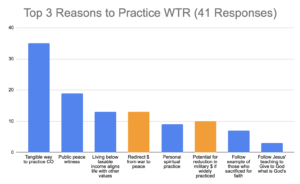
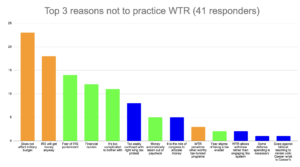
So, in order to answer my question, I put a survey in my church newsletter and emailed it to my left-leaning Mennonite friends in other places. I got 41 responses: 19 from those who have at some point practiced war tax resistance (whether living below taxable income or refusing payment) and 22 from those who have never done war tax resistance in any form. There is nothing scientifically rigorous about this, but here is how the responders to my survey listed their top three reasons to do war tax resistance and their top three reasons NOT to do war tax resistance.
I color coded the responses according to broader themes I saw. Orange indicates effectiveness (or lack thereof), blue indicates principles, and green, personal consequences/fear. I was not surprised that lack of effectiveness was high on the list of reasons against war tax resistance, and that principles were high on the list of reasons for war tax resistance.
It was interesting to me to see that there were a number of reasons that left-leaning Mennonites would, on principle, oppose war tax resistance. We are living in a very different time than the Anabaptists of 1525. We have a bill of rights and a representative democracy in which we have other levers of power. We also see the many positive things that our taxes fund, and we benefit greatly from many of these. And if we really dig deep into our thoughts, maybe we also take some comfort in knowing that we’ve got the world’s biggest military.
These questions challenge me and my idealism. On one hand, I seek to engage these questions as valid challenges and practice my war tax resistance with humility. On the other hand, I must remember that even if my war tax resistance isn’t changing the world, neither is it a meaningless act if it is done from a place of conscience. And maybe enough acts of conscience can eventually create some change.
To learn more:
How your income tax dollars are spent: War Resisters League Federal budget pie chart.
Information on how to resist war taxes: National War Tax Resistance Coordinating Committee
MCUSA’s response to militarized taxes: MC USA Peace Tax Fund


Have a comment on this story? Write to the editors. Include your full name, city and state. Selected comments will be edited for publication in print or online.