


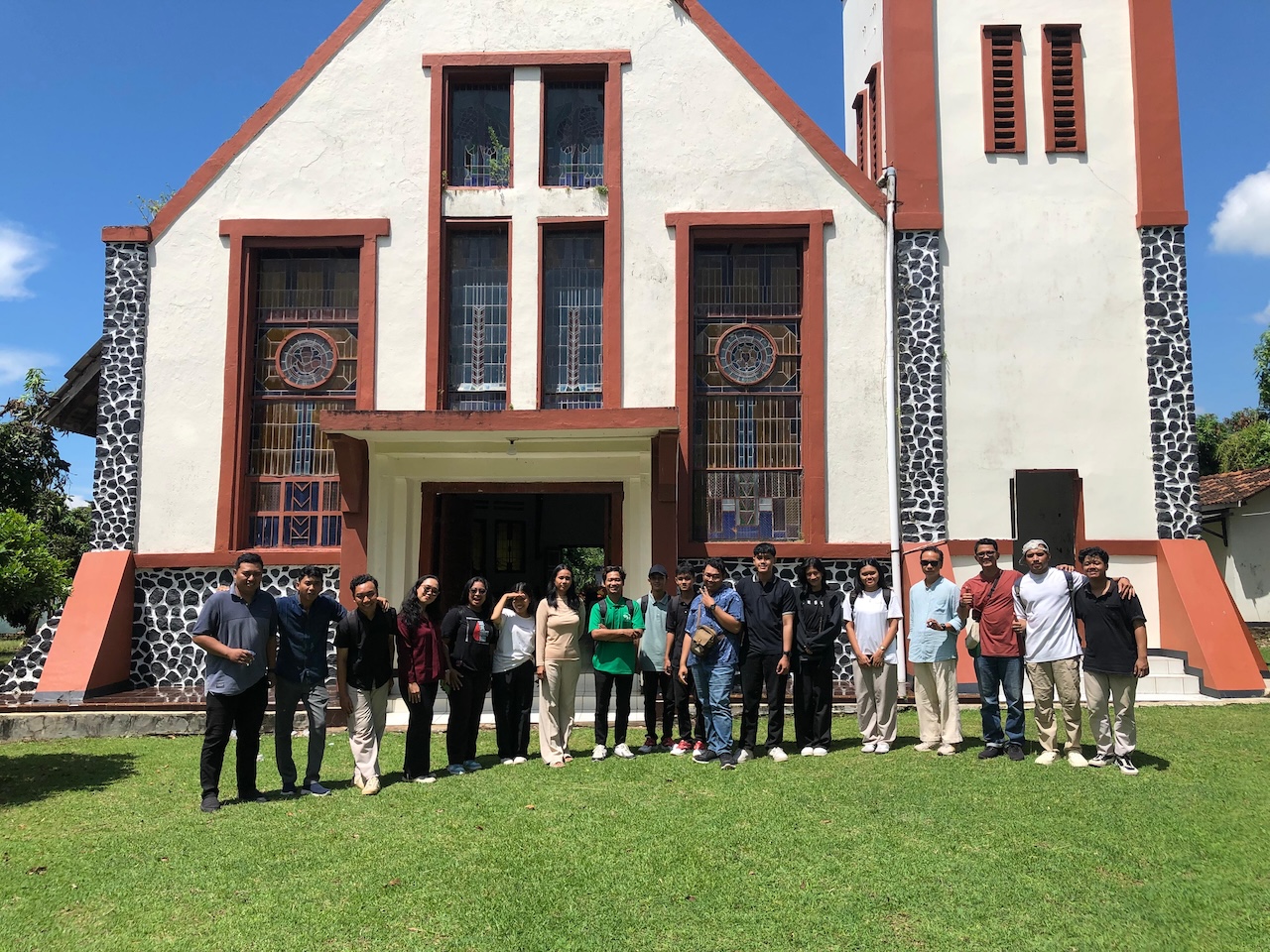
Last week, I stepped out of the classroom with twenty of my Wiyata Wacana seminary students from Pati, Java. We left our books behind and embarked on a pilgrimage — by motorcycle — along the north coast of Java, from Pati to Jepara. We visited historic sanctuaries, listened to local leaders and ended with a shared meal at sunset on Jepara beach.
Why a pilgrimage? Because history learned through the soles of your feet feels different. Breathing the coastal air, standing in the same dust as our ancestors — that moves us beyond academic study into living reality. Local testimonies transform dry data into a breathing narrative. To guide our journey, I asked three questions: What captures our interest? What needs a critical lens? And what can transform us as we step into the future?
From that day, five reflections emerged about the history of our shared faith.
1. History is God’s story
Theologically, the history of a faith community is a sacred record of God’s active presence within time and context. God’s work is not a relic of the past; it is unfolding now and into the future. The stories passed down through our community serve as a “living text‚” a theology that is lived out and transmitted across generations. This is not merely an inheritance to admire, but a call to remain open to the divine creative love constantly manifesting in our lives today.
2. History calls us to recognize the seeds of love
The Mennonite mission in Java is essentially a chronicle of love planted, rooted and bearing fruit. We remembered Pieter Jansz, a Dutch missionary who arrived in 1851 at age thirty. He and his wife committed so fully to Java that they never returned to Europe. We also honored local missionaries who preached through immense hardship.
In that era, the mission manifested through healing and learning for those long denied both. While formal education was then a luxury reserved for the nobility, the mission threw open the doors for common people — and most radically, for women — to claim the transformative power of knowledge. Yet the most poignant expression of this love was the refuge built for those the world had cast out: the leprosy hospitals. To this day, the church in Donorojo remains a vibrant, independent witness alongside the nearby hospital. Though the hospital is now under government management, both stand as enduring monuments to that original compassion. They remind us that a relentless concern for the marginalized must remain the beating heart of our faith today.

3. History demands honesty and vulnerability
History demands humility and a radical honesty about the complexities of the path we have traveled. The church’s journey is rarely smooth; internally, we wrestled with the tension between Pieter Jansz’s Western mission approach, which could be rigid toward local traditions, and Tunggul Wulung, a local leader who sought to integrate Javanese spirituality. Externally, early Mennonites navigated a colonial landscape and social suspicions that stifled independence. In such tangled historical contexts, the church often had to make difficult choices, some of which we might recognize today as mistakes. Yet, acknowledging this vulnerability reminds us that while our decisions may be flawed, God’s work continues through and even beyond the church’s weaknesses. We must remain transparent about our limitations, trusting that grace transcends our human errors.
4. History shows the wonder of hope
A long view of history reveals how hope survives in unexpected ways. The first Mennonite baptism in Java took place on April 16, 1854, in Jepara, where five people were baptized, yet none of them remained in the faith. At the time, the effort appeared to be a failure. Yet, the seed did not perish; it simply waited for its season. Fifty years later, Christian believers from the mission villages moved to the city for work and formed a new fellowship. This small gathering became the precursor to what we now know as GITJ Jepara, the Javanese Mennonite Church.
What was once dismissed as a failed mission resurfaced through the lives of ordinary people in extraordinary ways. We see this same grace in the community that grew from a group of farmers whose lives were transformed by the simple hospitality of a Christian family after they failed to sell their produce. In God’s economy, no act of faithfulness — no matter how small — is ever truly lost; what looks like an end is often just a hidden beginning.
5. Oral history: Ink written on the heart
A challenge in studying our history is the dominance of oral culture. Most written documentation came from Dutch mission boards — an outsider’s perspective. The Javanese perspective is largely preserved through oral tradition.
Formal research often prioritizes written records. But oral stories carry their own profound validity; they hold the essential meaning of the community. If written documents are ink on paper, oral stories are records inscribed upon the soul. They are not just about facts, but about what those events mean for a people’s faith.
The pilgrimage with my students was a multidimensional journey. We learned that studying history is not about collecting data but about sharpening our spiritual sensitivity. We saw how love is sown, how fragility is admitted and how hope is nurtured. May we each continue to inscribe the ink of kindness upon the hearts of those we encounter — just as our predecessors did for us.


Have a comment on this story? Write to the editors. Include your full name, city and state. Selected comments will be edited for publication in print or online.