


There’s no easy way to say this: The United States is celebrating its semiquincentennial amid a surge of Christian nationalism on the religious right and in the halls of power.
In their groundbreaking 2020 book Taking America Back for God, sociologists Andrew Whitehead and Samuel Perry define Christian nationalism (AW, Aug. 18, 2023) as “a cultural framework asserting that all civic life in the United States should be organized according to a particular form of conservative Christianity.”
It isn’t simply about conservative Christians wanting Christianity to influence public morality. It is about these Christians wanting to impose their beliefs and morality on society through any and all levers of political power.
For Anabaptists, Christian nationalism is nothing short of a theological crisis.
Given our convictions about the noncoercive, voluntary nature of faith and our history as an often-persecuted religious minority, Anabaptists across the political spectrum should be able to stand arm-in-arm on the front lines of nonviolent resistance to Christian nationalism. The question is not whether to do so but how to go about it.
When faced with theological crises, Anabaptists have three standard playbooks:

— Go back to the Bible, the New Testament in particular, to recover the politics of Jesus and the early church.
— Examine the tradition’s origins to recover the founders’ vision.
— Hold up stories of the tradition’s martyrs as a mirror that reflects the faithful witness of those who have come before.
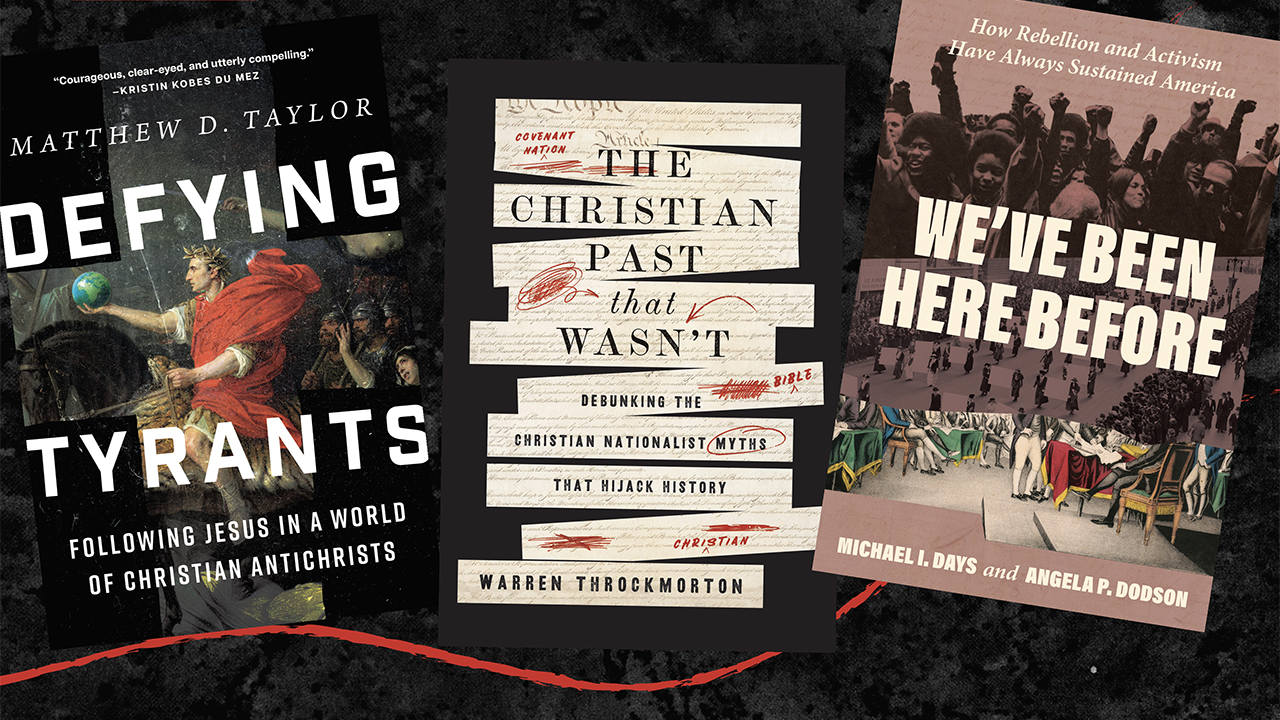
Three new books by Broadleaf aim to resist Christian nationalism. While none of the authors is Anabaptist, their views parallel these common Anabaptist approaches.
In Defying Tyrants: Following Jesus in a World of Christian Antichrists, religious scholar Matthew Taylor returns to the New Testament to demonstrate how Christian nationalism is a distortion of the religion of Jesus and the early church.
“This book is titled Defying Tyrants,” writes Taylor, “because I am calling us back to the assumption of the early church: that Christians of good conscience and a sincere desire to follow the way of Jesus Christ should denounce and loathe all authoritarian abuses of power, whether inside the church or outside it.”
Through a survey of the Gospel of Mark, the Book of Revelation and other New Testament passages, Taylor argues that the “tradition of Jesus — other-centeredness, loving the lowest, unbowed before tyrants — is written plainly in the pages of the New Testament.”
Drawing from John’s epistles, Taylor argues that the term antichristos (antichrist) does not refer to a singular end-times figure, as is often assumed. Instead, “to be an antichristos is to name oneself a Christian and then relate to other humans in a way that is the antithesis of Jesus christos, the incarnate God.”
In short, for Taylor, the most appropriate name for Christian nationalists from the perspective of the New Testament is Christian antichrists.
“These Christian villains of history and the present,” he writes, “along with many of their sycophants and theologians, are antichrists. They abuse power — and justify it in the name of Christ — in such a sweeping and devastating way that it utterly betrays the incarnation and contradicts the life and model of Jesus christos, the crucified God.”
For Taylor, the New Testament’s call to disciples of Jesus in the face of Christian nationalism is clear: “We must protest, petition and proclaim the gospel of powerlessness against power-hungry Christian wolves.”
Psychologist Warren Throckmorton represents the second approach to theological crises — recovering a tradition’s founding vision — in his book The Christian Past That Wasn’t: Debunking the Christian Nationalist Myths That Hijack History. For Throckmorton, the founders in question are not 16th-century Swiss Brethren but, rather, the framers of the U.S. Constitution.
“In writing this book, I realize that I am setting out on a difficult mission,” he writes. “I hope to expose and debunk myths, misinformation and half-truths about the history of the United States.”
Through meticulous research into the founding documents and the original context of their authorship, Throckmorton debunks seven myths propagated by Christian nationalist hucksters like David Barton — from the originating myth that “America is a covenant homeland for European Protestants” to its logical outworking that “Christianity should be promoted in public education.”
Along the way, he ably demonstrates how Christian nationalists quote selectively and misleadingly from U.S. founding documents and the Bible to make their case.
While all of Throckmorton’s arguments seem incontrovertible, I find particularly compelling his response to the sixth myth, that “America’s virtues justify America’s sins.” Instead of exegeting the founding documents to determine whether they promote Christian nationalism or democratic pluralism, Throckmorton takes a step back to ask a more basic question: “With deception, theft, racism, enslavement, lynchings and other atrocities embedded in the heritage and history of the nation, why does it matter how many times God is mentioned in the Declaration of Independence or whether there is some faint echo of a Bible verse in the Constitution?”
This question gets to the heart of a concern I have with these first two approaches to resisting Christian nationalism. They both seem to be predicated on the idea that Christian nationalists can be convinced to renounce their ways if only shown how inconsistent their views are with the New Testament or the nation’s founding vision.
I hope Christian nationalists do find copies of Taylor’s and Throckmorton’s books and repent of their ways, but I assume most readers of these books will be Christians who already reject Christian nationalism. These readers don’t need convincing. They need motivating.
Indeed, in the recent book Courage to Enter the Song (reviewed in AW, September), the organizers at Mennonite Action write that “throughout history, the reality is that big transformative social change is not won by persuading the people who actively oppose that change.” Instead, it comes through motivating passive allies to become active ones. This puts the focus not on convincing those who support Christian nationalism to renounce it but on motivating those who accommodate it to actively resist.
This is where the third approach comes into play. In We’ve Been Here Before: How Rebellion and Activism Have Always Sustained America, Michael Days and Angela Dodson tell stories of martyrs — in both the etymological sense of witnesses and the literal sense of those killed for their beliefs — for the cause of greater justice, equity, freedom and democracy in the United States.
“By looking back, we can find inspiration to move forward from where we find ourselves now,” they write. “We can remind ourselves how individuals who were brave enough and unswerving in their ideals often stepped out on their own to challenge the norms of their times.”
By doing so, “we can learn from how they conducted themselves, how they reached out to others to join them, how they organized for the fight and what they learned from failures. In these challenging times, we need to borrow from their courage and replicate their tactics.”
While Days and Dodson include a chapter on those who fled Europe in search of religious freedom, they begin not with the framers of the Constitution but with Indigenous people who resisted European colonizers. They likewise tell stories of enslaved people who resisted their enslavers through rebellion, self-emancipation and the Underground Railroad and of the abolitionists who agitated for an end to slavery.
Sometimes this resistance involved violence, as with John Brown, who took up arms to free enslaved people in Virginia. Because Brown was willing to die for the cause — ultimately being captured by Robert E. Lee and hanged for treason — Days and Dodson describe how “in several cities, including Boston, New York and Philadelphia, abolitionists observed the day of his death as ‘Martyr Day,’ attending prayer services and closing businesses in observance.” They quote another chronicler of Brown’s life who wrote that “nothing wins followers to a cause like a martyr.” After Brown’s execution, “thousands of people who had been indifferent were now persuaded that slavery should be abolished.”
Similarly, in their discussion of the labor movement, they tell of the 1886 Haymarket Riot where a peaceful strike for an eight-hour workday turned violent when police opened fire on the strikers. “The Haymarket Riot was viewed as a setback for the organized labor movement in America,” they note, “but many in the labor movement viewed the convicted men as martyrs.”
As Days and Dobson describe the freedoms won through these movements and those for women’s rights, civil rights, peace and the environment, they also lament the setbacks that have come at the hands of Christian nationalists in recent years. While we can pray for these people’s conversion through encounters with the truth provided by Taylor and Throckmorton, we cannot wait on their conversions to protect the most vulnerable and marginalized among us. Instead, let us draw inspiration from Days and Dobson’s modern martyrs for justice and peace to creatively and nonviolently resist Christian nationalism before it’s too late.
David C. Cramer is communications assistant program director for the Institute for Social Concerns at the University of Notre Dame. An ordained pastor in Central District Conference of Mennonite Church USA, he is a core adjunct faculty member at Anabaptist Mennonite Biblical Seminary.


Have a comment on this story? Write to the editors. Include your full name, city and state. Selected comments will be edited for publication in print or online.