


It is of utmost importance that Indigenous children who died at the Carlisle Indian Industrial School in Pennsylvania and other Indian schools are repatriated to their tribal nations. I appreciate the report by Camille Dager of Mennonite Church USA on the powerful ceremony that brought Cheyenne children home to Oklahoma last October (“Reburial of Native Children Is an Invitation in Remember and Repent,” AW, January).
While I honor the wisdom and long campaign that made the children’s journey possible, as a historian of Mennonite missions to Cheyenne and Arapaho people, I had to wonder about the article’s claim of Mennonite “deep connections” to Carlisle, that “Mennonite teachers and administrators staffed Carlisle and other boarding schools” and that children from Carlisle were placed on Mennonite farms as part of Carlisle’s Outing Program.
Federal and church-run schools for Indian children have rightly been criticized for stripping Indian children of their native language, culture and identity. Students experienced high rates of illness and mortality.
Given this history, what can we know about the Indian schools Mennonites operated and how involved they were in the U.S. Indigenous boarding school effort, including Carlisle? There were connections to Carlisle, but calling them “deep” may be an overstatement. The evidence is mixed.
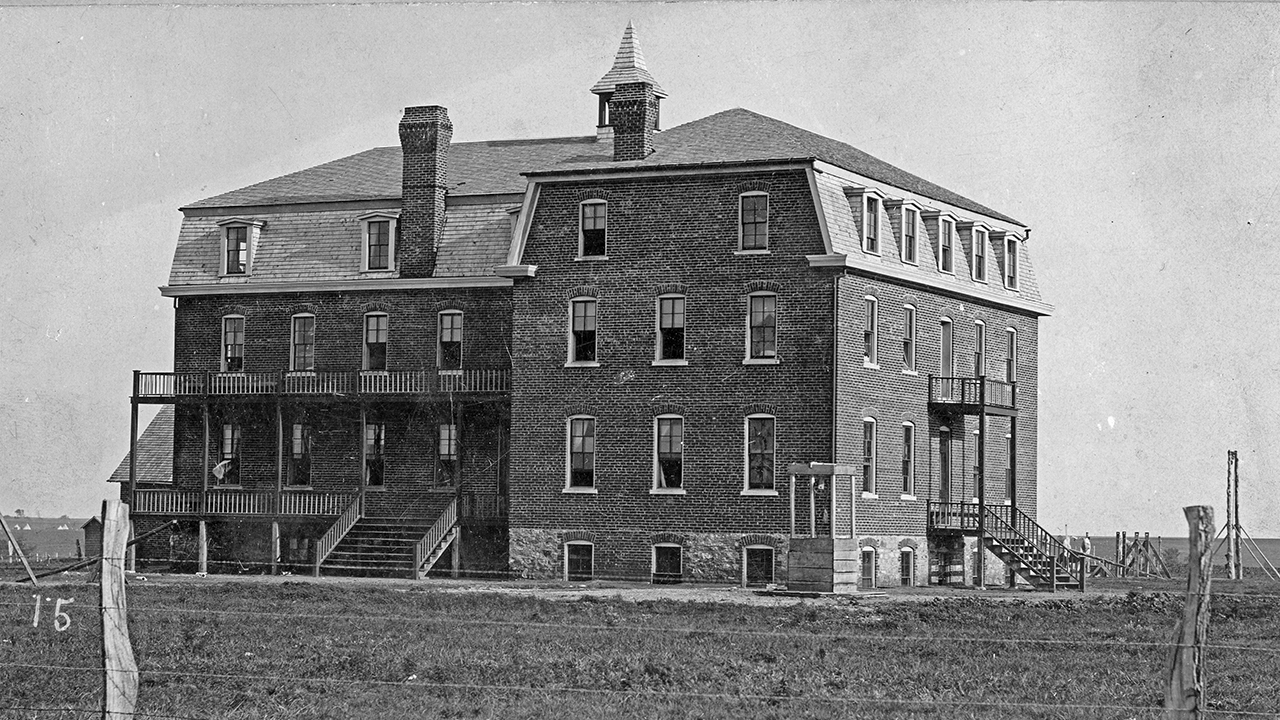
Mennonites were no exception to international missionary and boarding school movements targeting Indigenous people. Mennonites cooperated with the U.S. government to found and operate three boarding schools among Southern Cheyenne and Arapaho peoples: Darlington School in Oklahoma Territory, 1881-1898; Cantonment School in Oklahoma Territory, 1883-1901; and Halstead Indian Industrial School in Kansas, 1885-1896.
In 1880, shortly after Carlisle opened, a Bureau of Indian Affairs Indian Agent, John D. Miles, a Quaker, wrote to the General Conference Mennonite Church requesting a partnership at the Darlington Agency among the Arapaho people. Mennonites eagerly embraced the opportunity, and in 1881, under Samuel S. Haury’s leadership, teachers at the Darlington Boarding School admitted pupils for the first time.

Mennonite missions to the Southern Cheyenne and Arapaho people in Oklahoma and Kansas included administering, teaching and maintaining the schools. Many Mennonite teachers, maintenance workers, farmers, cooks, laundresses, seamstresses, preachers and administrators worked in the schools. These men and women came mainly from the central plains of Kansas, Oklahoma Territory, South Dakota and Nebraska, as well as from Ohio, Illinois, Indiana, Iowa, Pennsylvania and California.
By contrast, my research has uncovered only one Mennonite who taught at Carlisle: J.A. Ressler, who went on to become a Mennonite minister in Scottdale, Pa. If there were more Mennonite teachers or any administrators at Carlisle, I would welcome a correction from MC USA’s Project SACRED (Solidarity, Acknowledgment, Collaboration, Recognition, Education, Dignity), which has worked since 2022 to uncover the connections between Mennonites and boarding schools.
The historical records of direct Mennonite connections to Carlisle are sparse, but there is evidence of Mennonite admiration for Carlisle’s Outing Program. At the Halstead school, Mennonites instituted an Outing Program, like the one at Carlisle.
In Carlisle’s Outing Program records, there are many traditional Mennonite names on the lists of hosting farmers, called “patrons.” However, fewer than 5% have any connection to Mennonite, Church of the Brethren or other Anabaptist groups.
Most of the folks with traditional Mennonite names have turned out to be Lutherans, Quakers, or Presbyterians, who dominate the records. Some patrons who had been raised Mennonite had converted to Lutheranism by the time they participated in the Outing Program. The 5% figure will likely decrease as research continues.
It is reasonable to argue that the Mennonite schools were feeder schools for Carlisle. A number of students were sent from Mennonite schools in Darlington and Cantonment, Okla., to Halstead, Kan., and then on to Carlisle. In 1886, Mennonite missionary Samuel S. Haury led a “party” of 43 Southern Cheyenne students to Carlisle. Usually, U.S. Indian Agents brought student parties to Carlisle.
Mennonite schools closed after federal funding ceased. As Mennonite missionary Anna Hirschler (Mrs. Gustav A.) Linscheid made clear when explaining school closures, Mennonites depended on U.S. government funding: “The only reason these [schools] were discontinued was that the Government put up schools for the Indian youth and withdrew the support the mission schools received from time to time.”
The depth of Mennonite involvement in Carlisle may be overstated, but, regarding the repatriation ceremony, the extent of sickness and death found in the Carlisle records is horrific, and examinations of student records are exercises in shock and grief.
Records show that of the 216 Cheyenne students admitted to Carlisle during its years of operation (1879-1918), 108 — exactly half — either died at the school or were sent home in “ill health” or “sick.” Many of these died within a few weeks to a few years of having attended Carlisle. Tuberculosis is a slow killer, and some of these students took years to succumb to the disease.
This is in keeping with a finding by a missionary from the Wind River Reservation (Arapaho) in Wyoming, who reported that “of the 73 children sent to Carlisle between 1881 and 1894, more than half had died either at the school or shortly after returning home.”
To date, finding lists of students and their mortality rates at Mennonite schools in the archives has proven elusive. Visits to the Mennonite mission cemeteries in the early 2000s revealed several small graves and young mortality ages. Were these children students at the schools, or were they from the nearby reservation? Missionary school records have been inconclusive.
A return visit in 2021 found that many of the tombstones had been removed, including the stone for Marie Gerber Petter, a Swiss missionary who died of tuberculosis in 1910. A local Cheyenne elder and cemetery caretaker posited that vandalism was responsible for the tombstones’ disappearance.
Given the prevalence of Indigenous grave desecration, it’s possible that relatives of the deceased preferred to have the child’s tombstone on protected family land. Whatever the cause, the disappearance of tombstones and the lack of written sources make charting childhood deaths at Mennonite schools extremely difficult.
I doubt folks will find many burial sites on school grounds since I suspect that, following Carlisle’s example, Mennonites may have sent the children home sick. If so, this practice potentially furthered contagion and the spread of already rampant diseases on reservations.
Repatriation from Carlisle is a powerful and long-overdue first step. Students who were sent home sick from Carlisle only to perish should also be recognized and honored.
Kimberly D. Schmidt is professor of history emerita at Eastern Mennonite University. In 2003, Lawrence Hart, Southern Cheyenne Peace Chief and Mennonite minister, asked her to write a women’s history of the Southern Cheyenne. The resulting 2006 article was the first of many publications and conference presentations examining Mennonite missions among the Southern Cheyenne, Northern Cheyenne and Arapaho peoples.



Have a comment on this story? Write to the editors. Include your full name, city and state. Selected comments will be edited for publication in print or online.