


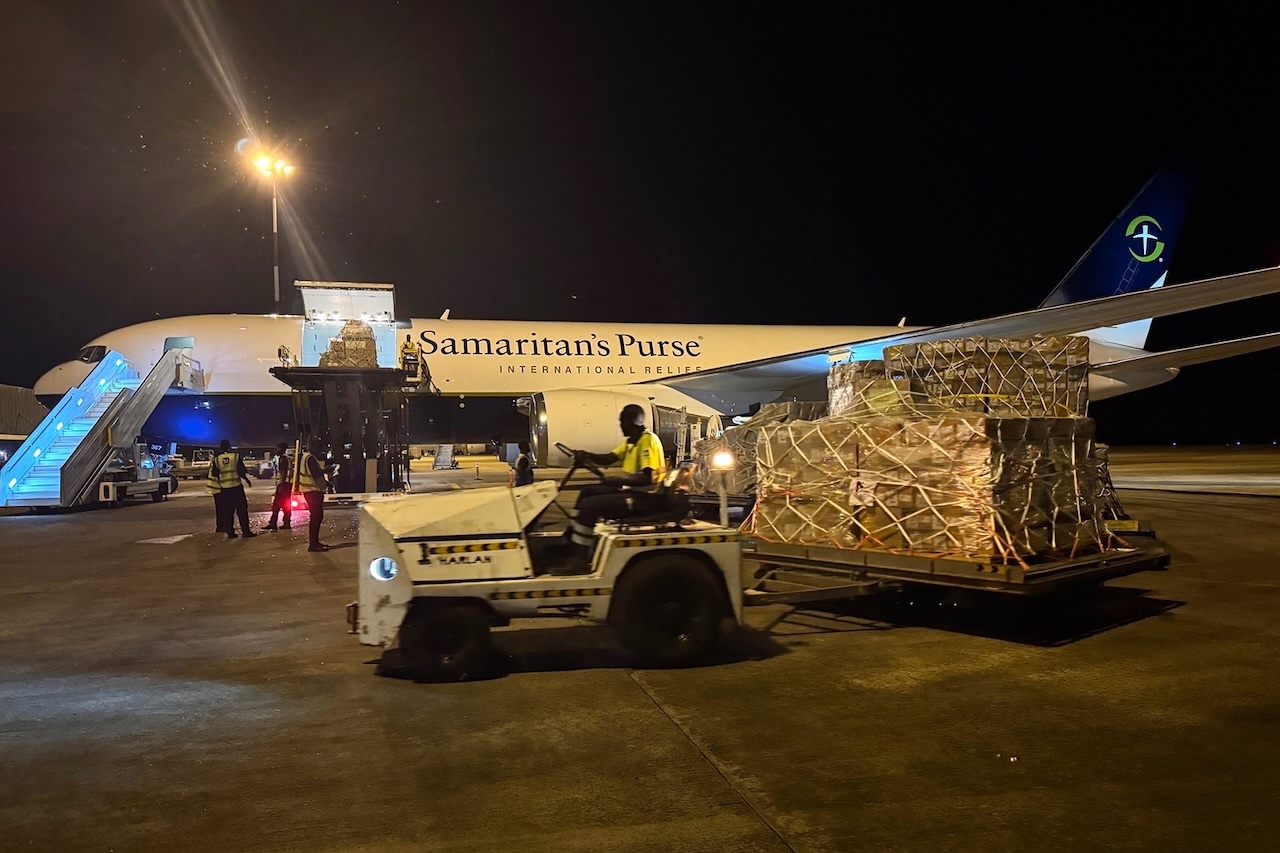
Samaritan’s Purse, the Christian international humanitarian relief organization, airlifted an Ebola treatment unit to the Democratic Republic of the Congo during the last week of May in response to the outbreak of the deadly disease.
The airlift from Greensboro, North Carolina, to Uganda and then to neighboring Congo included a team of 23 medical specialists in the prevention and control of the disease. More medical specialists — as many as 60 people in all — may eventually work in the Ebola unit, said Franklin Graham, president and CEO of Samaritan’s Purse.
“Our staff know the risk, and they know how to protect themselves, and they’re ready for the task, but it’s dangerous,” Graham said May 28 in a phone conversation from Madrid, where he was preaching.
There were 906 suspected cases of Ebola, with 240 suspected or confirmed deaths in the DRC, and seven confirmed cases and one death in Uganda, the DRC and Uganda Ministries of Health reported as of May 29.
Samaritan’s Purse has deep expertise in assembling emergency field hospitals and treating a host of infectious diseases. Over the past several decades, the organization has put them to use on multiple continents to address the COVID-19 pandemic, cholera, diphtheria and Ebola. It has built up a corps of Christian doctors, nurses and other medical professionals who volunteer on short-term trips to mission hospitals across the world.
Peter Stafford, an American medical missionary working in the Congo, became the first U.S. citizen confirmed to have contracted Ebola amid the recent outbreak. Stafford, his wife and four children were airlifted to Berlin for treatment on May 19. Graham said Stafford worked as a medical missionary for Samaritan’s Purse until recently but wanted to remain in the country longer and signed on with Serge, a Christian mission organization that offers medical professionals longer-term assignments.

Another American medical missionary working with Serge was airlifted to Prague. Physician Patrick LaRochelle was asymptomatic but being watched.
The Trump administration used a public health law to bar U.S. citizens, as well as immigrants who had been in Congo, from entering the United States. The administration also announced that it plans to send U.S. citizens exposed to Ebola to Kenya where they can quarantine and be treated.
People get infected with Ebola through direct contact with the blood or body fluids of an infected person. Graham said a common form of transmission is through handling bodies of deceased people.
“In Africa, it’s common practice when a loved one dies, you take them home and the family prepares the body for burial,” Graham said. “But you cannot give the body back to the people because it’s so infected.”
When Congolese authorities have refused to release bodies to the families, people have torched clinics, Graham said.
Samaritan’s Purse plans to work with local churches to educate communities about how Ebola is transmitted.
“We’ve got some great, great friends within the church, and also the missionary doctors and nurses on the ground,” Graham said. “But it’s going to take time.”
Elliott Tenpenny, director of international health at Samaritan’s Purse, based in Boone, North Carolina, will oversee the operation in the DRC.
Tenpenny said the hospital, with about a 50-bed capacity, will be assembled over the next few days in Bunia, the capital of the Ituri Province where the outbreak is concentrated.
“You have to set up the site very intentionally,” he said. “All has to be done via the approval channels in the requirements of the Ministry of Health locally.”
In 2014, Samaritan’s Purse opened an Ebola treatment center in Liberia. At that time, Dr. Kent Brantly, a Samaritan’s Purse staffer, and Nancy Writebol, who was working for the evangelical mission agency SIM, tested positive for Ebola. Both were evacuated to Emory University Hospital in Atlanta, where they were treated with ZMapp, an experimental Ebola drug, and recovered.
In 2018, Samaritan’s Purse again established an Ebola center in the DRC, where it treated more than 600 patients.
Ebola has a death rate of about 50%, but early access to monoclonal antibodies can dramatically improve the odds of survival. Tenpenny said that treatment has not yet been available for this most recent strain of the virus.
The growing epidemic in the Congo has prompted the World Health Organization to call it a public health emergency of international concern.



Have a comment on this story? Write to the editors. Include your full name, city and state. Selected comments will be edited for publication in print or online.