


Much attention has been paid to the Trump administration’s ongoing attacks on the Smithsonian museums and on American history generally. What is less well known is that alongside their claims that the Smithsonian’s Museum of American History promotes “extreme political activism,” Trump and his allies are simultaneously using the nearby “Museum of the Bible” located just yards from the Smithsonian museums on the National Mall to legitimize an alternate Christian nationalist history of America.
Just under a year ago, Trump spoke at the Museum of the Bible, praising its founders, Steve and Jackie Green, for creating a “museum to honor the most widely read book in history.” Trump even went on to say that “the Museum of the Bible had more come here than anywhere else.” Although his syntax is confusing, what Trump appears to be claiming is that the Museum of the Bible attracts more visitors than the neighboring Smithsonian and other DC-based museums, a claim that is false.
This summer, as people flocked to the capital to celebrate America’s 250th anniversary, the Museum of the Bible offered visitors a simultaneous and coordinated “museum experience” designed to pair with and augment Rededicate 250 and The Great American State Fair.
On July 3, the Museum of the Bible debuted its new exhibit, “Sacred Liberty,” which “highlight(s) individuals whose lives were impacted by the Bible throughout American history — both historically influential figures and everyday Americans,” and “showcase(s) the ways these individuals used the Bible, [drawing out] themes related to the Bible in foundational and influential American documents.”
The Museum of the Bible purports that not only was America founded as a Christian nation, but that the idea of a democratic republic was somehow foretold in the Bible itself. A label exploring “Monarchy and the Bible” states that “the Bible’s notion of kingship under a higher law represents an early chapter in the history of limited government and constitutional thought.” This claim would seem to be an attempt to de-emphasize American democracy in favor of the notion of a strong executive leader whose role is to consolidate religio-political power.
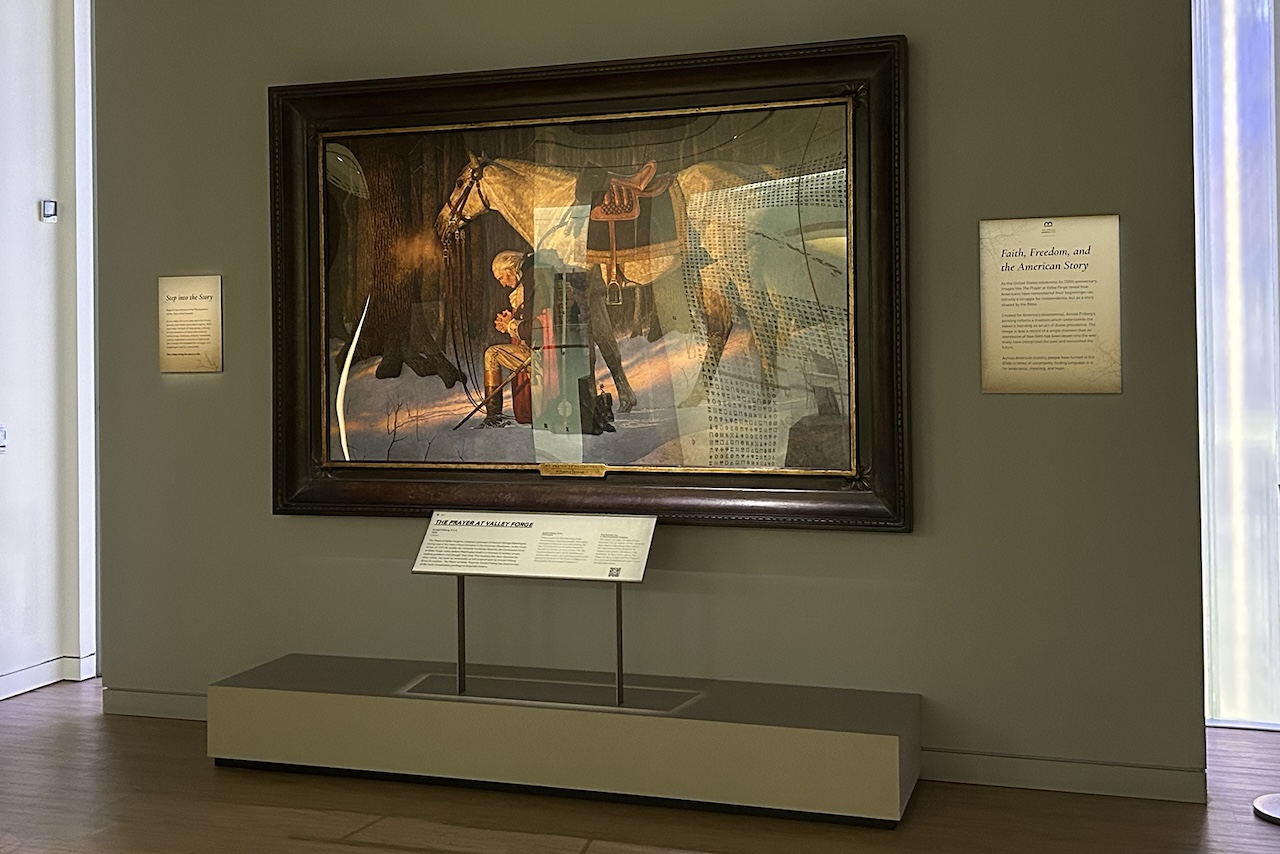
In another exhibit on the Declaration of Independence, a label describes the Bible as the “spiritual framework” of the burgeoning republic. This overarching claim becomes especially glaring with the display of Arnold Friberg’s “The Prayer at Valley Forge” (1975) at the start of the exhibit. Today, historians recognize that the story of George Washington kneeling in the snow was merely legend, yet the Museum of the Bible situates it next to a label that reads, “Friberg’s painting reflects a tradition which understands the nation’s founding as an act of divine providence.”

The label, titled “Faith, Freedom, and the American Story,” frames the Museum of the Bible’s renovation as a critical historical exercise: “As the United States celebrates its 250th anniversary, images like ‘The Prayer at Valley Forge’ reveal how Americans have remembered their beginnings — not only a struggle for independence, but as a story shaped by the Bible.”
What is happening here is more than an issue of competing historical emphases or differences in interpretation. The Museum of the Bible is appropriating the familiar material aspects of museums (signage, interactive displays, artifacts) along with the very term “museum” in order to present a predetermined version of American identity.
Of course, museums have never been neutral spaces. Historically, they have been used by colonial and fascist leaders to define national identity, promote racial superiority and marginalize some groups while centering others. In recent years, many museums, such as the Museum of Us, the Peabody Museum of Archaeology, as well as the Smithsonian’s many museums, have begun reframing and addressing these wrongs and facing them headlong. This process involves repatriating objects that were stolen or obtained under duress and also challenging the segregation, exoticization and racist display of Black and Brown peoples and their bodies in museum galleries. The Museum of the Bible is at the heart of this work, given that it has been involved in the looting and illegal smuggling of objects out of Iraq (which it is now returning).
But beyond repatriating objects back to descendant communities, museums are just beginning to confront the ways in which its curatorial work and collecting also fed into Christian nationalist frameworks. In exhibits that fetishized people of color, museums also exoticized non-Christian religious beliefs, using objects (many of which were collected by White people on evangelization missions). The Museum of the Bible builds on this framework, arguing that an ideal America was envisioned by and built on the foundations of White Protestant Christianity.
While neighboring museums like the Smithsonian present a more complicated picture of how Christianity not only emboldened but enabled colonial violence, segregation, slavery and discrimination, or one that challenges the idea that the Founding Fathers were all unequivocally Christian, the Museum of the Bible offers an easier, unified alternative, one where patriotism is likened to an unwavering belief in America’s White Protestant Christian origins.
When the administration officially praises the Museum of the Bible as the museum aligns its own marketing with the 250th celebrations (giving it the impression that it is officially approved or connected to the government), it creates yet another institution functioning to promote the well-being of, and faith in, a Christian nationalist state.


Have a comment on this story? Write to the editors. Include your full name, city and state. Selected comments will be edited for publication in print or online.