


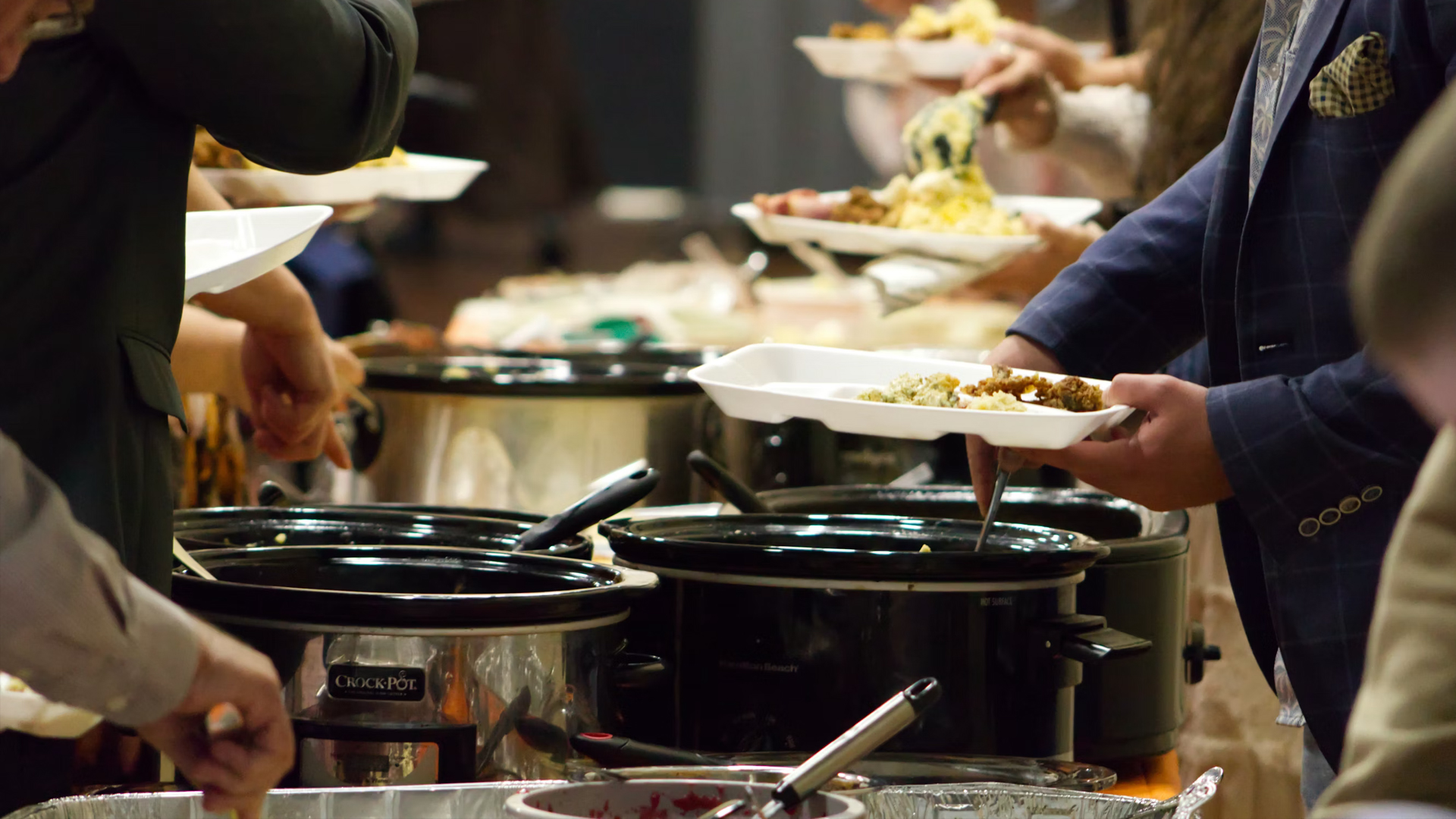
Last Sunday somebody brought a green bean casserole to our weekly fellowship meal and put it next to somebody else’s arroz con pollo, and I stood there for a second looking at the table before anybody touched it and thought: This is it. This is the whole argument.
The potluck is not just the potluck. It’s a slightly chaotic exercise in too many desserts and not enough protein — and that one dish nobody can identify but everybody politely takes a spoonful anyway.
I’m not trying to over-spiritualize the beanies and weenies. But I think we have underestimated what it means to eat together, on purpose, week after week, with people we would not necessarily have chosen.
We live inside an economic order that is good at making us forget other people exist. Not through malice exactly, more through architecture. The house with the three-car garage where you can go days without seeing a neighbor. The algorithm that serves you a feed of people who already think like you. The grocery self-checkout that removes the possibility of even an accidental interaction in the checkout line.
The whole system hums along on the fuel of our isolation and calls it convenience. And we have mostly accepted the trade.
The potluck refuses that trade. It is not convenient. It requires you to cook something, or at least stop and buy something, and show up with it and find a place to set it and then stand around in a room with people across several generations who have different politics and different tastes and different ideas about how much salt is appropriate. You cannot algorithm your way out of the woman who wants to tell you about her knee replacement. You cannot skip the part where the toddler puts his hand directly into your hummus.

This sounds small. It is not small.
There is a reason the early church was so threatening to Rome, and it was not primarily their theology. Rome was fairly tolerant of theologies. What Rome could not abide was a community that ate together across the lines that were supposed to hold society in its proper order.
Slave and free at the same table. Jew and Gentile passing the same bread.
The meal was the message, and the message was that Caesar’s order was not the only order available. Another way of organizing life was not only imaginable but already happening, every time they pulled up a chair.
We are not so different from that moment as we might think.
Something is happening in this country that I do not have clean words for. It is a narrowing. A slow sorting. By documentation, by zip code, by who the algorithm decides you should know. The culture is getting smaller and meaner and more convinced that the people on the other side of whatever line are not quite real.
The congregation that eats together across the lines being drawn outside its doors is practicing something prophetic. It does not require a permit. Just somebody’s arroz con pollo and an empty chair pulled up to the table.
Let me be careful here, because I have seen churches use the language of radical welcome as a substitute for actual welcome, a branding exercise rather than a practice. The potluck only means something if the table is genuinely wide, if the people who are most at risk in this political moment are actually present and fed and known by name. Otherwise, it’s just dinner. There is nothing wrong with just dinner, but let us not confuse it for the kingdom.
But when it is real, when the table actually holds the kind of diversity that the world outside is busy dismantling, something happens that is impossible to manufacture. You find out that the woman you disagreed with at the last congregational meeting makes extraordinary desserts. You find out that the quiet man in the third row has been feeding the unhoused people in the park every Saturday morning. You find out that you are part of something that has been practicing this longer than you have been alive and will keep practicing it after you are gone.
In this moment when powerful forces want us isolated, afraid and separated, the potluck is an act of defiance disguised as dinner.
Sunday I filled my plate and sat down and asked the woman next to me how she was doing, and she told me more than I expected, and I’m glad I asked. The green bean casserole was solid. The kingdom was present.



Have a comment on this story? Write to the editors. Include your full name, city and state. Selected comments will be edited for publication in print or online.