


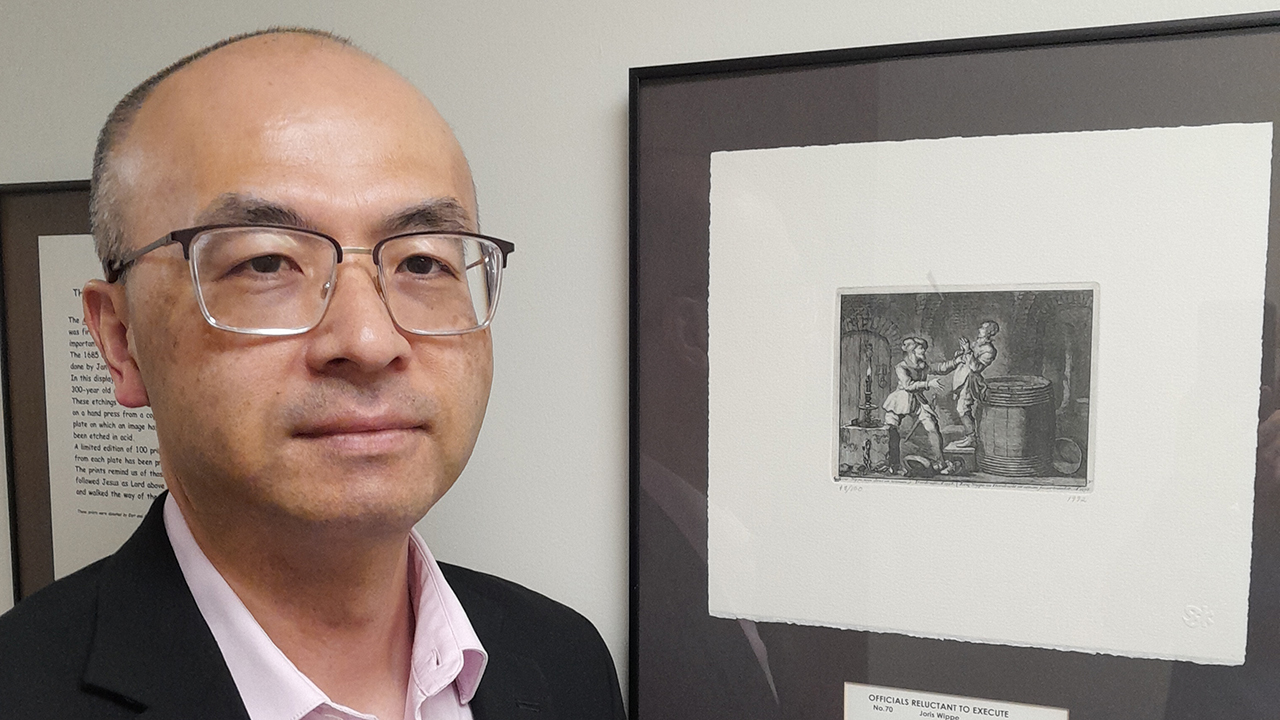
I converted to Christianity and received baptism in the Mennonite church in Japan on May 14, 1989. Arriving at Goshen College three months later, I felt euphoric. I was suddenly surrounded by all things Mennonite — hymnals, cookbooks, “Mennonite names,” even an insurance company. It was like inhaling a distinctive air flowing continuously from the 16th-century Radical Reformation.
Gruesome pictures of the martyrs set my fledgling faith ablaze. I idealized, even idolized, North American Mennonites, direct descendants of those heroic witnesses.
My roommate at Goshen told me about his father doing alternative service as a conscientious objector during the Vietnam War and eventually becoming a college professor. I envied him for having such a role model.
I demonized the persecutors in Martyrs Mirror. I was proud to be “neither Catholic nor Protestant,” superior to infant-baptizing Christians tainted by Emperor Constantine’s handprint.
A good Mennonite and a good Christian were two different things in my mind — and the former was better than the latter.
I finished college in Japan and returned to Indiana in 1994, this time for seminary education. I married a seminary classmate, moved to Minneapolis, became a father and a U.S. citizen. Now we live in southeast Iowa, another Mennonite enclave. My home congregation covers its educational wing wall with framed prints of Martyrs Mirror art.

My professional ministry has taken place in ecumenical, interreligious settings outside Mennonite communities. In clinical chaplaincy and a local pastorate, I have worked with people from all backgrounds. Through those relationships there appeared many saints who carried me through times of personal crises. (One of my favorite saints is St. Martin of Tours — a convert, a 4th-century bishop, a conscientious objector.) I once guarded against the danger of cheap grace; I have learned to speak of the theology of grace.
I heard the late historian C.J. Dyck say Mennonites tend to jump from the early church to the 16th century and then to our time today, skipping medieval and modern times. I owe much to Catholic and evangelical theologians and friends to discover that despite humans’ lack of faithfulness, God’s faithfulness has persisted throughout history.
In my paper, “Salvation for the Weak in Faith? The God of Shusaku Endo and the God of Mennonites” (Mennonite Quarterly Review, April 2024), I juxtaposed the ways Anabaptists have traditionally used the martyr stories with how Endo, a Japanese Catholic author (1923-1996), used them in his literary works, focusing on his 1966 historical novel, Silence.
Near the end of the story, staged in the period of harsh persecution of Christians in early 17th-century Japan, Rodrigues, a Portuguese missionary, endures physical and psychological torture to force him to renounce his faith. As his faith was nearly crushed by God’s long silence in a time of unthinkable suffering, his own and the locals, Christ speaks to him directly.
The face of Christ carved in the fumie plate — (literally “picture to step on”), a tool officials used to stage public acts of recantation — speaks tenderly to Rodrigues: “Step on me! Put your foot on me! I, more than anybody else, know the pain in your foot. Step on me! It was to be trampled on by people like you that I was born into this world. It was to share their pain that I carried my cross.”
Rodrigues finally places his foot on the bruised, tired face of Jesus. This intimate encounter transforms his faith in a personal way.
My faith grew and matured as well. I started seeing in Jan Luyken’s Martyrs Mirror pictures what I had missed earlier. Once my gaze had been fixed upon the brave and innocent, like Dirk Willems. Now I was drawn to the thief-catcher who seized Willems and the neighbor who betrayed Anneken Hendricks.
Their villainous images had long overshadowed the disturbing likeness between their humanity and mine. Now I confess that as others killed, I could have killed, too. As others tortured, I could have done the same.
My old attitude spoke boldly, “O God, be pleased with me, the virtuous.”
I have since befriended this Orthodox prayer: “Lord Jesus Christ, the Son of God, have mercy on me, a sinner.”
Likewise, I began to see the Martyrs Mirror bystanders more clearly, though obscured in the background, and to find my own image in them. They and I are neither entirely brave nor wicked, neither fully obedient nor utterly corrupt.
I am touched by the martyrs’ defenseless devotion — and startled by my own raging impulse to annihilate the evildoers.
In Silence, there is a character named Kichijiro. His faith, though pure, wavers at crucial times. He gets captured, recants and is released, again and again.
At the end, he aids the officials in capturing Rodrigues. In the jail cell next to Rodrigues, Kichijiro cries and seeks assurance of pardon from him.
How many of us are like Kichijiro? Is there salvation for the weak in faith? Is there room for people like him (and me) in the Anabaptist family?
“What ultimately saves us?” turns out to be Endo’s hope-filled question for me. I will cast the same question to my fellow Anabaptists, as I believe what ultimately saves us shall also unite us, despite our vast cultural differences.
What will save us? Is it a communal spirit, or thriftiness, or a willingness to accept defenseless death? We can find examples of these values in other faith traditions.
All are commendable, if they are responses to God’s initiative in our lives. Yet we do not earn our salvation. Endo tells us that even if our efforts fall short, our souls will still receive consolation, not condemnation, because God is merciful and meets with us where we are, amid human weakness.
I hope the global Anabaptist body continues to mature as an inclusive community, where those weak in faith, full of contradictions and plagued with imperfection, will be welcome at the table.
I hope we will not reject forgiveness but acknowledge both our human frailty and our dignity — and rejoice in God’s mercy.
Besides the 500th anniversary of Anabaptism, 2025 is also the 1,700th anniversary of the first ecumenical council, which produced the Nicene Creed. I hope our common baptism and the power of the Holy Spirit will draw us closer and dispel our sad divisions, both within and beyond Anabaptism. Perhaps these will lessen and finally disappear, in keeping with Christ’s prayer “that they may all be one” (John 17:21).
I rejoice over our 500th anniversary as a part of, and a gift to, the body of Christ and the world. I have received God’s grace abundantly through the Anabaptist expression of Christian faith. I am a joyful witness to God’s unending love.
Shuji Moriichi is manager of pastoral care at Mercy Medical Center in Cedar Rapids, Iowa, and lives with his wife and their son in North Liberty, Iowa. He is a member of First Mennonite Church in Iowa City, Iowa.


Have a comment on this story? Write to the editors. Include your full name, city and state. Selected comments will be edited for publication in print or online.