



Lent is an interesting fast. This year its start synced with Ramadan, a much more literal fast. Between Lent and Ramadan, Lent is much less demanding. It doesn’t demand abstinence from food, but abstinence from certain foods.
Catholic observance of Lent requires a fast from land-animal flesh on Ash Wednesday and each Friday. These Friday fasts are for penance, suffering as a performance of gratitude for God’s mercy. Protestants and Anabaptists are more accustomed to selecting something to make a symbolic fast. Mine was no phone in the bathroom. We break the norms and hope to gain something from breaking our ordinary routine.
I have also been doing intermittent fasting. Intermittent fasting is a practice of stretching the time you don’t eat and only eating within certain hours. Many people do 16 hours of fasting, then eight hours for feeding. For me that means I don’t have lunch until 12:00 and I wrap up dinner before 8:00 pm. Eating, not eating and waiting to eat have been on my mind.
Fasting is interesting because it is a negative experience. It’s characterized by what we’re not doing. A fast can only exist in the context of being regularly fed. Without a normal rhythm of feeding, a fast would be a pointless distinction.
And even though intermittent fasting is about what I’m not doing, it does add some significant hunger in the last hour or two before a meal. It’s a strange experience to voluntarily create this hunger and then resolve it in a short time. Knowing that the plan is to have lunch at 12:00 doesn’t stop the hunger at 10:00. It makes the hunger a frequent nuisance. I know the plan; I know I’ll be fed soon and still I must go through the hunger, the discomfort. It’s an embodied experience that stays with you.
Historically the reasons for the fast of Lent are penance, exercising and building self-discipline and to orienting ourselves to the cross. Penance is a tough one for me to consider. As I usually mention every November, gratitude is a weird concept to me. I think it’s weird to do things to prove we are sufficiently grateful to Jesus for his mercy. Why is the simple truth not enough? Surely Jesus knows our hearts.
The self-discipline angle of Lent is one that I admire quite a lot. When you make a new rule that changes your norms and routines, it’s easy to accidentally break and even when you’re focused on keeping your rule, a lot of complications can come up. Our routines exist for reasons. Bathroom phone time gives me an opportunity to check social media without disrupting the flow of work or being seen on my phone. By following my rule, I have to decide if I should openly use my phone at work or if it’s better to fully abstain while on clock.
Lent is a time to re-orient ourselves to the cross. Yes, the sermons of Lent teach us about Jesus’ journey to the cross; there are lots of fun things to learn about the cross, but only action, not learning, can orient us to the cross. Taken from that perspective, penance makes more sense. It is not simply to perform suffering sufficiently, but to create a little bit of suffering and choose to let it orient us to Jesus’ suffering and to Jesus’ mercy.
The literal Friday fasts or symbolic Lent fasts are negative actions; they are about what we aren’t doing. They’re specifically about not doing something we could do, or something we would do. An old pattern is broken. Pretty quickly new patterns become enticing. Do I want to plan my next client calls while I’m alone? Rehearse a joke? Take a deep breath and enjoy the quiet for a moment? All of a sudden the time I was spending on nothing useful feels like it has boundless potential. There is so much I could do with that time. And given a second thought, I shouldn’t do any of them. I should simply be off my phone.
It is so hard to accept that the solution isn’t in finding the right thing to do. It’s in abstaining from something and not replacing it at all. I think much of the time mercy is a negative action. Jesus’ mercy says, “I don’t condemn you.” God is not doing something God could do.
So in thanks to God for not doing something God could do, we abstain from something we could do. We invite a bit of hunger; we shake up our habits. We use just a bit of self-deprivation to re-orient ourselves. We find alignment with the cross. When we create and maintain symbolic or literal hunger, surely it goes deeper than our appreciation for Easter. We become keenly aware of hunger and longing. How does a soul stand when it was hungry just days ago? How does a soul see the one whose hunger isn’t self-imposed when it remembers how hunger warps time? How does one define the line between enough and excess when it remembers how little it takes to sate?
The interesting and symbolic fast of Lent calls us to deny ourselves a bit. As we shake up our routines we find space for new choices. We can fill the gaps with new habits: more space for silence, more space for mercy. Each moment of the fast asks us, “Do you really mean it?,” and we get to practice and prove to ourselves “yes.” Breaking habits and patterns is a necessary step for Lent because breaking norms and routines is disorienting. Reorienting to the cross takes disorientation first.
Activity
No-Mow May: Another kind of fast
So often, powerful solutions are in not doing something. We are really bad at recognizing when the solution to a problem isn’t to add or change, but to subtract. This is the lesson of fasts.
Not acting creates space for something new to happen. Not acting can be a powerful act of mercy.
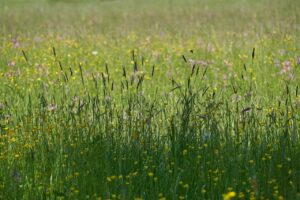
Not acting, specifically not mowing during May, is also a key solution in helping conserve key insects. Until the end of May, vulnerable insects are in grass and leaf litter, trying to wake up and begin their lives as hard working pollinators. This is a vulnerable time for them. Not mowing is an opportunity to decide a new pattern for how to relate to your yard. It’s an opportunity for mercy.
Please don’t mow until the end of May. If there are legal complications, please try to mow as tall and infrequently as you can get away with.



Have a comment on this story? Write to the editors. Include your full name, city and state. Selected comments will be edited for publication in print or online.