


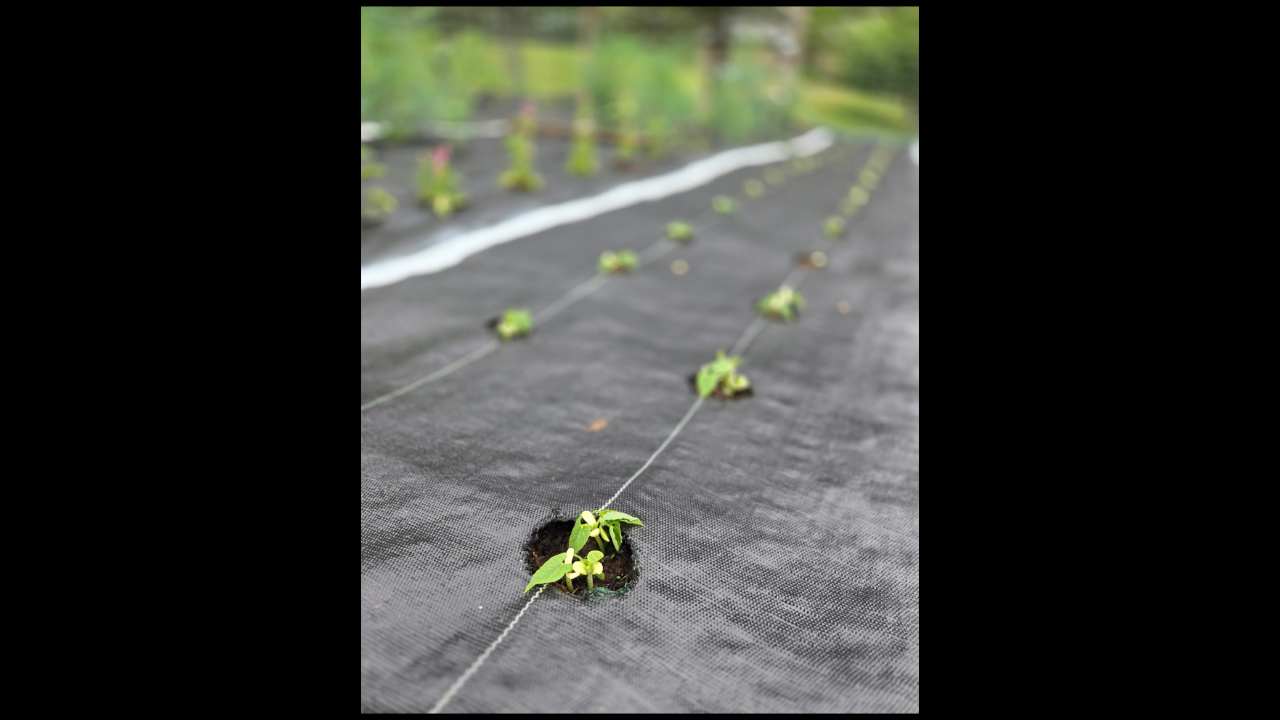
After returning to Florida from my trip north, I’m still thinking about the 17 people I led in planting the Sabbath garden at the Hermitage Community retreat center in Three Rivers, Michigan. I was elated to receive photos of bush beans pushing out of the holes they had been caringly planted in.
But I have a confession: In addition to delighting in the new life, I feel a twinge of judgment. Surrounding the plant was a long stretch of the landscape fabric, a central strategy of our model. Even after years of practicing this method, I still think, “Ugh, plastic.”
In this model, pioneered by many, especially Ben Hartman of Lean Farming fame, about three quarters of the ground is covered by landscape fabric. It is a simplified system that allows groups with little experience to have success. It simplifies rotation. By moving crop placement each year, we disrupt pest food sources and interrupt cycles of destruction. There are good reasons to use landscape fabric with holes burned in it.
All the same, every time I step on the fabric, I cringe.
Because Hartman’s model is intended for church gardens, it raises a question: does using plastic conform to the “patterns of the world”? Reading Romans 12, “Don’t be conformed to the patterns of the world, but be transformed,” feels like a direct challenge.
But we do well to engage Paul more deeply. He emphasizes grace and community. The next section in the passage discusses the many gifts in the body of Christ and how we ought to accept gifts without judgment as a process of maturing.
This is an important grace for me. As I learned from experience and Hartman’s teachings, there are a huge range of possibilities, but we must accept their limits. I could eschew all plastic to be ‘pure,’ but without it, I would not have been able to support Hermitage’s busy staff in having a successful garden. Now, in the third year, the staff serves garden-grown food to retreatants and fills spaces with the garden’s flowers.
As for the plastic itself, there is nuance: It is reused year after year. Like Ben Hartman, who reports using pieces for over 12 years, we are finding this fabric to be incredibly durable.
I recommend this model for anyone growing on collectively-held land. Even more, I recommend Paul’s wisdom: Recognize different gifts and practices, and listen deeply to people’s reasons. I am glad I got over (enough) my aversion to plastic and accepted this pragmatic strategy that is life-giving on a growing number of farms, retreat spaces and church grounds.
Journal prompt
Think of a compromise a community you know has made that has been life-giving. Do you have complex feelings to work through about it? And concretely, what do you think of using (plastic) landscape fabric as a way to suppress weeds and bring order to a garden?



Have a comment on this story? Write to the editors. Include your full name, city and state. Selected comments will be edited for publication in print or online.