


The Sermon on the Mount is a collection of Jesus’ teachings that amount to theological comfort food for many Anabaptists. Yet how do the teachings hit differently when, like Jesus, you’re sharing them with the marginalized?
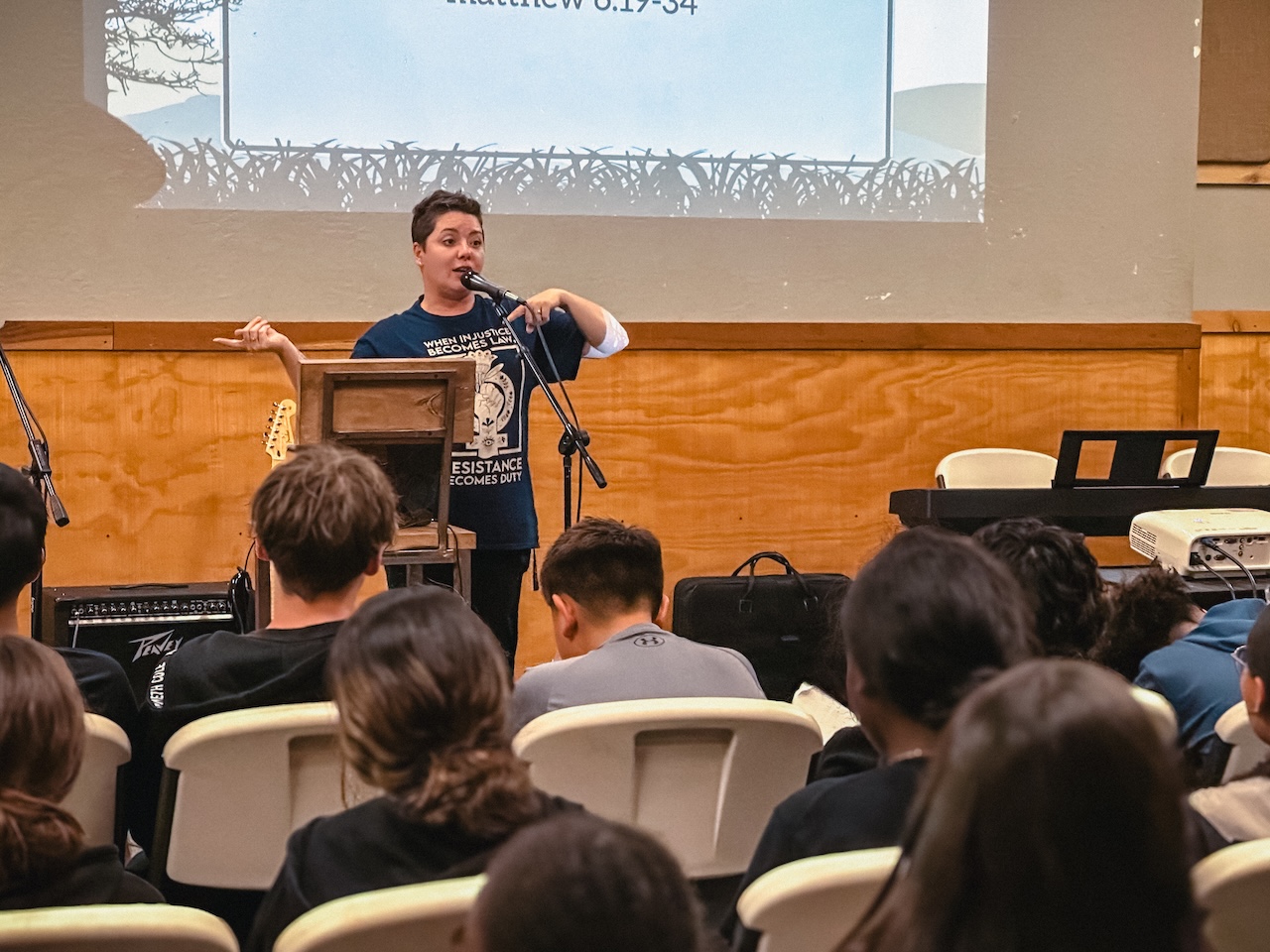
This is my (Alisha’s) first summer as the Pastor of Rising Generations at Neighborhood Ministries. The kids I serve are, by definition, those who live on the margins – housing-insecure, undocumented, under-resourced – and the summer is an especially busy season:
- In June, we held a two-week day camp in downtown Phoenix, serving 350 K-7th-grade students and led by 88 teen staff – a discipleship ministry all its own.
- In July, I preached twice a day at an overnight kids camp for 55 6-8th graders in Payson, AZ – once again staffed by 43 teens.
As I prepared for the middle schoolers, I began asking myself a deeper question: What does it mean to share the gospel of an inverted Kingdom with a captive audience of urban preteens, many of whom have been discarded and further marginalized by the “kingdom” they live in?
With the Sermon on the Mount as the guiding text for the week, these are the five lessons that connected.
1. God’s blessing begins at the margins
The setting of the Sermon on the Mount wasn’t a hall of power or a fortress tower, but a hillside near the Sea of Galilee, among the marginalized, the laborers, the overlooked. Jesus intentionally chose this audience to deliver one of his most essential messages: “Blessed are the poor in spirit, for theirs is the kingdom of heaven.”
For our campers, this message wasn’t theoretical. It was personal. To hear that God’s kingdom isn’t reserved for the rich and powerful, but belongs to the poor, the oppressed and the weary was a profound and comforting revelation. For them (and perhaps for us too) to be seen and blessed by Jesus is no small thing.

Reader reflection: Where in your life (or in your community) do you need to be reminded that God’s blessing is for the overlooked?
2. Jesus’ revolution runs on peace, not power
In a world where power and might still dominate headlines and policy, to hear that the peacemakers are blessed is like a healing balm. Many of these teens come from families torn apart by violence, gangs and addiction. The fear of immigration raids keeps them up at night.
So when Jesus says in Matthew 5:11, “Blessed are you when people revile you and persecute you and utter all kinds of evil against you falsely on my account,” he extends a dignity that cannot be understated. These youth are made in the image of God and are worthy of love, no strings attached.
As author and theologian Greg Boyd once said, “The only kingdom worth entrusting our hope is the kingdom of Christ.” This upside-down, cross-shaped kingdom doesn’t coerce; it invites. It doesn’t conquer; it heals.
Reader reflection: What false hopes in worldly power are you being invited to release in order to more fully entrust your hope to Christ’s kingdom?
3. Every person bears sacred worth
In reinterpreting the Law, Jesus reveals a deeper, heart-centered ethic that reflects God’s values. He’s speaking to the intrinsic worth of human beings. He emphasizes that dignity, respect and faithfulness are not just about external actions, but about internal intentions.
People are not disposable. Dignity is tied to how we think about, speak to and treat others. To honor someone is to see them as fully human — not as a means to an end (personally, politically, or otherwise), but as a bearer of God’s image.
Jesus calls us to see every person (enemy, spouse, stranger) not as an obstacle or object, but as someone made in the image of God. For the young people in our ministry, and for all of us, this is a radical invitation for our thoughts, words and actions to reflect that deep, sacred worth.
Reader reflection: Whom are you tempted to see as less than fully human, and what might it mean to honor their sacred worth?
4. Loving enemies reveals our spiritual lineage
Conflict is unavoidable with friends and family as well as those who are hardest for us to love. Jesus’ message here continues to be radically countercultural.
Don’t manipulate or deceive those who mistreat you. Instead, remain a person of integrity. Don’t answer harm with harm. Instead, disarm hatred with mercy. Choose peace over power plays, because loving enemies shows you belong to God’s family.
Jesus calls his followers to radical love: honest, generous and non-retaliatory. It’s not about who’s “deserving.” It’s about becoming children of a God whose grace is scandalously inclusive.
Enemy love is not optional; it’s the clearest sign that we are children of a God whose grace is for all.
Reader reflection: When have you chosen mercy over retaliation … and how did that shape your sense of belonging to God’s family?
5. The Sermon reimagines what’s possible
The Sermon on the Mount invites those who feel overlooked or powerless to reimagine what is possible, not just personally, but communally. Jesus flips the script on who is blessed. He redefines strength not as domination revenge or accumulation, but as mercy, peacemaking and generosity.
In a world that often feels unjust, the Sermon calls us to live differently: to believe righteousness isn’t a fantasy, but a calling. It’s an invitation for not just the kids at my camp, but all of us to live out God’s Kingdom with courage, truth and compassion, right where we are.
As I prepare to serve with Communitas International in Belfast, Northern Ireland, I’m certain to carry this experience and these truths with me to another community shaped by trauma, division, and longing for peace.
May the words of Jesus continue to shape our hearts and imaginations — so that wherever we go, we embody a kingdom not of this world, but deeply for it. I invite you to follow along.
Reader reflection: Where do you need a fresh imagination for what the kingdom of God might look like, right where you are?



Have a comment on this story? Write to the editors. Include your full name, city and state. Selected comments will be edited for publication in print or online.